Measuring Coefficients of Friction

Click For Summary

Homework Help Overview

The discussion revolves around measuring the coefficients of friction between a wooden board and various objects. The original poster describes a lab task involving static and kinetic friction, noting specific angles at which an object begins to move and maintains constant velocity. There is confusion regarding the components of forces involved and how to apply relevant equations.

Discussion Character

  • Exploratory, Conceptual clarification, Mathematical reasoning, Assumption checking

Approaches and Questions Raised

  • Participants discuss the breakdown of forces into components using trigonometric functions, questioning how to apply these to find the coefficients of friction. There is mention of using Newton's laws and the relationship between normal force, gravitational force, and frictional force. Some participants express uncertainty about the definitions and calculations related to static and kinetic friction.

Discussion Status

The discussion is ongoing, with participants providing guidance on labeling forces and considering vector components. There is a lack of consensus on the specific calculations needed, but several participants are exploring the relationships between forces and the coefficients of friction.

Contextual Notes

Participants note a lack of clarity regarding the setup of the problem and the definitions of forces involved. There is also mention of imposed homework constraints and the need for a deeper understanding of vector components in this context.

Dirkpitt
Messages
2
Reaction score
0
first off I'd like say thanks to everyone on here, I've lurked and solved many questions thanks to you guys. First post woo.

Basically we were tasked to design and carryout a lab to measure the coefficients of friction between a wooden board and some random objects (teachers gone for a few days so busy work basically). Easy stuff really, but I'm getting all confused with the components and way to solve for the coefficients/distinguish difference between solving for kinetic and static (if there is one).

Homework Statement


Have a bunch of angles but only need some help on getting started.

Object 1 - Static 18 degrees to start moving, kinetic 13.6 degrees to move at a constant velocity.


Homework Equations


This is where I'm lost basically.

The Attempt at a Solution


2zscs1s.jpg


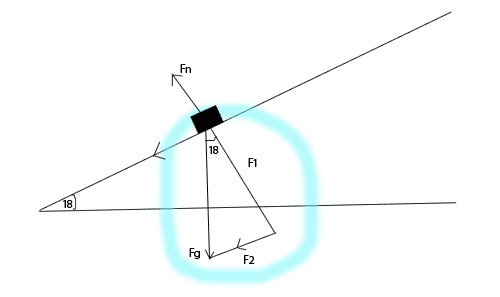
This is the diagram I have. Excuse my 5 minute pentool job XD. With similar triangles the angle is 18 degrees, and I know you have to use cos and sin to make up for the "F1, F2" variables. Cos for F1, and Sin for F2, all I'm missing is how to use them. Thus I haven't gotten too far yet :(

From my current understanding, Fn = Fg - Ff. So Normal force has to equal the force of gravity minus the force of friction for the object to move, I'm just not sure on how to add in the F1 and F2. I'm thinking F=mg would work, and setting them equal to each other?

Something like;

F1=M(Gcos)
F2=M(Gsin)

Then M(Gcos)=M(Gsin), you could take out the "M", since M=M.

Gcos=Gsin
G=Sin/Cos
G=Tan

Honestly I don't really know where I was going with that, other then taking out the M :/
 
Physics news on Phys.org
Dirkpitt said:
first off I'd like say thanks to everyone on here, I've lurked and solved many questions thanks to you guys. First post woo.

Basically we were tasked to design and carryout a lab to measure the coefficients of friction between a wooden board and some random objects (teachers gone for a few days so busy work basically). Easy stuff really, but I'm getting all confused with the components and way to solve for the coefficients/distinguish difference between solving for kinetic and static (if there is one).

Homework Statement


Have a bunch of angles but only need some help on getting started.

Object 1 - Static 18 degrees to start moving, kinetic 13.6 degrees to move at a constant velocity.


Homework Equations


This is where I'm lost basically.

The Attempt at a Solution


2zscs1s.jpg


This is the diagram I have. Excuse my 5 minute pentool job XD. With similar triangles the angle is 18 degrees, and I know you have to use cos and sin to make up for the "F1, F2" variables. Cos for F1, and Sin for F2, all I'm missing is how to use them. Thus I haven't gotten too far yet :(
yes, F1 = mg cos theta, and F2 = mg sin theta. Those are the componets of mg. So now cross out mg in your free body diagram, because you already broke it up into its vector components.
From my current understanding, Fn = Fg - Ff. So Normal force has to equal the force of gravity minus the force of friction for the object to move,
Don't solve it by adding vectors, rather, solve it by adding vector components. Choose the incline as the x axis, and the normal force then acts along the y axis. Please label the friction force in your diagram, and show its direction. Now use Newton's Law (which one?) in the x and y direction, separately.
 
ip48cx.jpg


Adding in Ff, which would be going up the incline, opposite to the direction of Fd. So Fnet=Fd-Ff, which is where I was earlier. Then from that, I've broken Fd into it's components and now I'm stumped.

I'm still getting lost in the equation part. I just don't know what the coefficient of friction is made up of. I feel like this is just a lack of my understanding of solving vector components. I've done that before, and vector addition, but in those cases there was always clear sets of x and y to be found. In this there is only F1 and F2, a single x and y.

Also to solve with Newton's laws, you would use the second one? F=ma or F=mg?

Thanks for the help.
 
Dirkpitt said:
ip48cx.jpg


Adding in Ff, which would be going up the incline,
yes, parallel to the incline
opposite to the direction of Fd. So Fnet=Fd-Ff, which is where I was earlier. Then from that, I've broken Fd into it's components and now I'm stumped.
What is Fd? The force acting opposite to Ff is F2, where F2 is mgsin theta, acting on the object . So in the x direction (take the x direction as parallel to the incline), it's F_net = F2 - Ff, but what is F_net if the object is not moving, or moving at constant velocity?
I'm still getting lost in the equation part. I just don't know what the coefficient of friction is made up of. I feel like this is just a lack of my understanding of solving vector components. I've done that before, and vector addition, but in those cases there was always clear sets of x and y to be found. In this there is only F1 and F2, a single x and y.
You know the force of friction is (mu_s)(N) when the object is just about to move, and (mu_k)(N) when it is moving relative to the incline, right? What is the value of N?
Also to solve with Newton's laws, you would use the second one? F=ma or F=mg?

Thanks for the help.
If the object is not moving, or moving with constant velocity, F_net = ?
 

Similar threads

  • · Replies 6 ·
Replies
6
Views
2K
  • · Replies 22 ·
Replies
22
Views
1K
  • · Replies 1 ·
Replies
1
Views
1K
Replies
5
Views
2K
Replies
22
Views
2K
Replies
6
Views
2K
  • · Replies 97 ·
4
Replies
97
Views
6K
  • · Replies 5 ·
Replies
5
Views
2K
  • · Replies 11 ·
Replies
11
Views
3K
Replies
2
Views
841