Modeling an electric circuit by tracking individual charges

Click For Summary

Discussion Overview

The discussion revolves around the feasibility of modeling an electric circuit by tracking the forces acting on individual free electrons. Participants explore whether it is possible to derive all currents and voltages in a circuit through such detailed tracking, the essential laws of physics that would be necessary for this simulation, and the limitations of existing simulation methods like SPICE.

Discussion Character

  • Exploratory
  • Technical explanation
  • Debate/contested

Main Points Raised

  • Some participants question whether all essential facts and laws needed for simulating individual electron behavior are known to physics.
  • Others suggest that Many-body physics is relevant to the discussion, indicating that individual particle behavior can be modeled in certain contexts, such as beam physics.
  • One participant argues that while simulating electron flow is theoretically possible, it would be impractical due to the complexity of forces acting on electrons, including interactions with the lattice and other electrons.
  • Another participant mentions that Kirchhoff's laws, derived from Maxwell's equations, are typically used to find current and voltage, but applying these to individual electrons introduces complications due to nondeterministic factors like thermal forces.
  • Quantum Electrodynamics (QED) is referenced as a framework that considers individual electron interactions, highlighting the significance of these interactions in a crystal lattice.
  • Concerns are raised about the realism of existing animations that depict electron flow, with some participants asserting that they do not accurately represent the actual motion of electrons or the forces acting on them.

Areas of Agreement / Disagreement

Participants express differing views on the feasibility and practicality of simulating individual electron behavior in electric circuits. There is no consensus on whether the necessary laws are fully understood or if such a simulation could be realistically achieved.

Contextual Notes

Limitations include the complexity of interactions at the electron level, the challenges posed by thermal forces, and the assumptions inherent in lumped element models used in traditional circuit analysis.

nik2011
Messages
11
Reaction score
0
Hello,

Given a simple electric circuit like the one below (taken from Wikipedia)
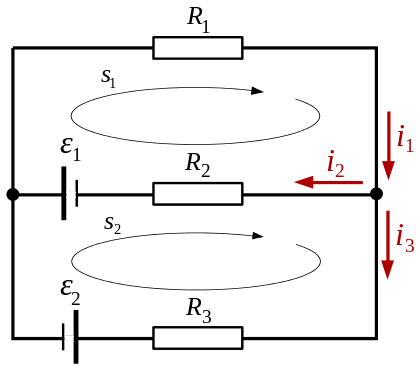
djpSM.png


If we were to start from tracking all the forces acting on each individual free electron in the circuit, would it be possible to eventually find all the currents and voltages acting in the circuit?

Probably a computer program would be designed to perform the modelling.
Anyway, tracking each individual free electron is obviously highly impractical and likely the existing computers are not powerful enough.
But the real question is if all the essential facts and laws necessary to make such a simulation possible in principle are known to physics? And if so, what are these laws?

In case tracking individual free electrons is absolutely infeasible even in principle: What is the deepest level of details describing the phenomena/processes happening in an electrical circuit that is known to the contemporary physics?

A note that hopefully helps clarify the question:
Please contrast the simulation described in this question with an approach used in software based on SPICE: applications based on SPICE derive a system of linear equations from the modeled circuit and solve it. This SPICE-based or similar kind of simulators is not what the question is about.

Thank you!
 
Physics news on Phys.org
You should ask yourself first:
  1. How well do I understand mechanics
  2. How well do I understand thermodynamics
  3. How well do I understand electrodynamics
  4. How well do I understand quantum mechanics
 
nik2011 said:
Hello,

Given a simple electric circuit like the one below (taken from Wikipedia)
djpSM.png


If we were to start from tracking all the forces acting on each individual free electron in the circuit, would it be possible to eventually find all the currents and voltages acting in the circuit?

Probably a computer program would be designed to perform the modelling.
Anyway, tracking each individual free electron is obviously highly impractical and likely the existing computers are not powerful enough.
But the real question is if all the essential facts and laws necessary to make such a simulation possible in principle are known to physics? And if so, what are these laws?

In case tracking individual free electrons is absolutely infeasible even in principle: What is the deepest level of details describing the phenomena/processes happening in an electrical circuit that is known to the contemporary physics?

A note that hopefully helps clarify the question:
Please contrast the simulation described in this question with an approach used in software based on SPICE: applications based on SPICE derive a system of linear equations from the modeled circuit and solve it. This SPICE-based or similar kind of simulators is not what the question is about.

Thank you!

I am not quite sure what you are trying to ask, but if I interpret it correctly, the more GENERAL question that you are asking is if there is such a thing as Many-body physics.

Look it up. There is!

BTW, just for an additional information, in beam physics, we do model and track "individual" particle behavior. This is how we know to design particle accelerator components. Without such knowledge, we will end up building massive, expensive items by trial and error.

Zz.
 
  • Like
Likes   Reactions: cnh1995
nik2011 said:
But the real question is if all the essential facts and laws necessary to make such a simulation possible in principle are known to physics? And if so, what are these laws?

Sure they are, and I don't think an animation would really be that difficult. Think of one side of the battery as attracting electrons with a certain force, think of the resistors as a counter force, either slowing their flow, or if strong enough, completely blocking the flow. In more detail, flow along the wire starts with electrons being attracted into the battery, causing a shortage of electrons in the wire close to the battery. This attracts electrons from further down the wire in the direction of the battery and there is probably a certain amount of resistance in the wire itself. It would really neat is to see a much more complex circuit animation at the electron level with diodes and transistors.

I see a link http://www.falstad.com/circuit/ on the page you reference that looks like electrons flowing, but clearly is not using force on individual electrons in the calculations. The density of the electrons is the same everywhere, they just move at different speeds. An animation you describe would see differences in electron density. Hope you find an animation like this and please post if you do. Would love to see it.
 
An animation won't be difficult if it is not realistic at all.
The one in the link is not even close to the actual motion of electrons or the "requirements" presented in the OP . It does not track all the electrons in the wire and it does not show their actual motion in the crystal. All the forces acting on an electrons should include not just the force from the external electric field but also the forces between electrons an the forces from the lattice.
 
nik2011 said:
But the real question is if all the essential facts and laws necessary to make such a simulation possible in principle are known to physics? And if so, what are these laws?

when you try to find out the current and the voltage you probably use Kirchhoff's laws, those laws derives from maxwell's equations under the limitation that we use the lumped element model(and few more approximations to make it simple). so, you can try to apply the maxswell's equations on your circuit, you will get very complicated equations, but it will work. and now you talk in terms of electrons density.

You want to do that for the single electron? you can't(I think) because now you have to add few more considerations to your equations that becomes nondeterministic, for example, you have to consider thermal forces in the wires, and such statistics forces(when you talk about a lot of electrons all the random forces would be offset)
 
What you are asking about has a name "Quantum Electrodynamics", called QED for short. When you consider electrons one at a time, their interactions with each atom and with the crystal lattice become significant.

See Richard Feyman's famous book, https://www.amazon.com/dp/0691164096/?tag=pfamazon01-20. It won't help you make your simulation, but it is a highly entertaining and educational book. After reading that, you'll understand much better the implications of your question.
 
Last edited by a moderator:

Similar threads

  • · Replies 22 ·
Replies
22
Views
7K
  • · Replies 36 ·
2
Replies
36
Views
6K
  • · Replies 38 ·
2
Replies
38
Views
6K
  • · Replies 3 ·
Replies
3
Views
2K
  • · Replies 21 ·
Replies
21
Views
3K
  • · Replies 2 ·
Replies
2
Views
2K
  • · Replies 1 ·
Replies
1
Views
2K
  • · Replies 11 ·
Replies
11
Views
2K
  • · Replies 5 ·
Replies
5
Views
2K
Replies
11
Views
3K