Discussion Overview
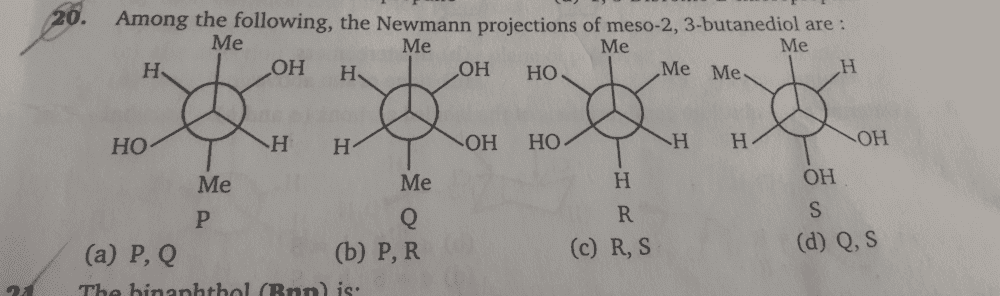
The discussion revolves around identifying the Newman projections of meso-2,3-butanediol, focusing on the characteristics of meso compounds, the conversion between Fischer and Newman projections, and the implications of molecular symmetry.
Discussion Character
- Homework-related
- Technical explanation
- Conceptual clarification
- Debate/contested
Main Points Raised
- Some participants assert that a meso compound has a chiral center and a plane of symmetry, while others clarify that it must have at least two chiral centers.
- One participant expresses uncertainty about how to determine if a chiral molecule possesses non-chiral symmetry.
- There is a discussion about the rotation of molecules in Newman projections, with some participants suggesting that rotating by multiples of 60° maintains the same configuration.
- Participants discuss the difference between "configuration" and "conformation" in the context of Newman projections.
- One participant inquires whether they can rotate about a single carbon at a time or both simultaneously, receiving confirmation that either is possible.
- A later reply introduces a method for identifying meso compounds based on R and S configurations, noting that meso compounds will have configurations of (R,S) or (S,R).
- There is a question about whether R and S configurations can be assigned directly from a Newman projection, with a response indicating that it is possible with mental visualization and molecular models.
Areas of Agreement / Disagreement
Participants generally agree on the definition of meso compounds but have differing views on the specifics of symmetry and the methods for visualizing and manipulating molecular structures in Newman projections. The discussion remains unresolved regarding the best approach to determine the meso nature of the compounds.
Contextual Notes
Some participants express uncertainty about the definitions and processes involved in determining meso compounds, particularly in relation to the conversion between different projection types and the implications of molecular symmetry.