Discussion Overview
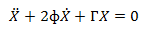
The discussion revolves around the normalization and scaling of second order systems when the parameters involved are matrices rather than scalars. Participants explore the implications of this change on the normalization process, particularly in the context of differential equations and state space representation.
Discussion Character
- Exploratory
- Technical explanation
- Debate/contested
- Mathematical reasoning
Main Points Raised
- One participant seeks clarification on whether the normalization steps differ when dealing with matrices instead of scalars, specifically in the context of a second order system.
- Another participant questions the specific type of normalization being referred to, noting that it can mean different things in different contexts, such as converting to dimensionless form.
- A participant expresses interest in producing dimensionless and scaled parameters to improve the condition number of the dynamics matrix in state space form.
- There is uncertainty about how to nondimensionalize a system of simultaneous differential equations, with one participant explaining that the process involves substituting new variables and dividing by constants across the equations.
- A participant mentions the potential for using linear combinations of equations in a system but is unclear about the simplification possibilities this introduces.
- One participant shares a resource for nondimensionalizing a predator-prey system as an example, indicating the difficulty in finding relevant examples online.
Areas of Agreement / Disagreement
Participants express varying levels of understanding and agreement regarding the normalization process for matrix systems. There is no consensus on the specific steps or methods to be used, and the discussion remains unresolved regarding the best approach to take.
Contextual Notes
Participants acknowledge the complexity introduced by working with systems of equations and the challenges in finding clear examples or guidelines for nondimensionalization in this context.