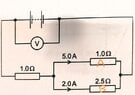
Potential difference calculation

Join the discussion
Ask a follow-up here, or get your own question answered by working scientists, mathematicians and engineers — people, not an autocomplete.
Real named experts · corrections over time · the nuance an AI answer skips
2 replies · 1K views
ellieee
Messages
78
Reaction score
6
Homework Statement
for the 2 resistors in parallel, is is true that only need to find p.d across one of them (eg. (5.0)(1.0)=5.0V) to determine the p.d across both parallel resistors ? in this case (2.0.)(2.5) = (5.0)(1.0), but what If the p.d across resistor A not equal to that of B, then which resistor do you calculate the p.d of?
Relevant Equations
V=IR
?hash=8c77edc8c11b6539bb9dae2fc1be8b7a.jpg
 

Attachments

  • CamScanner 05-11-2021 12.11_2_edit_8520459510157.jpg
    CamScanner 05-11-2021 12.11_2_edit_8520459510157.jpg
    42 KB · Views: 126
Physics news on Phys.org
For these types of school problems, a wire is considered to be 'perfect'; specifically that is: "The potential at any point on a wire is the same as the potential at any other point on that wire."

Keeping that in mind, since the respective ends of the two resistors A and B are connected by wire, they are at exactly the same potential.

Hope this helps!

Cheers,
Tom
 
Reply
  • Like
Likes   Reactions: ellieee