Q: In a relative non-inertial reference frame, the fluid velocity is zero?

Join the discussion
Registration is free. Ask a follow-up in this thread, or start your own.
3 replies · 1K views
tracker890 Source h
Messages
90
Reaction score
11
Homework Statement
It's not apparent why the fluid velocity in the relative non-inertial reference frame is zero.
Relevant Equations
Momentum equation in non-inertial coordinates
Q: Regarding item (4), my understanding aligns with (eq_1), where M is a constant. However, why does ##\left( \frac{\partial}{\partial t}u_{xyz} \right)## in (eq_1) equal 0?

$$
\frac{\partial}{\partial t}\int_{CV}^{}{u_{xyz}}\rho d\forall =\frac{\partial}{\partial t}\left( u_{xyz}\cdot M \right) =M\left( \frac{\partial}{\partial t}u_{xyz} \right) =0\cdots \text{(}eq\_1\text{)}
$$
reference
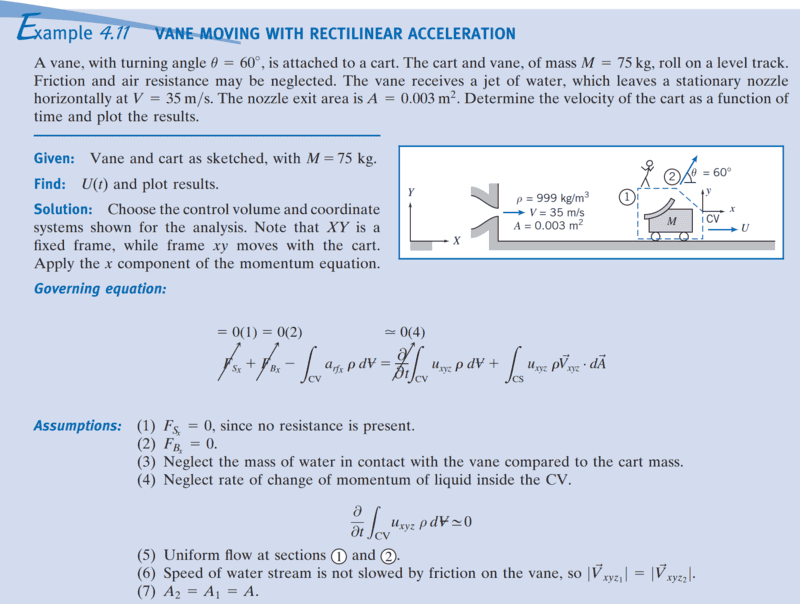
1701185080605.png
 
Physics news on Phys.org
I believe that the reason for assumption 4 is to eliminate the reduction of fluid entering velocity as the cart increases its horizontal velocity.
 
  • Like
Likes   Reactions: TSny and tracker890 Source h
Lnewqban said:
I believe that the reason for assumption 4 is to eliminate the reduction of fluid entering velocity as the cart increases its horizontal velocity.
Thank you for the explanation. So, for now, let's consider it as an assumption for simplifying the problem.
 
tracker890 Source h said:
Homework Statement: It's not apparent why the fluid velocity in the relative non-inertial reference frame is zero.
Relevant Equations: Momentum equation in non-inertial coordinates

Q: Regarding item (4), my understanding aligns with (eq_1), where M is a constant. However, why does ##\left( \frac{\partial}{\partial t}u_{xyz} \right)## in (eq_1) equal 0?

$$
\frac{\partial}{\partial t}\int_{CV}^{}{u_{xyz}}\rho d\forall =\frac{\partial}{\partial t}\left( u_{xyz}\cdot M \right) =M\left( \frac{\partial}{\partial t}u_{xyz} \right) =0\cdots \text{(}eq\_1\text{)}
$$
reference
What you have written here is incorrect. The integral term on the LHS of the governing equation from the example is what represents the solid mass ##M## momentum accumulation rate (when solid mass is contained inside the control volume - that is accelerating)