Question about design active filter

  • Thread starter Thread starter samaaa
  • Start date Start date
  • Tags Tags
    Design Filter
Click For Summary

Discussion Overview

The discussion revolves around the design of an active low-pass filter, specifically focusing on achieving a cutoff frequency of 200 Hz with a filter order of 4. Participants explore various methods and considerations in filter design, including the implications of using first-order versus second-order stages.

Discussion Character

  • Technical explanation
  • Debate/contested

Main Points Raised

  • One participant describes their method for designing a 4th order active low-pass filter using four first-order stages, calculating component values based on a specified cutoff frequency.
  • Another participant suggests that while the proposed method can work for an overdamped system, using second-order stages may be necessary for achieving a sharper Q factor, which would involve a different configuration of components.
  • A third participant challenges the initial design, stating that the gain at the cutoff frequency for the proposed first-order filter configuration would be too low when cascaded, suggesting that the participant may need to study filter design fundamentals further.
  • One participant provides a link to a filter design tool, implying it could be a practical resource for those needing to design filters without extensive theoretical knowledge.

Areas of Agreement / Disagreement

Participants express differing views on the appropriateness of using first-order stages versus second-order stages for the filter design. There is no consensus on the best approach, and the discussion remains unresolved regarding the optimal design method.

Contextual Notes

Participants note the importance of understanding the implications of filter order and gain, as well as the potential need for further study in filter design principles. Specific assumptions about the desired performance characteristics of the filter are not fully articulated.

Who May Find This Useful

This discussion may be useful for individuals interested in electronic filter design, particularly those exploring active low-pass filters and the trade-offs between different design methodologies.

samaaa
Messages
48
Reaction score
0
hi:

i designed an active low-pass filter,but i don't know if it correct method or not

i want fc=200 Hz and n(order)=4. i use this method:
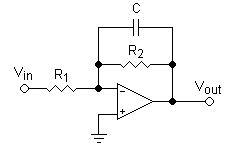
Active_lowpass_filter.png

by let C=100 nF and use this equation "fc=1/(2*pi*C*R1)"
i get R1= 8 Kohm,R2=R1
this is for one stage

to get filter of 4 order,i repeat that stage 4 times
http://uploadpic.org/storage/2011/M3Oveluhfm4grO0dEPhZiUv.png


so is this method correct?
 
Engineering news on Phys.org
You show four stages, each of 1st order. That will work for an overdamped system (low Q), but if you are designing for a sharp Q (lower damping and with overshoot in its step response), then you'll have to use 2nd order stages. Each comprises 2 capacitors and 2 resistors (at least), and can provide a high Q response (i.e., Q greater than 0.707). In practice, the professional designer faces a bewildering choice, each offering its own set of pros and cons. But for an introduction to the topic there are a few well-tried classics. Any general second-order filter stage will do the job nicely; you'll need two stages.
 
samaaa said:
i want fc=200 Hz and n(order)=4. i use this method:
...
so is this method correct?

No, because your first order filter has a gain of 0.5 at fc=200 Hz.

When you put the four filters in series, the gain at 200 Hz will be ##0.5^4## = 0.0625.

We don't know how much you already know about filter design, so it's hard to give much advice beyond "get a textbook and study it".

You could try Google for "design a low-pass Butterworth filter" (which seems to be what you were trying to do) but you might need to study some more basic ideas first.
 
NascentOxygen & AlephZero thank you very much
 

Similar threads

  • · Replies 51 ·
2
Replies
51
Views
9K
Replies
8
Views
2K
  • · Replies 1 ·
Replies
1
Views
3K
Replies
14
Views
3K
  • · Replies 5 ·
Replies
5
Views
2K
  • · Replies 6 ·
Replies
6
Views
3K
Replies
20
Views
3K
  • · Replies 10 ·
Replies
10
Views
2K
  • · Replies 6 ·
Replies
6
Views
2K
  • · Replies 1 ·
Replies
1
Views
3K