Body roll and RC location
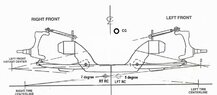
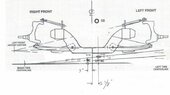
Back on Page 14, post # 479 I used an illustration not to scale but relative to the point. The front Roll Center location matters greatly in the performance of the race car. Below illustration has the RC way up there at about 13” above the track. The Center of Gravity is about 16” above the track. Not to realistic. The pic below is a lot more real world with the Roll center up about 3 inch and 3 inch to the right of center. The CG is offset to the left 1 inch as most rules permit it.
Down force quick tutorial - Take a tire ( mounted on the wheel of course) and stand it up on its wide tread. Now facing the wheel Grip both sides like you are going to put it on the wheel lugs. Slide it on the garage floor. Slides pretty easy, right? Now have Lumpy the fat neighbor kid, sit on the tire and try this again. Sliding a 40 pound tire/wheel was easy but sliding a 165 pound tire/wheel/ fat kid set up is way more difficult. This is what happens when you add DOWN FORCE. More grip.
Increasing the amount of vertical downforce on the right front tire increases the available traction, but in a non-linear way. When you increase loading on a tire, it will gain traction, but not in constant multiples. Adding 706 lbs down force adds traction but if we double it the results will not double the traction. The amount of traction will be something less than 2 times.
Big Bar and Soft Spring setups - This setup limits body roll in an attempt to place more load on the left-side tires, leading to more equally loaded sets of tires to produce more traction. One major factor is to limit the air under the car and kill off lift. Initially when this set up developed ride heights were about 4 inch track to chassis now it is 3 inch. Everyone is going lower. This and a more aero body adds downforce on the car body to provide tire loading. You
still need to take advantage of RC location to properly load the right front tire.
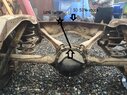
Per attached pic note -
Left RC has a 4° angle to the right front tire contact patch. The Right side RC has a 6° angle. This is the jacking effect that can lift the left side tire if it is great enough. Remember the sprint cars carrying the left front tire off the ground thru the turns. This happens when the roll center is placed too far to the right of centerline.
Note the longer moment arm or lever between the CG and the Rt RC.
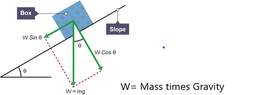
Now let us look at what happens during cornering. Momentum will continue to travel in a straight line until another force changes the direction. In this case the tires will do this through the suspension linkages.
Now let us look at the MASS that will have Momentum and must be dealt with before the car starts pushing like a freight train. Typical Late Model car min wight limit is 3000 lbs.
Of this, Unsprung weight of quick change, coil overs (50% unsprung weight, sway bar (ARB), upper control arms) amount to 400 lbs. We need to handle 2600 lbs. mass.
On a typical race car the front to rear weight is 52-48%. Caution- the calculations here are not going to be accurate but are close enough to demonstrate the need for proper location of the front roll center. In this example 52% of 2600 lbs is 1352 lbs.
This Mass will continue forward or diagonal once the tires cause opposing force on the MASS. One force vector is from the right front tire to the Roll Center.
If we know the Angle Sine of the left RC has a 4° angle has SIN of 0.07. and we multiply this by the 1352 Mass we have 95 lbs. acting on the tire contact patch thru this vector and the remaining 1257 lbs. moving laterally to the outside of the track. But wait a minute. What also is happening during the cornering process.
The typical late model car has 34” between the front spring upper mounting points. Our left roll center is offset 3 inches to the left which means 42% of the body roll will act on this RC. We have 42% of the Mass moving thru the RC rotating and planting the right front tire with 528 lbs. downforce. The remaining 1402 lbs. is moving laterally and pushing directly on the tires.
Now let us look at the Angle Sine of the right RC, 6° angle has SIN of 0.10 and we multiply this by the Mass we have 135 lbs. acting on the tire contact patch thru this vector and the remaining 1217 lbs. moving laterally to the outside of the track. But wait a minute. What also is happening during the cornering process.
The typical late model car has 34” between the front spring upper mounting points. Our right roll center is offset 3 inches to the right. Now we have 58% of the body roll rotating thru this RC. We have 58% of the Mass moving thru the RC rotating and planting the right front tire with 706 lbs. downforce. The remaining 511 lbs. is moving laterally and pushing directly on the tires.
Feature ................................ Left RC......................Right RC
Downforce on rt ft tire......528 lbs...................706 lbs or 25% more downforce
Force lateral thru tire...........1402 lbs..............511 lbs
Jacking force rt ft tire............95 lbs.................135 lbs
I would prefer 25% more down force on the right front tire and handle the momentum with this set up as opposed to the left side roll center method.