Solving Doubts about Simultaneity Exp. in Special Relativity

Click For Summary

Discussion Overview

The discussion centers on the concept of simultaneity in special relativity, particularly through a thought experiment involving a photon source in a moving train and detectors positioned at rest relative to a platform. Participants explore how events are perceived differently in various reference frames, the synchronization of clocks, and the implications of these differences on the detection of light signals.

Discussion Character

  • Exploratory
  • Technical explanation
  • Conceptual clarification
  • Debate/contested

Main Points Raised

  • Some participants express confusion about the synchronization of clocks across different reference frames, questioning the feasibility of such synchronization when time dilation occurs.
  • One participant proposes a method for the platform observer to determine the time difference between the reception of photons at the source, suggesting the use of synchronized clock-detectors along the platform.
  • Another participant emphasizes that synchronization of clocks should only occur when they are in close proximity, arguing that relativistic effects can be ignored at negligible distances.
  • Some participants critique the wording regarding clock synchronization, suggesting it may imply that synchronization is possible across frames, which they argue is not the case.
  • One participant asserts that the emissions of light from the source will not be simultaneous in any frame other than the train's frame, based on kinematic arguments related to the speed of light.
  • Another participant reiterates that the two frames regard the moment of light emission as time zero but interpret the timing of events differently due to their relative motion.

Areas of Agreement / Disagreement

Participants generally do not reach a consensus on the synchronization of clocks across different reference frames and the implications for simultaneity. Multiple competing views remain regarding how events are perceived in different frames and the validity of synchronization methods proposed.

Contextual Notes

Participants note limitations in the wording of the original problem, particularly regarding the synchronization of clocks and the interpretation of simultaneity across different frames. There are unresolved assumptions about the nature of light emission and detection in the context of relative motion.

Shirish
Messages
242
Reaction score
32
I'm reading about how the concept of simultaneity breaks down in special relativity. Here's the relevant paragraph:
-----
Consider a photon source ##C_0## in a train car situated equidistant between detectors ##C_1## and ##C_2##. The source emits photons back to back. In a reference frame at rest with respect to the train car, photons arrive at the detectors simultaneously. In a reference frame at rest relative to the train station, however, which the train is assumed passing through, the photon source and the detectors are in motion with speed ##v## from left to right. The two frames synchronize their identical clocks when the origins of their coordinate systems coincide, whereupon the photons are emitted. Seen from the frame of the station, event ##C_1## happens before ##C_2##; the photon first encounters detector ##C_1## moving toward it.
----
I'm a bit confused by the part in bold, though I might be wrong. I googled on how clocks are synchronized in the same reference frame, but I've heard that from the perspective of an inertial observer, time goes slower in another inertial reference frame moving w.r.t. them, so isn't it pointless to sync clocks across two reference frames moving w.r.t. each other?

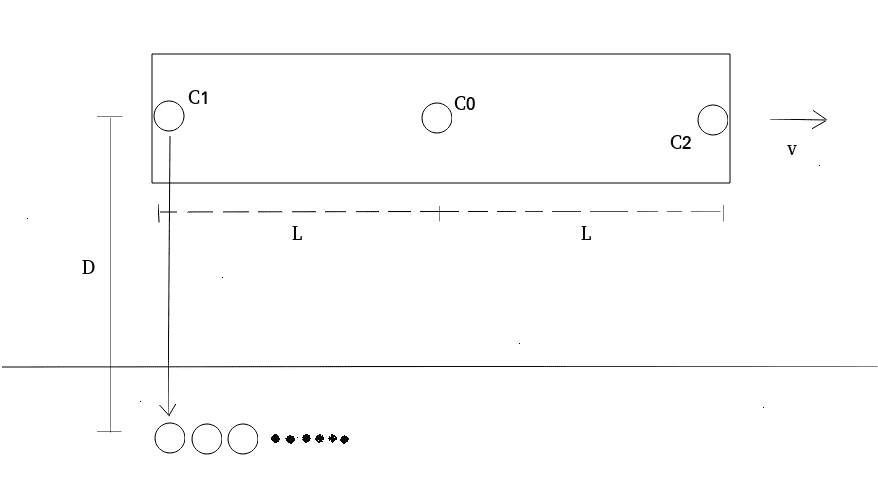
Another aspect that I'm trying to get is exactly how does the platform observer come to "know" of the events in the train. (ref. following poorly drawn diagram)
1588099410561.png


Let's say in the train's frame, clocks at ##C_1## and ##C_2## are synchronized. They simultaneously (in the train frame) emit photons towards ##C_0##. ##C_0## emits red light in all directions when it receives a photon from ##C_2## and emits green light in all directions when it receives one from ##C_1##. In the train's frame, both ##C_1## and ##C_2## photons simultaneously reach ##C_0## ==> ##C_0## emits yellow light (red and green simultaneously).

What kind of a setup can a platform observer use to find the time difference between ##C_0## receiving the two photons? Suppose there's an array of clock-detectors lined up on the platform parallel to ##v## and at a distance ##D## from the train - all of them synchronized in the platform's frame.

Each of those clock-detectors are set up in such a way that they record the time when a beam of light perpendicular to the line of detectors (i.e. perpendicular to ##v##) in the platform frame reaches them. What should the platform observer notice? I'm confused between two possibilities:

1. He will notice red light being emitted first from the train: out of that the red ray traveling perpendicular to the platform will set off one of the detectors. After that, he will notice green light coming out from the train which sets off another platform detector further to the right.
2. He will notice yellow light being emitted from the train, which sets off one of the detectors on the platform. The emission of photons from ##C_1## and ##C_2## was out of sync (in the platform frame) in the first place, and the movement of ##C_0## to the right causes it to receive both simultaneously.

I'm not sure which of these options is correct, or whether both of them are wrong.
 

Attachments

  • cm (1).png
    cm (1).png
    3 KB · Views: 229
Physics news on Phys.org
Shirish said:
Another aspect that I'm trying to get is exactly how does the platform observer come to "know" of the events in the train. (ref. following poorly drawn diagram)
...
What kind of a setup can a platform observer use to find the time difference between C0 receiving the two photons?
One way of resolving these issues is to position a recording device at each clock. Whenever anything interesting (flash of light is emitted, flash of light is received, a clock moving past us emits or receives a flash of light, ...) the recording device prints out a slip of paper saying “This clock read X and Y happened”. When the experiment is done we can gather up all these time stamped slips of paper and reconstruct the entire sequence of events.
 
My understanding is that in thought experiments like this, synchronisation of clocks across reference frames occurs when the two clocks are right next to each other. Imagine a clock right on the edge of the platform and another that hangs out the window of the train, so they pass one another at a distance of less than one metre.
At that distance, time delays from transmission of light are negligible, so relativistic effects can be ignored. The two clocks are effectively instantaneously in the same spacetime location. Imagine the clocks as radio-equipped and the train clock sends time signals to the platform clock every 0.001 seconds. The time signal that is from the closest position will be the one that occurs just before the interval between signal receipts increases. The platform clock synchronises to that time signal, ie it sets its time so that the time now is the time received in that signal plus the time interval it has measured since then.
Note that the sync is only between one clock in each frame. Trying to do more would create problems, and be unnecessary. After the initial sync, each frame syncs all its clocks to the clock that synced with the other frame, using the procedure for syncs within a single inertial frame.
 
Shirish said:
The two frames synchronize their identical clocks when the origins of their coordinate systems coincide
The wording here isn’t as specific as it could be, but what they are saying is that when the origins coincide, each frame synchronizes its own clocks. Synchronization within and across frames is not possible.
They simultaneously (in the train frame) emit photons towards C0C0C_0.
Note that this setup is different from what you originally quoted. If the light rays from 1 and 2 reach the same place at the same time in one frame, it is considered to be a single event, and will therefore remain a single event in all frames. The emissions of the light rays will not be simultaneous in any frame other than the train’s, however.
 
Shirish said:
I'm reading about how the concept of simultaneity breaks down in special relativity. Here's the relevant paragraph:
-----
Consider a photon source ##C_0## in a train car situated equidistant between detectors ##C_1## and ##C_2##. The source emits photons back to back. In a reference frame at rest with respect to the train car, photons arrive at the detectors simultaneously. In a reference frame at rest relative to the train station, however, which the train is assumed passing through, the photon source and the detectors are in motion with speed ##v## from left to right. The two frames synchronize their identical clocks when the origins of their coordinate systems coincide, whereupon the photons are emitted. Seen from the frame of the station, event ##C_1## happens before ##C_2##; the photon first encounters detector ##C_1## moving toward it.
----
I'm a bit confused by the part in bold, though I might be wrong.

I can't see any reason to synchronise clocks in this experiment. The light is emitted from a single source ##C_0## and in the platform frame reaches ##C_1## before ##C_2##. This can be deduced from a purely kinematic argument using the postulate about light speed.
 
Shirish said:
The two frames synchronize their identical clocks when the origins of their coordinate systems coincide,
As others have noted, I think this is poor wording. I think they actually mean that the two frames both regard time zero to be the moment that the ##C_0## emits light pulses. We then go on to show that the two frames mean completely different things by "the moment" - that two things that happen at the same time in different places according to one frame happen at different times according to the other.
 
Ibix said:
As others have noted, I think this is poor wording. I think they actually mean that the two frames both regard time zero to be the moment that the ##C_0## emits light pulses. We then go on to show that the two frames mean completely different things by "the moment" - that two things that happen at the same time in different places according to one frame happen at different times according to the other.
Hm I understand. And I'm guessing as for the 2nd part of my question on which of the two possibilities must be correct, the 2nd possibility seems to be true. I mean if ##C_0## were designed in such a way that, for some reason, it'd get destroyed if both photons were to simultaneously strike it, then it'd get destroyed in the train frame. So it'd have to get destroyed in the platform frame as well, otherwise we'd have an inconsistency once the train stopped and the platform observer went inside to check.
 
Shirish said:
Hm I understand. And I'm guessing as for the 2nd part of my question on which of the two possibilities must be correct, the 2nd possibility seems to be true. I mean if ##C_0## were designed in such a way that, for some reason, it'd get destroyed if both photons were to simultaneously strike it, then it'd get destroyed in the train frame. So it'd have to get destroyed in the platform frame as well, otherwise we'd have an inconsistency once the train stopped and the platform observer went inside to check.
Right. It’s the same as asking if in the original scenario you quoted whether or not the emission event is simultaneous in all frames—it doesn’t really make sense since you’re talking about a single event.
 
PeroK said:
I can't see any reason to synchronise clocks in this experiment. The light is emitted from a single source ##C_0## and in the platform frame reaches ##C_1## before ##C_2##. This can be deduced from a purely kinematic argument using the postulate about light speed.
One small follow-up regarding kinematics - if a beam of light is emitted from the train such that in the platform frame, it travels perpendicular to the platform, then how would it appear to the train observer? Would it appear to be going something like this?

cm23.jpg


Put another way, to ensure that the beam appears perpendicular to the platform in the platform frame, would the guy in the train have to emit the light beam as shown above?
 
  • #10
Pencilvester said:
Right. It’s the same as asking if in the original scenario you quoted whether or not the emission event is simultaneous in all frames—it doesn’t really make sense since you’re talking about a single event.
So then events happening simultaneously at the exact same spatial point in one frame will also be simultaneous in all other IRFs? That seems to be the implication for me.
 
  • #11
Shirish said:
events happening simultaneously at the exact same spatial point in one frame will also be simultaneous in all other IRFs?
You say “events” (plural), but if something happens at a single time in a single place, then it should be considered as just a single event. And changing between frames will never turn one event into multiple events, so yes, it will still be one single event in all frames.
 
  • Like
Likes   Reactions: PeroK and Shirish
  • #12
Shirish said:
One small follow-up regarding kinematics - if a beam of light is emitted from the train such that in the platform frame, it travels perpendicular to the platform, then how would it appear to the train observer? Would it appear to be going something like this?
Yes. These angles are frame-dependent.
That's not a relativity thing, it's that way with ordinary classical mechanics as well. Imagine two cars driving side by side down the road, and someone in one car shoots a bullet into the other car: using the frame in which the cars are at rest the bullet's path is perpendicular to the road; using the frame in which the road is at rest and the cars are moving the bullet's path is at an angle to the road.
 
  • Like
Likes   Reactions: Shirish
  • #13
andrewkirk said:
At that distance, time delays from transmission of light are negligible, so relativistic effects can be ignored
Delay due to light travel time is classical physics.
 
  • #14
David Lewis said:
Delay due to light travel time is classical physics.

How is this relevant to what you were responding to?
 

Similar threads

  • · Replies 6 ·
Replies
6
Views
2K
  • · Replies 7 ·
Replies
7
Views
2K
  • · Replies 26 ·
Replies
26
Views
4K
  • · Replies 36 ·
2
Replies
36
Views
4K
  • · Replies 20 ·
Replies
20
Views
3K
  • · Replies 5 ·
Replies
5
Views
2K
  • · Replies 25 ·
Replies
25
Views
2K
  • · Replies 221 ·
8
Replies
221
Views
16K
  • · Replies 12 ·
Replies
12
Views
2K
  • · Replies 16 ·
Replies
16
Views
2K