Testing if a multiplier is doubling frequency

  • Thread starter Thread starter r19ecua
  • Start date Start date
  • Tags Tags
    Frequency Testing
Click For Summary

Discussion Overview

The discussion revolves around the challenge of doubling the frequency of an input signal using an AD633 multiplier circuit. Participants explore the circuit design, component connections, and the behavior of the output signal in relation to the expected results. The context includes both theoretical and practical aspects of circuit implementation.

Discussion Character

  • Technical explanation
  • Debate/contested
  • Experimental/applied

Main Points Raised

  • One participant describes their circuit setup aiming to double the frequency of an input signal using the AD633 multiplier, expressing confusion over the output not reflecting the expected doubling.
  • Another participant inquires about the DC biasing conditions at the inputs, suggesting that this could affect the circuit's performance.
  • Several participants ask for clarification on the power supply connections, particularly the need for both positive and negative voltage rails for the AD633 to function correctly.
  • Concerns are raised about the grounding of the signal generator and its relationship to the power supply ground, with suggestions that mismatched grounds could introduce noise affecting the output.
  • A participant shares their waveform measurements, noting that the output frequency fluctuates and is lower than expected, prompting further analysis of the circuit's performance.
  • Another participant provides a detailed mathematical breakdown of the expected output signal based on the input parameters, indicating the expected DC offset and AC component amplitude.
  • Recommendations are made regarding grounding practices, measurement techniques, and potential circuit modifications to improve performance.

Areas of Agreement / Disagreement

Participants express various viewpoints regarding the circuit setup and potential issues, with no clear consensus on the exact cause of the output discrepancies. Multiple competing views on grounding and circuit configuration remain unresolved.

Contextual Notes

Participants note limitations in the circuit's performance due to potential grounding issues, incorrect voltage rail connections, and the need for proper biasing. There are also mentions of discrepancies between simulation results and practical implementation.

Who May Find This Useful

Individuals interested in circuit design, particularly those working with multipliers and frequency doubling, as well as those troubleshooting similar electronic setups.

r19ecua
Messages
17
Reaction score
0
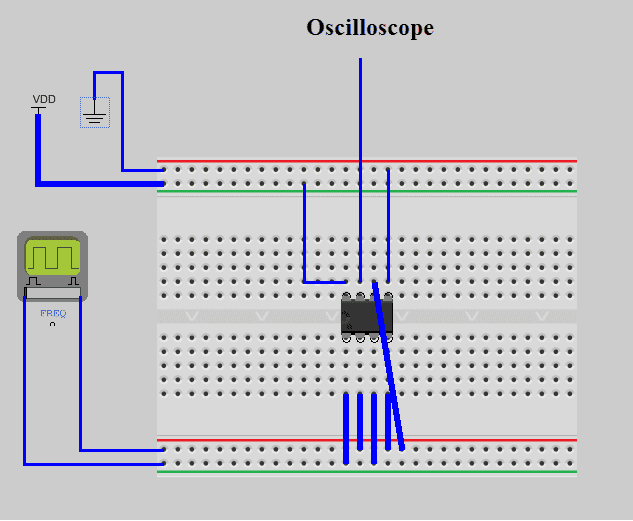
Here is my circuit
Untitled-2.png


I'm trying to double the frequency of my input to my output.

k = 1/10 V

For example: input is VmSin(2\pi1000t)/10
Vo = (VmSin(2\pi1000t))^2/10
Output should be Vm^2/20 + Vm^2cos(2\pi2000t)/20

My oscilloscope isn't picking up on the doubling, so I know my circuit is incorrect. May I have assistance? The ultimate goal, is to develop a phase detector.
Circuit I'm trying to create:
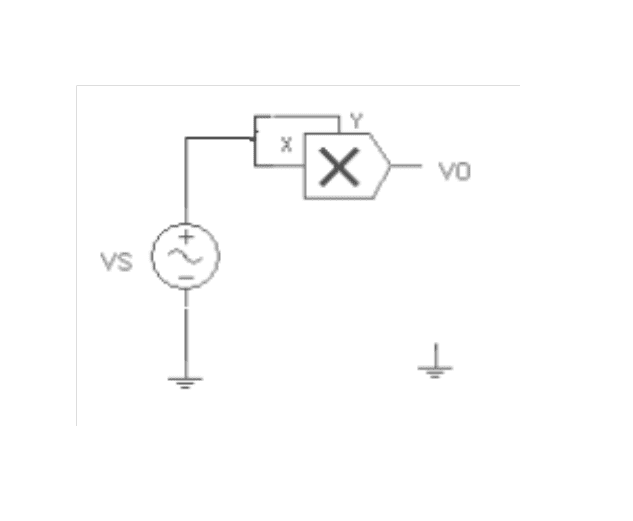
Untitled2.png
 
Last edited:
Engineering news on Phys.org
Have you any biasing to define the DC conditions at the inputs?
 
And ... what is the chip ??

giving ALL the info helps people help you :)

Dave
 
Apologies! I'm using an AD633 with Vs = +15V and -VS = -15V.. X2 = Y2 = Z = 0

Here is the data sheet:
AD633-pinout.jpg
 
r19ecua said:
Apologies! I'm using an AD633 with Vs = +15V and -VS = -15V.. X2 = Y2 = Z = 0

Here is the data sheet:
AD633-pinout.jpg

Your picture does not show +/- 15V rails. It shows a positive rail and ground for powering the IC.

And when you correct that, is your signal generator ground the same as the power supply ground? What amplitude and frequency are your sig gen set for?
 
And when you say "My oscilloscope isn't picking up on the doubling", what does the output look like?
 
berkeman said:
Your picture does not show +/- 15V rails. It shows a positive rail and ground for powering the IC.

And when you correct that, is your signal generator ground the same as the power supply ground? What amplitude and frequency are your sig gen set for?

That's what I wanted to make sure of! In order to meet the +/- 15V rail requirement, I'd need a +15V rail and a - 15V rail, yes? So 2 different sources and a separate rail for ground, but I did this and my frequency is not doubled. I had used a red lead for both Vs inputs (+/-) and grounded the negative leads on another rail.

My amplitude(Vm) is 10V and my frequency is 1000Hz.

Here is my waveform:
Untitled-3.png
 
Last edited:
@r19ecua
Is there a problem for you to give us a proper schematic diagram of the exact circuit you are (or think you are) using? Either the chip is broken or you have connected it wrongly and a schematic could help people find what's wrong. It's not too much to ask, is it? You should already have drawn yourself one, in any case.
 
My first post is the circuitry I was rolling with, the schematic followed soon after.. The VDD is suppose to be the Vs 15V and the ground rail is coming from the negative terminal of the power supply. The problem? I just want to see the frequency doubled using a multiplier (AD633) with X2, Y2 and Z = 0 (grounded). The input frequency is Vm = 10Sin(2pi1000t)V

@berkeman
No, the ground for my function generator is not the same as the power supply ground. Should I make them the same? I was using some virtual breadboard software and it turns out it was a bust.
 
Last edited:
  • #10
r19ecua said:
My first post is the circuitry I was rolling with, the schematic followed soon after.. The VDD is suppose to be the Vs 15V and the ground rail is coming from the negative terminal of the power supply. The problem? I just want to see the frequency doubled.

@berkeman
No, the ground for my function generator is not the same as the power supply ground. Should I make them the same? I was using some virtual breadboard software and it turns out it was a bust.

Now there's a lesson for you. :biggrin:
You can only believe what you draw on paper and analyse with your mind. Simulations are always to be treated with some suspicion if you don't 'test' them like you'd test a wired circuit. A dodgy bit of software is worse than a dodgy component because you can replace a component but the software will do the same daft thing again and again.
 
  • #11
sophiecentaur said:
Now there's a lesson for you. :biggrin:
You can only believe what you draw on paper and analyse with your mind. Simulations are always to be treated with some suspicion if you don't 'test' them like you'd test a wired circuit. A dodgy bit of software is worse than a dodgy component because you can replace a component but the software will do the same daft thing again and again.

The waveform I posted is an actual test. I only drew up the circuit via simulation software just so you all could see what I put together. If I were to simulate the schematic on multisim, the frequency doubles. When I put it into practice (by building it the way I initially posted), my results are the waveform I posted. The 2 Vs inputs of the AD633 are receiving +15V (the + & - inputs of the IC).
 
Last edited:
  • #12
You have 15 V from +Vs to -Vs. The AD633 datasheet lists a minimum of ±8 V, i.e. you should have 16 V from +Vs to -Vs at minimum. It might work at 15 V but you'll have no guarantee that it'll be within the specifications listed in the datasheet.

For 20 V from +Vs to -Vs, your inputs should be between 4 V and 16 V relative to -Vs (have a look at figure 6 in the datasheet).

Edit:
Did you use a single-ended probe:
Oscilloscope_Pro_4d7b2c7269f62.jpg


when you recorded the waveforms you posted in #7? Where did you attach the ground clip?
 
Last edited:
  • #13
OK, this is my actual circuit:
doublingfreqcircuit.png


I have 2 different sources putting out 15V. If you refer to the datasheet there are two inputs.. a VS+ and a VS-. In the picture, I have for both inputs, a +15V going through them. The negative terminal of these two inputs are placed on the same rail and are grounded. X2 = Y2 = Z = 0, these inputs were grounded as well.

My initial guess was to put a +15V(1st source) through the +Vs input(pin 8) on the IC and a -15V (from the second source) on the -Vs input(pin 5) of the IC. The -15V (from 1st source) would be ground and the +15V(from second source) would be grounded as well. X2 = Y2 = Z = 0, these inputs were grounded as well.

Edit: If you refer to the datasheet above, w is my output.
 
Last edited:
  • #14
I won't have a chance to look it through until later, but could you try disconnecting the +15 V and -15 V clips and measure the voltage between them with a multimeter?
 
  • #15
OK, I finally have the frequency being doubled. I didn't draw it, but the clip for my function generator is grounded... This is the circuit I constructed:
blah.png


my output waveform:
Untitled432.png

The frequency for my output (CH2) continues to fluctuate between 1 ~ 2kHz. The result is also smaller than expected. Input voltage is 10V as seen by the 5 volts / div. While the output voltage is at 1 volt/div and barely passes 3V. Output was expected to be 5V based on the formula
Vo(t) = Vs(t)^2/10
Vs(t) = 10sin(2pi1000t)
Vo(t) = 5 - 5cos(2pi1000t)V (estimated)

@milesyoung
DMM measures 30V
 
Last edited:
  • #16
Your input signal is:
Vin = A*sin(ω*t), A = 5 V, ω = 2*pi*1000 rad/s

Your output signal should be:
Vout = Vin2/(10 V) = (A*sin(ω*t))2/(10 V) = A2/(10 V)*sin2(ω*t) = A2/(10 V)*( (1 - cos(2*ω*t))/2 ) =
A2/(20 V)*(1 - cos(2*ω*t))

The DC offset and amplitude of the AC component at the output should be (5 V)2/(20 V) = 1.25 V, which seems about right for the output you've measured.

I can only recommend that you:
- Bond together the ground of the signal generator and both supplies at a common point so you won't have the noise between them added to the AD633 input signal.
- Move the probe and ground clip as close as possible to the pins for measurements.
- Consider adding some decoupling caps to the AD633 supply pins (as close as possible) as shown in the datasheet.
 

Similar threads

Replies
55
Views
8K
  • · Replies 78 ·
3
Replies
78
Views
6K
  • · Replies 46 ·
2
Replies
46
Views
6K
  • · Replies 41 ·
2
Replies
41
Views
8K
Replies
2
Views
3K
Replies
20
Views
3K
  • · Replies 3 ·
Replies
3
Views
2K
  • · Replies 6 ·
Replies
6
Views
5K
  • · Replies 9 ·
Replies
9
Views
4K
  • · Replies 14 ·
Replies
14
Views
2K