To calculate torque on a supported beam

  • Thread starter Thread starter gnits
  • Start date Start date
  • Tags Tags
    Beam Torque
Click For Summary
SUMMARY

The discussion focuses on calculating torque on a supported beam, specifically addressing the relationship between forces and torque after an external torque (L) is applied. The key equations derived include the center of gravity (COG) distance from point A, expressed as a(1+n)/n, and the weight W1 defined as W(1+n)/3. The participant, Mitch, seeks assistance in establishing the equation to calculate torque L, noting that after its application, the force F1 increases by 1.5 times, leading to the conclusion that moments should be taken about point Q to simplify the analysis.

PREREQUISITES
  • Understanding of static equilibrium in mechanics
  • Familiarity with torque and moment calculations
  • Knowledge of center of gravity (COG) concepts
  • Basic principles of forces acting on beams
NEXT STEPS
  • Study the principles of static equilibrium in beam systems
  • Learn how to calculate moments about different axes in mechanical systems
  • Explore the effects of applied torque on beam forces
  • Investigate the relationship between center of gravity and torque in structural analysis
USEFUL FOR

Mechanical engineers, physics students, and anyone involved in structural analysis or mechanics of materials will benefit from this discussion.

gnits
Messages
137
Reaction score
46
Homework Statement
To calculate torque on a supported beam
Relevant Equations
equate forces and torques
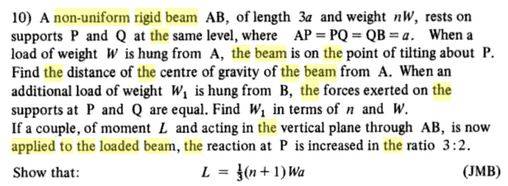
Could I please ask for help with the last part of the following question?
q.JPG


I have the first two parts done, answers are:

Distance of COG from A = a(1+n)/n

and W1 = W(1+n)/3

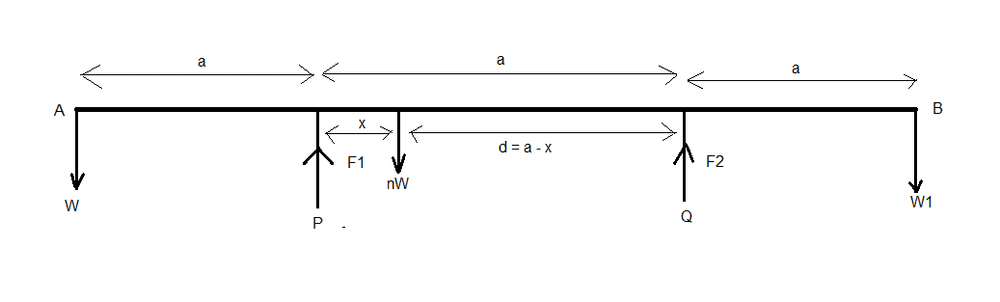
I can't see how to go about the last part. Here's my diagram for the system prior to the torque L being added:
d.png

In this situation we have (are told) F1 = F2 = F say, and so W1 + W + nW = 2F and so as we know W1 in terms of W and n we have F = 2W(n+1)/3 and we are told that after torque L is applied then this increases by 1.5 times, so now F1 = W(n+1) and so F2 = W(n+1)/3. As F1 has increased then we know that L is counter-clockwise.

Can't see though what equation to set up to calculate the L which would lead to this value for F1.

Thanks for any help,
Mitch.
 
Physics news on Phys.org
Of all the forces acting on the beam after L is applied, which is the one that you neither know nor care about? What axis can you take moments about to avoid involving that force?
 
haruspex said:
Of all the forces acting on the beam after L is applied, which is the one that you neither know nor care about? What axis can you take moments about to avoid involving that force?

Thanks very much. That helped me to see it. Moments about Q.

Mitch.
 

Similar threads

Replies
6
Views
3K
  • · Replies 7 ·
Replies
7
Views
3K
Replies
17
Views
3K
Replies
5
Views
2K
Replies
6
Views
2K
  • · Replies 6 ·
Replies
6
Views
2K
  • · Replies 42 ·
2
Replies
42
Views
4K
  • · Replies 14 ·
Replies
14
Views
3K
  • · Replies 5 ·
Replies
5
Views
3K
  • · Replies 3 ·
Replies
3
Views
4K