Vortex Experiment: Can Vacuums Create a Vortex?

Click For Summary

Discussion Overview

The discussion revolves around an experimental setup involving two vacuum cleaners aimed at creating a vortex through air circulation. Participants explore the feasibility of this idea, the mechanics of vortex formation, and potential methods for visualizing the results. The conversation includes elements of aerodynamics, experimental design, and the operation of vortex-generating devices.

Discussion Character

  • Exploratory
  • Technical explanation
  • Experimental/applied
  • Debate/contested

Main Points Raised

  • One participant describes setting up two vacuum cleaners facing each other and questions whether a more symmetrical airflow could create a vortex.
  • Another participant asks for the origin of the idea, suggesting that various tornado machines exist that utilize a vacuum fan to create rotation in the air.
  • Some participants propose using smoke or powder to visualize the airflow and vortex formation, questioning how to determine if a vortex is actually forming.
  • There is uncertainty about the intended outcome of the experiment, with one participant noting that vortices may form but questioning if they are the desired type.
  • Another participant speculates on the interaction between two tornado machines and whether they could link up to form a single vortex.
  • Concerns are raised about the mechanics of the setup, particularly regarding the lack of inlets and the potential for creating a partial vacuum that could damage the motors.
  • One participant describes a successful observation of a strong vortex using a modified box design with angled slots for air intake, indicating some level of vortex activity.
  • Another participant emphasizes that while vortices will likely form, their size and location depend on various factors, including the power of the vacuums and the design of the enclosure.
  • A participant shares details about a homemade probe used to measure airflow, noting that it indicates a strong vortex near the center line of the setup.

Areas of Agreement / Disagreement

Participants express a mix of curiosity and skepticism regarding the vortex creation experiment. While there is general agreement that vortices will form in the airflow, there is no consensus on the effectiveness of the setup or the specific outcomes that can be achieved.

Contextual Notes

The discussion reflects various assumptions about the operation of vacuum cleaners and vortex mechanics, with some participants expressing uncertainty about the principles behind tornado machines and vortex formation. The effectiveness of the experimental design remains unresolved.

Keith_McClary
Messages
752
Reaction score
1,506
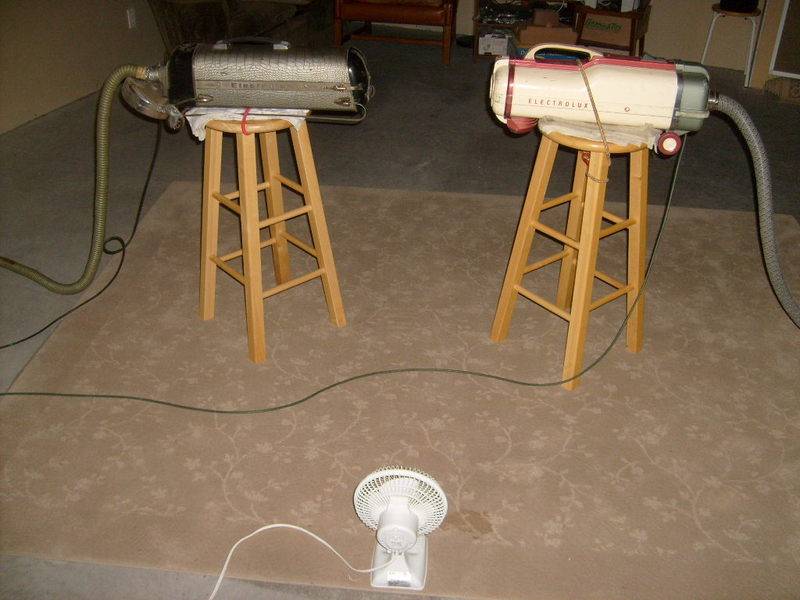
I set up two canister vacuum cleaners facing each other:
Wjw4POY.jpg

I had the idea that if there was some circulation in the air (provided by the small fan) then a vortex would form between the inlets. This does not seem to work. I don't have much knowledge or intuition about aerodynamics. Would this work if I arranged a more symmetrical air flow? (The hoses are in the exhaust ends.)
 
Physics news on Phys.org
Where did you get this idea from?
 
Fervent Freyja said:
Where did you get this idea from?
There are various tornado machines described on the web based on a vacuum fan and providing rotation to the air. I thought it should work better with a vacuum at both ends. I tried to google this, no luck.
 
If this is even supposed to work... how are you going to know if a vortex forms? Try throwing powder on it to see what is actually happening. Instead of the small fan, maybe a smoke machine directed at the center?
 
It's not clear to me exactly what you are hoping to achieve here. Undoubtedly there will be vortices that form somewhere in that flow system, but whether they are the sort you are looking to create is another question entirely.
 
I love fried bacon (extra crispy :cool: ) so I would probably make smoke that way, hobby supplies might have inexpensive machines (or method) for smoke. Try to find some method of diffusing the air coming out of the vacuum, you need the least amount of air turbulence possible in the room. I would like to help more, but I'm a master "thread locker" and would likely start talking about "Tesla Turbines" :rolleyes:
 
boneh3ad said:
It's not clear to me exactly what you are hoping to achieve here. Undoubtedly there will be vortices that form somewhere in that flow system, but whether they are the sort you are looking to create is another question entirely.
I'm wondering what happens if you have two "tornado machines" facing each other. Will the two tornados link up, forming a single vortex (line?, tube?, what is the terminology?) connecting the two exhaust fans? This seems like an obvious thing to try, but I can't Google anything like this.
 
I suppose part of the problem would be that I am not sure how a "tornado machine" operates. There are likely a number of different operating mechanisms for a machine to make a tornado-like vortex that I just don't know what you are trying to do.
 
boneh3ad said:
I suppose part of the problem would be that I am not sure how a "tornado machine" operates. There are likely a number of different operating mechanisms for a machine to make a tornado-like vortex that I just don't know what you are trying to do.
Like one of these
http://amasci.com/amateur/tornbox.html
http://www.facethewind.com/tornsim/open_air/
except I want to put exhaust fans at both ends.
 
  • #10
Well for one, it wouldn't do much since you would have two outlets and no inlets, so eventually it would just set up a chamber with a partial vacuum. Either the motors would just keep running without moving much air and they may burn up, or your chamber would fail due to the differential pressure inside versus out.
 
  • #11
boneh3ad said:
Well for one, it wouldn't do much since you would have two outlets and no inlets, so eventually it would just set up a chamber with a partial vacuum. Either the motors would just keep running without moving much air and they may burn up, or your chamber would fail due to the differential pressure inside versus out.
There are angled slots to let air in and provide rotation:
3tDXNcD.jpg

This was easy to make once I found a box the right shape.
When I suspend a small binder clip on a thread in the center of the box, it spins rapidly (not so much when above or below the center).
5otYOHa.jpg

This seems to indicate a strong vortex between the exhausts. I am thinking of making an "open air" version similar to the last link above.
 
  • #12
I mean, there will definitely be vortices in there, as is the case in most real-world situations where you have moving air. The operative question is going to be where they are located and how large they are, and that will depends on so many factors such as the power of your vacuums, the size and location of your slots, and the geometry of your enclosure.
 
  • #13
I made this hi-tech probe from tape and baling wire (bamboo skewer also worked).
fjxnMVc.jpg

If i probe near the center line I can see the tape flutter and feel the vibration. The active part is only about 1 cm in diameter. It stays close to the center line, does not wander like single ended tornadoes.
The box is 50x30x26 cm and the vents are about 2 cm wide.
 

Similar threads

  • · Replies 18 ·
Replies
18
Views
4K
  • · Replies 4 ·
Replies
4
Views
3K
  • · Replies 5 ·
Replies
5
Views
4K
  • · Replies 11 ·
Replies
11
Views
4K
  • · Replies 7 ·
Replies
7
Views
2K
  • · Replies 4 ·
Replies
4
Views
2K
  • · Replies 10 ·
Replies
10
Views
2K
  • · Replies 3 ·
Replies
3
Views
2K
Replies
9
Views
2K
  • · Replies 9 ·
Replies
9
Views
14K