Why does the pressure of a gas bubble change as it rises?

Click For Summary

Homework Help Overview

The discussion revolves around the behavior of gas bubbles as they rise through a liquid, specifically focusing on how the pressure within the bubble changes in relation to the external pressures exerted by the liquid and atmosphere. The subject area includes fluid dynamics and gas laws.

Discussion Character

  • Exploratory, Conceptual clarification, Assumption checking

Approaches and Questions Raised

  • Participants explore the relationship between the pressures inside and outside the bubble, questioning how the changing volume of the bubble affects these pressures. There is a focus on Newton's third law and the equilibrium of forces acting on the bubble.

Discussion Status

The discussion is active, with participants clarifying concepts related to pressure and volume changes in the bubble. Some guidance has been provided regarding the equilibrium of forces and the implications of pressure changes as the bubble rises.

Contextual Notes

Participants are navigating assumptions about the pressures involved and the implications of volume changes as the bubble ascends. There is an acknowledgment of the complexity of the forces at play without reaching a definitive conclusion.

TomK
Messages
69
Reaction score
14
Homework Statement
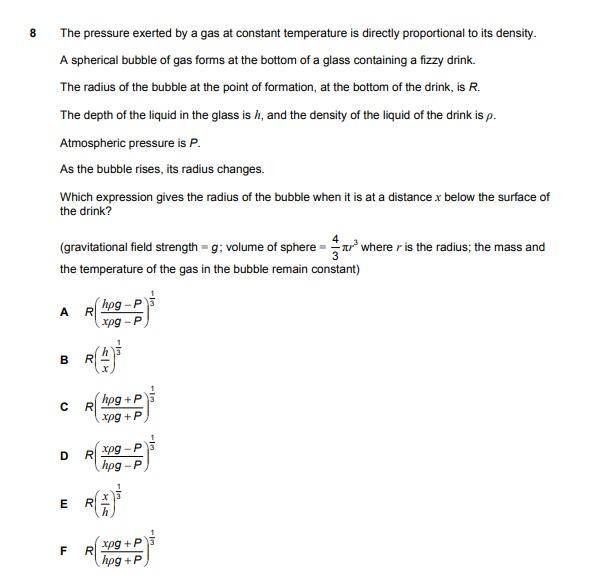
ENGAA 2019 (Q8, Section 2)
Relevant Equations
Pressure Equations
Ideal Gas Laws
Q8 (Section 2) - Imgur.jpg
Q8 (Section 2) - New Working.jpg
Q8 (Section 2) - New Working 2.jpg


The correct answer is 'C'.

I'm having trouble understanding the solution shown on this link (http://www.engineeringadmissionsassessment.com/2019-solutions.html) - scroll down to Section 2, Question 8.

From what I've gathered, [final pressure = initial pressure x 'R^3/r^3'], as PV must be constant. Therefore, I understand why they equate 'R^3/r^3' to 'final pressure/initial pressure'.

However, why doesn't the pressure exerted by the gas (within the bubble) affect the values of the initial and final pressure, since the bubble's volume is changing as it rises? Doesn't the pressure exerted by the gas (outward) oppose the pressure exerted on the gas (inward) by the liquid and atmospheric pressure?

In the solution, it looks like their initial/final pressure values only account for the 'pressure due to being submerged' and 'atmospheric pressure'. This is what I'm getting confused by.
 
Physics news on Phys.org
TomK said:
Doesn't the pressure exerted by the gas (outward) oppose the pressure exerted on the gas (inward) by the liquid and atmospheric pressure?
Newton's third law.

The outward pressure of the gas in the bubble on the fluid outside is exactly equal to the inward pressure of the fluid outside on the gas inside.

The two forces are not "opposed". They are part and parcel of the same force pair.
 
jbriggs444 said:
Newton's third law.

The outward pressure of the gas in the bubble on the fluid outside is exactly equal to the inward pressure of the fluid outside on the gas inside.

The two forces are not "opposed". They are part and parcel of the same force pair.

So, as the bubble rises from the base to the given height, the bubble changes volume, in order for the pressure outside = pressure inside?
 
TomK said:
So, as the bubble rises from the base to the given height, the bubble changes volume, in order for the pressure outside = pressure inside?
Yes.

If pressure inside had remained the same while pressure outside declined, the fluid at the boundary would be under an unbalanced net force. The bubble would expand, forcing that fluid outward.

Which is exactly what happens. The fluid is forced outward, the bubble expands, its volume increases and its pressure declines so that a new equilibrium is attained.
 
jbriggs444 said:
Yes.

If pressure inside had remained the same while pressure outside declined, the fluid at the boundary would be under an unbalanced net force. The bubble would expand, forcing that fluid outward.

Which is exactly what happens. The fluid is forced outward, the bubble expands, its volume increases and its pressure declines so that a new equilibrium is attained.

Thank you for helping.
 

Similar threads

Replies
3
Views
1K
  • · Replies 12 ·
Replies
12
Views
2K
  • · Replies 3 ·
Replies
3
Views
3K
  • · Replies 7 ·
Replies
7
Views
1K
Replies
6
Views
3K
Replies
5
Views
4K
  • · Replies 5 ·
Replies
5
Views
4K
Replies
5
Views
1K
  • · Replies 7 ·
Replies
7
Views
2K
Replies
10
Views
2K