Will this circuit work? what am i missing?

Click For Summary

Discussion Overview

The discussion revolves around the design of a circuit that controls a motor based on input from an infrared (IR) detector. Participants explore the correct configuration for integrating the motor, detector, and transistor, as well as the implications of using a diode for protection against voltage spikes generated by the motor.

Discussion Character

  • Technical explanation
  • Exploratory
  • Debate/contested

Main Points Raised

  • One participant suggests connecting the IR detector and a transistor in series, with the motor in parallel, to control the motor based on the detector's input.
  • Another participant argues that the proposed configuration would not work because the transistor would be hard biased on all the time.
  • A participant introduces the idea of placing a diode across the motor to protect the transistor from voltage spikes caused by the motor's inductance when the current is interrupted.
  • Further explanations clarify that the diode allows current to flow during voltage spikes, preventing potential damage to the transistor.
  • There is a discussion about whether the voltage spike produced by the motor when turned off should be classified as AC or DC, with participants expressing uncertainty about the terminology.
  • One participant explains that the system operates in two modes: steady state and transient, with the voltage spike being a transient pulse due to changing conditions.

Areas of Agreement / Disagreement

Participants express differing views on the effectiveness of the proposed circuit design and the classification of the voltage spike. There is no consensus on the terminology used to describe the voltage spike, and the discussion remains unresolved regarding the best approach to the circuit design.

Contextual Notes

Participants mention various considerations for the transistor, such as current handling and potential voltage drops, but do not reach a definitive conclusion on the optimal configuration or components.

sulicat
Messages
5
Reaction score
0
hi,
so i want to be able to run a motor depending on whether or not an IR detector senses IR light. so the basic idea at the start was to connect the motor with the detector and a resistor in series and therefore if there is IR the current will flow turning on the motor. I then learned that the current is limited by the low current device, ie:- the detector.

so will the correct way to go about this be to connect the detector and a transistor in series then connect a motor in parallel and make it depend on the transistor ?
here's a quick diagram of what i mean.
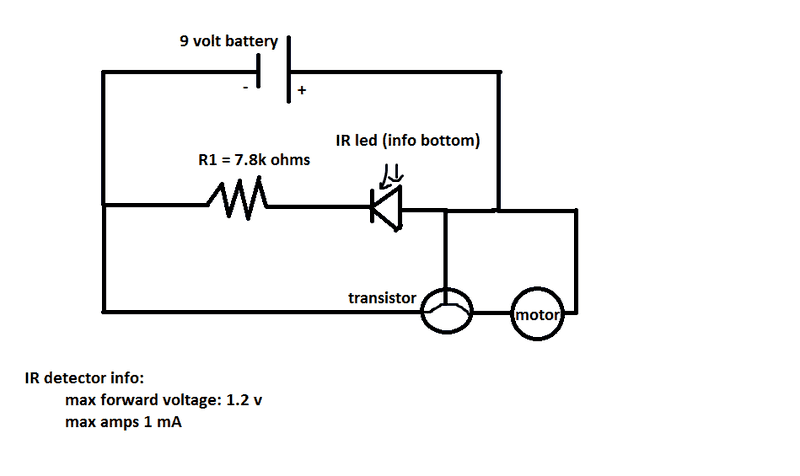
oqzjfd.png

will this work ?

the math i used to determine the resistance of R1 is as follows.
needed voltage drop = 9 - 1.2 = 7.8
r = v/I = 7.8/0.001
r = 7800 ohms
again I am not completely sure that this way of doing it is correct. you can probably tell I am very much a newbie...

also what kinda stuff will i have to consider for the transistor ? like is there a voltage limit ? does it provide considerable Resistance ? will it cause a voltage drop ? will the voltage from the inner circuit be added to it ?
the motor is a 9 v DC motor.

thank you
 

Attachments

  • circuit.png
    circuit.png
    60.9 KB · Views: 515
Engineering news on Phys.org
hi there

welcome to PF :smile:

No it won't work the way you want because the transistor is hard biased on all the time

here's a quick cct I put together for you
see how you go
diode across the motor a 1N4007
the variable resistor experiment with something ~ 4k7 to 10k ... it will adj the turn on sensitivity
make sure the transistor can handle the current required by the motor

motor drive.GIF


cheers
Dave
 
Can you explain to me why you put a diode across the motor ? How does it affect current flow ?
 
sulicat said:
Can you explain to me why you put a diode across the motor ? How does it affect current flow ?
a motor is basically an inductotor. When you shut the transistor off there will be a voltage spike due to the motor inductance. That diode will clamp the voltage and allow current to flow. Otherwise you can/will damage the transistor.
 
  • Like
Likes   Reactions: davenn
When you interrupt the current through an inductor (including motors) you get a voltage spike that can damage transistors etc.. The diode will not conduct in normal operation because it is reverse biased but a voltage spike in the other polarity will make the diode conduct and dissipate the magnetic energy in the inductor when the transistor turns off. It's a very effective form of protection (and quite smart, imo).
 
  • Like
Likes   Reactions: davenn
Hmmmnn that is extremely interesting. Thank you for explaining. So the voltage spike that the motor will produce once turned off is AC?
 
thanks Don and sophie for answering that Q in my absence :smile:

sulicat said:
Hmmmnn that is extremely interesting. Thank you for explaining. So the voltage spike that the motor will produce once turned off is AC?

ummmm ... not sure if I would deem it AC or DC ... its just a large spike

one of the others may clarify it better :smile:

cheers
Dave
 
sulicat look at it this way. It is a DC system, due to the fact that it runs off DC voltage.
Most systems have 2 main modes of operation, steady state and transient. Transient operations occur when something is a system changes (like a motor shutting off).
It is a transient pulse caused by changing conditions. When that pulse goes away, the circuit will be in steady state again (but the motor will be off)
 

Similar threads

  • · Replies 5 ·
Replies
5
Views
2K
  • · Replies 15 ·
Replies
15
Views
2K
Replies
12
Views
3K
  • · Replies 32 ·
2
Replies
32
Views
3K
  • · Replies 9 ·
Replies
9
Views
2K
  • · Replies 2 ·
Replies
2
Views
2K
  • · Replies 9 ·
Replies
9
Views
2K
  • · Replies 3 ·
Replies
3
Views
2K
  • · Replies 58 ·
2
Replies
58
Views
12K
  • · Replies 17 ·
Replies
17
Views
3K