Will water flow ever stop if we increase resistance?

Click For Summary

Discussion Overview

The discussion revolves around the behavior of water flow in a system of communicating vessels when resistance in the pipe is increased. Participants explore whether increasing resistance can lead to a reversal or cessation of flow, considering factors such as pressure differentials and pipe diameter.

Discussion Character

  • Exploratory, Technical explanation, Debate/contested

Main Points Raised

  • One participant questions whether flow will stop or reverse if resistance in the pipe is increased, suggesting that pressure from the left vessel may not be sufficient to overcome the pressure from the right vessel under certain conditions.
  • Another participant emphasizes that the critical factor is the pressure differential between the two vessels, implying that flow is dependent on this difference.
  • A third participant states that increasing resistance reduces flow rate but asserts that infinite resistance would be required to completely stop flow.
  • A participant shares a practical anecdote about water flowing downhill through a long pipe, highlighting that flow occurs regardless of pipe length, and mentions relevant mathematical principles such as the Moody chart and Bernoulli equation.
  • One participant challenges the basis of a previous claim regarding pressure at point A, expressing confusion over the reasoning presented.

Areas of Agreement / Disagreement

Participants exhibit disagreement regarding the implications of increased resistance on flow behavior. While some focus on pressure differentials, others question the foundational statements made about flow dynamics.

Contextual Notes

There are limitations in the assumptions made about pressure and flow dynamics, particularly regarding the definitions of resistance and the conditions under which flow may cease or reverse. The discussion does not resolve these complexities.

Gabriele99
Messages
5
Reaction score
0
Complete question:
Will flow ever reverse or stop if we increase resistance in this pipe scenario?
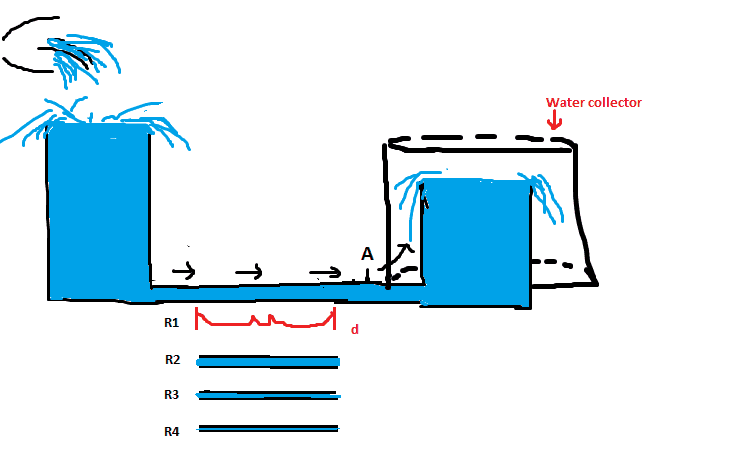
wI3VI.png
There are 2 comunicating vessels. The highest vessel is coninuosly alimented with new water. Water in excess flows down on the sides.
Water will try to reach the same height in both vessels, so some water will pour out of the shortest one and will be collected by the water collector.
The pipe distance d and the point A are our elements of interest.
The pipe distance d can be considered our main resistance to the flow, and it increases as the pipe become of a smaller diameter ( R1, R2, R3, R4 ).
In the first scenario, the pipe distance d doesn't get restricted so the pressure at point A should be the pressure exerted by the left vessel's water column minus the pressure exerted by the right vessel's water column.
Flow should be from left to right since the right vessel is higher, shouldn't?
What does it happen if we restrict the pipe distance d, given that some water is always able to flow through it ( Resistance it's not infinity )?
If we restrict the pipe distance d shouldn't pressure exerted by the water coming from the restricetd pipe too weak respect at point A to overcome the presssure exerted by the right vessel's water column?
If this is correct, shouldn't flow stop,or reverse and then stop?
 

Attachments

  • wI3VI.png
    wI3VI.png
    6.5 KB · Views: 1,653
Physics news on Phys.org
Gabriele99 said:
If we restrict the pipe distance d shouldn't pressure exerted by the water coming from the restricetd pipe too weak respect at point A to overcome the presssure exerted by the right vessel's water column?
What is important is the difference in pressure form the left and the right.
 
Increasing resistance reduces the flow rate at a given pressure differential. In order to reduce the flow rate to zero you would need an infinite resistance.
 
  • Like
Likes   Reactions: Lord Jestocost
A friend learned the hard way that water flows downhill regardless of the length of the pipe. It was a setup similar to your sketch. The pipe was 4800 feet of 2 inch PVC, and the elevation difference 10 feet. The liquid was chlorine dioxide in water solution. There was a pump on the supply tank, and several flow control valves on the discharge end. After the first startup test, he shut the pump off, and left. The flow control valves, in a different building, went full open. Part of the paper mill had to be evacuated until a valve was closed and the vapors cleared out. But he learned that water flows downhill, even through long pipes.

The math for this situation is shown in a Moody chart. The math still works for long, small diameter pipes with low pressure differences. The Reynolds number just gets smaller. A very large pipe would be analyzed using the Bernoulli equation.
 
Gabriele99 said:
In the first scenario, the pipe distance d doesn't get restricted so the pressure at point A should be the pressure exerted by the left vessel's water column minus the pressure exerted by the right vessel's water column.

On what basis have you made this statement. It makes no sense to me.
 

Similar threads

  • · Replies 8 ·
Replies
8
Views
2K
  • · Replies 4 ·
Replies
4
Views
2K
  • · Replies 14 ·
Replies
14
Views
2K
  • · Replies 25 ·
Replies
25
Views
2K
  • · Replies 8 ·
Replies
8
Views
2K
Replies
0
Views
2K
  • · Replies 9 ·
Replies
9
Views
2K
  • · Replies 11 ·
Replies
11
Views
4K
  • · Replies 28 ·
Replies
28
Views
3K
  • · Replies 31 ·
2
Replies
31
Views
5K