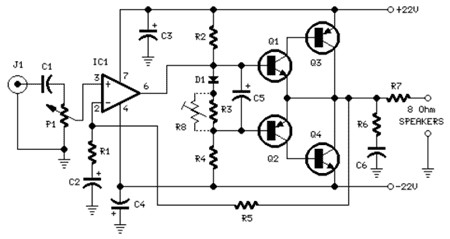
Analyse this amplifier for me please :)

Click For Summary
The amplifier design features an NE5532P op-amp for voltage amplification and a Darlington transistor output stage using TIP 121 and TIP 126. Feedback from experienced engineers highlights concerns about quiescent current, potential crossover distortion, and the need for better thermal regulation. The circuit is noted to clip at ±14.5V, raising questions about the biasing and whether it operates in class AB or class B. Suggestions include using matched transistor pairs for improved performance and simulating the circuit with LTspice for analysis. Overall, while the design has merit, it requires further refinement to address identified issues.
  • #31
What is the purpose of the 220k resistors from the op-amp's low-Z output to both supply rails ?
 
Engineering news on Phys.org
  • #32
I can easily see how it works as class B.
Nobody has actually answered by basic question. I'll ask the question another way. When the output voltage is exactly 0, what significant, controllable, current flows through the PNP and NPN final transistor's collectors to make it class AB (and not just a sloppy class B). And what, EXACTLY, sets that current?
 
  • #33
Svein said:
From your measurements, something is wrong around TIP112/TIP126. The emitter voltage should be -1.18V (the mirror image at the emitter of TIP117).

Thanks for the reply, I thought that also, I thought they were supposed to be identical just opposite polarity. But I have a stereo version of the above circuit and both channels show the same difference in voltage. -0.85 for the NPN and +1.18v for the PNP. I can't see how the circuit could influence these voltages either?? :)
 
  • #34
Baluncore said:
What is the purpose of the 220k resistors from the op-amp's low-Z output to both supply rails ?

I'll be honest, none I think. When I first started building this amp I only had basic knowledge of electronic design. I think I originally put them into set the mid-point or DC bias for the op-amp output signal. But I'm not sure they make a difference as the bias is controlled by the op-amp and its feedback.
 
  • #35
meBigGuy said:
I can easily see how it works as class B.
Nobody has actually answered by basic question. I'll ask the question another way. When the output voltage is exactly 0, what significant, controllable, current flows through the PNP and NPN final transistor's collectors to make it class AB (and not just a sloppy class B). And what, EXACTLY, sets that current?

Thanks for your reply, I have taken some current measurements, I believe the bias current is set by the 3K3 resistors connected to the emitters of the drivers.
Current measurements are in orange.
The measurements have been taken with no input signal again. :)

snipe.PNG
 
  • #36
You are correct. I didn't check the data sheets on the biasing transistors.

That makes them properly biased. It also makes for a strange current mirror using virtual grounds. A push pull current mirror with (almost) no quiescent current. Clever.
 
  • Like
Likes Gingerbunny82
  • #37
Jeff Rosenbury said:
You are correct. I didn't check the data sheets on the biasing transistors.

That makes them properly biased.
Nor did I.
 
  • Like
Likes Gingerbunny82
  • #38
meBigGuy said:
When the output voltage is exactly 0, what significant, controllable, current flows through the PNP and NPN final transistor's collectors to make it class AB (and not just a sloppy class B). And what, EXACTLY, sets that current?

with zero offset in the opamp,
I = (Vbe of biasing transistor - Vbe of final transistor )/ 0.33Ω ?
 
  • #39
Now I see one weakness with the construction. The driver transistors do not drive the output transistors, they work by stealing bias current from them.

Example: Assume that the OpAmp goes as high as possible (assume +15V). This brings the bases of TIP112/117 to +15V. This again takes the emitter of TIP112 to about +14V, causing a current through the 3.3k resistor of about 4.2mA. But as long as the base of TIP126 is more positive than the emitter, no current will pass through TIP126. On the mirror image, the emitter of TIP117 tries to go to +16.2V, drawing 0.54mA through the 3.3k resistor. This means that the output transistor (TIP121) will essentially have its base connected to +18V through a 3.3k resistor. The current through this resistor determines the output current!
 
  • #40
Svein said:
Now I see one weakness with the construction. The driver transistors do not drive the output transistors, they work by stealing bias current from them.
That is a stretch. The drivers are directly coupled emitter followers. That's it. If you want to consider that emitter followers operate in this manner then I guess that's that. You can say the same thing with a pair of diodes used to bias the outputs. Whatever is driving a pair of diodes being used for biasing is 'stealing current' from the outputs' bases as well.
 
  • #41
Here is an example of a similar audio amplifier. Observe that the current is amplified through the driver stage, not shared.
18Watt%2BAudio%2BAmplifier-Circuit%2BDiagram_thumb%5B6%5D.png
Personally, I would have added a few more components, but the principle is clear.
 
  • #42
Actually, no it is not amplified in what you call the driver stage since in order for the emitter of Q1 and Q2 to source this current it has to come through the base of Q3. This current won't be a whole heckuva lot. It will be enough to turn on Q3 and Q4. This circuit uses a current boost stage. I have seen and used this scheme in voltage regulators. Use a 2N3055 with a 7805 and you can get 10 to 15 amps out. A person can think of it this way: The emitter followers provide the voltage and the current boost transistors provide the current. Admittedly that is a very simplified and not technically correct description.

Edit: Actually the 2N3055 is an NPN and the voltage regulator scheme requires PNP. So the PNP version of the 3055 would be required.
 
Last edited:
  • #43
Svein said:
AJ8c%2Fjhw18SJGObY%2Fs1600%2F18Watt%252BAudio%252BAmplifier-Circuit%252BDiagram_thumb%255B6%255D.png
Svein said:
Here is an example of a similar audio amplifier. Observe that the current is amplified through the driver stage, not shared.
In that example, Q1 with Q3 and Q2 with Q4 form three terminal Complementary Darlington or Sziklai pairs.
Complementary Darlington transistors have lower base emitter voltages than the standard Darlington configuration that uses transistors of the same polarity. That is because saturation can allow the VBE of the two elements to overlap.
https://en.wikipedia.org/wiki/Sziklai_pair
 
  • #44
jim hardy said:
with zero offset in the opamp,
I = (Vbe of biasing transistor - Vbe of final transistor )/ 0.33Ω ?

HOORAY --- A coherent answer. And, given that answer, what determines the difference between the Vbe of those two transistors? Maybe the bias resistors have some effect. Certainly does not seem like a robust design with respect to class AB quiescent final stage current. I consider it a sloppy class B design. Some will work well, some not so well. Depends on Vbe matching of discrete devices.

As for the 220K resistors, I don't can't assign a purpose to those either.

Another quality of design issue is that the opamp is not sourcing current at 0V. I generally add a load resistor from the opamp output to the negative supply to keep the output transistor conducting. Helps with crossover distortion.

The lack of bypass on the feedback resistor has been mentioned before.

I don't have an answer for why lowering the bias resistors to 1.5K made the sound poor. I'd have to see the waveform. These transistors have internal resistors that are not on your schematic. Maybe that is part of it. ( see fig 1 in http://www.onsemi.com/pub_link/Collateral/TIP120-D.PDF )
 
  • #45
Averagesupernova said:
Actually, no it is not amplified in what you call the driver stage since in order for the emitter of Q1 and Q2 to source this current it has to come through the base of Q3. This current won't be a whole heckuva lot.
It has already been answered:
Baluncore said:
In that example, Q1 with Q3 and Q2 with Q4 form three terminal Complementary Darlington or Sziklai pairs.
Complementary Darlington transistors have lower base emitter voltages than the standard Darlington configuration that uses transistors of the same polarity. That is because saturation can allow the VBE of the two elements to overlap.
https://en.wikipedia.org/wiki/Sziklai_pair
 
  • #46
meBigGuy said:
what determines the difference between the Vbe of those two transistors?


TIP117PNP.JPG
TIP21NPN.JPG


at quiescent, perhaps their temperatures ?
Those Vbe curves are Onsemi
From TI:

TIP117Tempco.JPG
121tempco.JPG
 
Last edited:
  • #47
meBigGuy said:
HOORAY --- A coherent answer. And, given that answer, what determines the difference between the Vbe of those two transistors? Maybe the bias resistors have some effect. Certainly does not seem like a robust design with respect to class AB quiescent final stage current. I consider it a sloppy class B design. Some will work well, some not so well. Depends on Vbe matching of discrete devices.

As for the 220K resistors, I don't can't assign a purpose to those either.

Another quality of design issue is that the opamp is not sourcing current at 0V. I generally add a load resistor from the opamp output to the negative supply to keep the output transistor conducting. Helps with crossover distortion.

The lack of bypass on the feedback resistor has been mentioned before.

I don't have an answer for why lowering the bias resistors to 1.5K made the sound poor. I'd have to see the waveform. These transistors have internal resistors that are not on your schematic. Maybe that is part of it. ( see fig 1 in http://www.onsemi.com/pub_link/Collateral/TIP120-D.PDF )

- Thanks for the reply, I've removed the 220k resistors from the circuit. And added a bypass for the feedback. The Vbe of the output transistor increases as the collector current does, so the difference in Vbe between the driver and output transistors increases as the load does?
I think I understand, how does this Vbe difference affect the amplifier though? Does it cause increased excess current to flow through the output transistors?
 
  • #48
No, there is no issue with wasted current through the output transistors.

I want to focus on your first post where you asked whether this was class A or Class AB. My opinion is that it is class B, but sometimes (depending on transistor matching) it might turn out class AB. Being class B doesn't mean it will sound "horrible". It means there can be some non-linearity in the crossover region which your feedback will mostly fix. "Fix" in this case could mean reduce it to "not audible to most listeners" levels.
 
  • #49
Thanks for all your replies folks, I'll take what you all said on board - and thanks for taking the time to help me out, cheers Gingerbunny82
 
  • #50
Svein said:
  • Since there is almost no local feedback, only an overall feedback, I see a possible problem with TIM (Transient Intermodulation Distortion).
That is what struck me at once.
If you can get away with the one feedback from output back to the input as you do, that is nice, but there is a lot of circuitry inbetween. I would test trasient response with a square-wave drive to look at the leading & lagging edges. I suspect you're close to oscillation.
 
  • #52
Am I completely out of whack here? Is it a class B or a class AB?
 
  • #53
meBigGuy said:
Am I completely out of whack here? Is it a class B or a class AB?

Quiescent readings across the 0.33 ohm resistors would say which it is at the moment.
I suspect that'll change with temperature, especially if driver and output transistors aren't real close together on the heatsink.
 
  • #54
jim hardy said:
Quiescent readings across the 0.33 ohm resistors would say which it is at the moment.
I suspect that'll change with temperature, especially if driver and output transistors aren't real close together on the heatsink.

- I'm thinking it primarily operates in Class-B to be honest, the driver transistors aren't mounted on the same heatsink as the output transistors, so the output transistors get hot whilst the drivers barely get above ambient. :P

- I took a look at the output waveform on an oscilloscope, I can see a slight line in the waveform near the crossover point, very small though.

- The negative feedback must be the main reason it sounds acceptable, because if I remove any form of feedback the sound is horrific.

- It's good enough for my application though and the low quiescent power consumption of 2.5W for a stereo board is a bonus :P

I think If I was to design it again the first thing I'd do would be to replace the darlingtons with regular transistors, giving me more control over the design :)
 

Similar threads

  • · Replies 3 ·
Replies
3
Views
3K
  • · Replies 26 ·
Replies
26
Views
3K
  • · Replies 3 ·
Replies
3
Views
2K
  • · Replies 7 ·
Replies
7
Views
3K
Replies
33
Views
5K
  • · Replies 41 ·
2
Replies
41
Views
6K
  • · Replies 21 ·
Replies
21
Views
3K
  • · Replies 29 ·
Replies
29
Views
5K
  • · Replies 7 ·
Replies
7
Views
2K
Replies
7
Views
2K