Conflict Between Infinite energy levels and Valence Shells

Click For Summary

Discussion Overview

The discussion revolves around the concept of valence shells in atoms and their relationship to the infinite number of energy levels proposed by the Bohr model. Participants explore the implications of these concepts in the context of atomic structure and electron configuration.

Discussion Character

  • Conceptual clarification
  • Debate/contested
  • Homework-related

Main Points Raised

  • One participant expresses confusion about how valence shells can exist if the Bohr model suggests an infinite number of energy levels.
  • Another participant clarifies that while there are infinite energy levels, there is a finite number of electrons that fill these levels according to the aufbau principle.
  • It is noted that electrons cannot all occupy the lowest energy level due to Pauli's exclusion principle, which restricts the occupancy of quantum states.
  • A participant mentions that the Bohr model applies reasonably well to outer electrons, specifically those in the valence shell.
  • There is a discussion about the nature of energy levels in the Bohr model, emphasizing that while there are infinite levels, the energy itself is not infinite.
  • Some participants express that the explanations provided may not be effective for beginners who are encountering the Bohr model for the first time.
  • Clarifications are made regarding the terminology used, particularly the distinction between "infinite energy levels" and "infinite number of energy levels."

Areas of Agreement / Disagreement

Participants exhibit a mix of agreement and disagreement. While some clarify the concepts of energy levels and valence shells, others challenge the effectiveness of the explanations and express differing interpretations of the Bohr model.

Contextual Notes

Some participants highlight the need for clearer explanations for those new to the topic, indicating that the complexity of the concepts may lead to misunderstandings.

CGandC
Messages
326
Reaction score
34

Homework Statement


I'm having trouble understanding the existence of valence shells.

I understood that valence shell is the last energy level for the electrons to populate around an atom.

But, according to Bohr model , an atom can have infinite energy levels , so I don't understand:

How can an atom have a level , called ' valence shell ' ( which represents the last energy level for the electrons to populate an atom ) if the atom itself can have infinite energy levels ( at-least theoretically )?

Homework Equations

The Attempt at a Solution

 
Physics news on Phys.org
Hello CGC, ##\qquad## :welcome: ##\qquad## !

Here at PF it's "encouraged" that folks orient themselves and ask for help when they encounter trouble.

But I'll give you a few hints/questions:
CGandC said:
last energy level for the electrons to populate around an atom
In what order are these levels populated ?
When can the 'population process' stop ?
 
CGandC said:
according to Bohr model , an atom can have infinite energy levels

Infinite NUMBER of energy levels, not infinite energy levels.
 
BvU said:
Hello CGC, ##\qquad## :welcome: ##\qquad## !

Here at PF it's "encouraged" that folks orient themselves and ask for help when they encounter trouble.

But I'll give you a few hints/questions:
In what order are these levels populated ?
When can the 'population process' stop ?

I don't know, I'm learning chemistry for the first time that is why I'm asking.

Borek said:
Infinite NUMBER of energy levels, not infinite energy levels.

The bohr energy is quantified, as long as I can remmember then there was no limit which quantified energy level you can get to if you put enough energy to the system, so what I said is fine.
 
CGandC said:
How can an atom have a level , called ' valence shell ' ( which represents the last energy level for the electrons to populate an atom ) if the atom itself can have infinite energy levels ( at-least theoretically )?
An atom might have an infinite number of energy levels, but it doesn’t have an infinite number of electrons. In the lowest energy state, the finite number of electrons will fill the lowest energy levels. This is called the aufbau principle:
https://en.m.wikipedia.org/wiki/Aufbau_principle
So why don’t all the electrons just go into the lowest energy level and be done with it? Because electrons can’t all go into the lowest energy level. It’s a phenomenon known as Pauli’s exclusion principle:
https://en.m.wikipedia.org/wiki/Pauli_exclusion_principle
Electrons are fermions, and therefore only one electron is allowed to occupy a distinct quantum state. Based on these principles (and a few others relating to angular momentum), one can see that if an atom has 15 electrons, they will tend to occupy the 15 lowest energy orbital states. The valence orbitals are simply the highest of these low energy states that are occupied by electrons. The electrons occupying these valence orbitals are important because they are the ones that contribute most heavily to chemical bonding.
 
  • Like
Likes   Reactions: CGandC
I don't think this last answer is effective for someone who just sees the Bohr model for the first time ... :rolleyes:

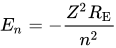
GC&C, have you seen the formula for the energies in the Bohr model ?
b27432dd0f4c6e0adfcd7bec092a24bb0d6a21ea

(formula picture: wikipedia | Bohr model | derivation )

The energies are negative (bound states -- zero or positive energy would mean a free electron, not in orbit) and there are an infinite number of them, but the energy is never infinite.

The Bohr model is restricted to looking at a single electron 'seeing' a positive charge at the origin. Meaning it applies reasonably well to an outer electron of an atom : an electron in the valence shell.
 
TeethWhitener said:
An atom might have an infinite number of energy levels, but it doesn’t have an infinite number of electrons. In the lowest energy state, the finite number of electrons will fill the lowest energy levels. This is called the aufbau principle:
https://en.m.wikipedia.org/wiki/Aufbau_principle
So why don’t all the electrons just go into the lowest energy level and be done with it? Because electrons can’t all go into the lowest energy level. It’s a phenomenon known as Pauli’s exclusion principle:
https://en.m.wikipedia.org/wiki/Pauli_exclusion_principle
Electrons are fermions, and therefore only one electron is allowed to occupy a distinct quantum state. Based on these principles (and a few others relating to angular momentum), one can see that if an atom has 15 electrons, they will tend to occupy the 15 lowest energy orbital states. The valence orbitals are simply the highest of these low energy states that are occupied by electrons. The electrons occupying these valence orbitals are important because they are the ones that contribute most heavily to chemical bonding.

This is what I needed and I understand now, thank you.

BvU said:
I don't think this last answer is effective for someone who just sees the Bohr model for the first time ... :rolleyes:

GC&C, have you seen the formula for the energies in the Bohr model ?
b27432dd0f4c6e0adfcd7bec092a24bb0d6a21ea

(formula picture: wikipedia | Bohr model | derivation )

The energies are negative (bound states -- zero or positive energy would mean a free electron, not in orbit) and there are an infinite number of them, but the energy is never infinite.

The Bohr model is restricted to looking at a single electron 'seeing' a positive charge at the origin. Meaning it applies reasonably well to an outer electron of an atom : an electron in the valence shell.

You haven't understood what I asked and I specifically wrote "## \textbf{ level } ##" which mathematically corresponds to ## n \in \mathbb{N} ## so this is just a memory refresh :biggrin: so you could recall about Bohr model .

By infinite energy levels I meant that I can have ## E_1 ## , ## E_2 ## , ... , ## E_\infty ## as the energy is quantified , I never said the energy can be infinite as if we have ## n=0 ## this situation corresponds to free electron not attached to any atom.
 
CGandC said:
I don't know, I'm learning chemistry for the first time that is why I'm asking
CGandC said:
You haven't understood what I asked
I find comfort in knowing that I am not the only one :rolleyes:
CGandC said:
infinite energy levels
Google would say: "Did you mean 'an infinite number of energy levels' ?" :wink:
CGandC said:
wrote "level " which mathematically corresponds to ## n \in \mathbb{N}##
Yes, well, this is a physics forum and an energy level corresponds to a real number (##\in \mathbb R##) times some unit of energy.
But don't let me distract you any further.
 

Similar threads

  • · Replies 2 ·
Replies
2
Views
7K
Replies
3
Views
3K
Replies
2
Views
3K
  • · Replies 1 ·
Replies
1
Views
2K
  • · Replies 2 ·
Replies
2
Views
2K
  • · Replies 10 ·
Replies
10
Views
2K
  • · Replies 2 ·
Replies
2
Views
3K
  • · Replies 2 ·
Replies
2
Views
2K
  • · Replies 15 ·
Replies
15
Views
3K
  • · Replies 35 ·
2
Replies
35
Views
4K