Confusion about combining resistors in series.

Click For Summary

Discussion Overview

The discussion revolves around the confusion regarding the combination of resistors in series and parallel configurations in an electrical circuit. Participants explore the principles of combining resistors to analyze circuit behavior, particularly focusing on a specific example from an electrical engineering textbook.

Discussion Character

  • Technical explanation
  • Conceptual clarification
  • Debate/contested

Main Points Raised

  • One participant expresses confusion about why certain resistors (4Ω and 2Ω) are not combined in the equivalent circuit after combining others (6Ω and 3Ω).
  • Another participant suggests that combining all resistors is necessary to find the total current from the battery, but keeping some resistors separate is essential for calculating voltage across specific points.
  • A third participant describes the voltage across the resistors as a potential divider, indicating that understanding this concept is crucial for circuit analysis.
  • One participant acknowledges the need to keep resistors separate for voltage calculations while confirming the ability to combine them for current calculations.
  • Another participant explains the parallel and series configurations, stating that the 6Ω and 3Ω resistors are in parallel, while the 4Ω and 2Ω resistors are in series, providing formulas for calculating equivalent resistance.

Areas of Agreement / Disagreement

Participants generally agree on the principles of combining resistors in series and parallel; however, there is some confusion and lack of consensus regarding the specific application of these principles in the given circuit example.

Contextual Notes

There are unresolved aspects regarding the application of combining resistors, particularly in the context of the specific circuit example discussed. Some assumptions about the circuit configuration and the implications of combining resistors remain unclear.

dragonkore
Messages
2
Reaction score
0
Hello, everybody.

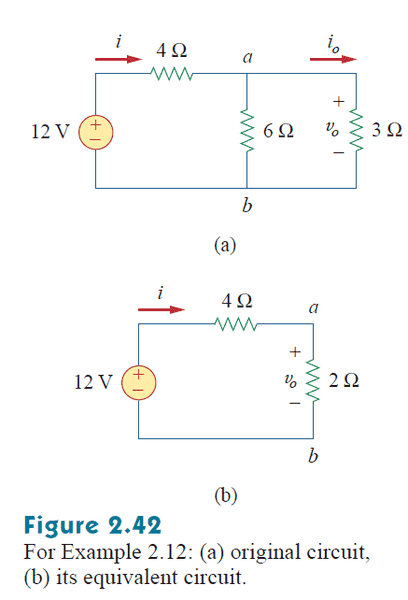
I'm reading through my EE textbook and I'm having some confusion about when to combine resistors in series. The following figure is in my book:
obFz5.png


I see that they combine the parallel resistors of 6Ω and 3Ω to make the equivalent circuit shown in 2.42b. What I'm confused about is why they didn't then combine the 4Ω and 2Ω resistors. They do this throughout the entire chapter's examples and it's causing me confusion. Resistors are considered in series if they share the same current, correct? And the two resistors in 2.42b appear to share the same current, so I don't see why they don't combine them.

Thanks for reading.

(I apologize if this is considered homework help. It seems to be more of a general circuit question.)
 
Engineering news on Phys.org
If you only wanted to get the current from the battery, you would combine all the resistors.

However, if you wanted to get the voltage across the parallel comination, then you would have to keep that resistance separate so that you could calculate the voltage.

In fact you could do both. The combined resistance is 6 ohms (4 ohms + 2 ohms) so the current is 2 amps (12 volts / 6 ohms).

So the voltage across (a) - (b) is 4 volts. (V = i * R = 2amps * 2 ohms = 4 volts)
 
The volts across ab will be 2/(4+2) of the total volts. It's a 'simple' potential divider, once you have manged to combine the 6 and 3 Ohm resistors correctly (which you have). The potential divider is one of those basic circuit elements that 'everyone' should get familiar with.
 
So you can combine all of the resistors to find the current through the circuit, but you have to leave them separated if you want to find v0. That makes sense; thanks to the both of you.


Hello,

Thank you for bringing up this confusion. It is important to understand the concept of resistors in series and parallel in order to accurately analyze circuits.

In this specific circuit, the 6Ω and 3Ω resistors are in parallel because they share the same two nodes and have the same voltage drop across them. When resistors are in parallel, the total resistance is calculated using the formula 1/Rt = 1/R1 + 1/R2. In this case, the equivalent resistance is 2Ω.

Now, the 4Ω and 2Ω resistors are in series because they are connected one after the other and have the same current flowing through them. When resistors are in series, the total resistance is simply the sum of the individual resistances. In this case, the equivalent resistance is 6Ω.

Combining these two equivalent resistances gives us the final equivalent resistance of 8Ω. So, in this case, the resistors are not combined because they are already in their respective equivalent forms.

I hope this helps clarify your confusion. If you have any further questions, please feel free to ask. It is always important to fully understand the concepts in order to accurately analyze and design circuits.

Best,
 

Similar threads

Replies
3
Views
2K
  • · Replies 7 ·
Replies
7
Views
2K
Replies
68
Views
7K
  • · Replies 9 ·
Replies
9
Views
3K
  • · Replies 3 ·
Replies
3
Views
939
  • · Replies 17 ·
Replies
17
Views
2K
  • · Replies 10 ·
Replies
10
Views
5K
  • · Replies 3 ·
Replies
3
Views
2K
  • · Replies 4 ·
Replies
4
Views
3K
  • · Replies 10 ·
Replies
10
Views
4K