DC12V 12A car window motor - what spec for a 220V PSU?
- Thread starter marcophys
- Start date
Join the discussion
Registration is free. Start your own thread to ask a follow-up.
136 replies · 23K views
Engineering news on Phys.org
Science Advisor
Homework Helper
Dearly Missed
- 9,864
- 4,896
That TomG is a very clever fellow.marcophys said:Therefore, at this moment in time, it may be possible for those of you with the theoretical knowledge to consider a suitable replacement.
I'm still trying to figure out just what his lamp did to alleviate the humming.
Come to think of it,
our thyristor relay drivers in the plant had resistors across their output... i'd forgotten that.
Your DC readings look great by the way.
Nice project, glad you're having fun..
marcophys
- 152
- 20
Yes, TBH I was thinking about a resistor bridging the dimmed output (resistive load).
100W or 40W lamp seemed to make no difference.
Perhaps if the wattage reduced significantly... I think that I have an 8W lamp - or used to have, as it hasn't turned up (and I've been looking).
Or perhaps it simply requires a resistive load, regardless of it's resistance.
The ideal place to locate a small component, from a topology perspective, would be in the MK socket outlet.
The question - is it possible vis a vis heat?
It's a metal enclosure, with sufficient space for careful routing of the cables.
If it is considered possible... what might be a suitable resistance range, to place between the dimmed live and neutral?
100W or 40W lamp seemed to make no difference.
Perhaps if the wattage reduced significantly... I think that I have an 8W lamp - or used to have, as it hasn't turned up (and I've been looking).
Or perhaps it simply requires a resistive load, regardless of it's resistance.
The ideal place to locate a small component, from a topology perspective, would be in the MK socket outlet.
The question - is it possible vis a vis heat?
It's a metal enclosure, with sufficient space for careful routing of the cables.
If it is considered possible... what might be a suitable resistance range, to place between the dimmed live and neutral?
marcophys
- 152
- 20
Just reading up on resistors:
It seems that I would need one rated at 400v.
If:
Current I = V/R 240/1000 = 0.24 Amps
Power consumed P = I2R = 0.242 x 1000 = 57.6 W
Is this correct?
I wonder if the resistance could be even higher - I don't understand the mathematical relationship between the resistive load, and the disharmony in the dimmed AC supply.
It seems that I would need one rated at 400v.
If:
Current I = V/R 240/1000 = 0.24 Amps
Power consumed P = I2R = 0.242 x 1000 = 57.6 W
10K Ω would consume 5.76 Watts.
100k Ω would consume 0.576 Watts
100k Ω would consume 0.576 Watts
Is this correct?
I wonder if the resistance could be even higher - I don't understand the mathematical relationship between the resistive load, and the disharmony in the dimmed AC supply.
Science Advisor
Homework Helper
Dearly Missed
- 9,864
- 4,896
Aha i remember now.
It's "holding current" for the thyristor.
Holding current is the minimum current required to hold a thyristor in its conducting state. It will be tens of milliamps.
When current drops below that amount it will turn back off unless there's still a gate signal applied.
.
This is a basic lamp dimmer
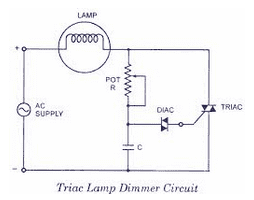
(Triac is the name for a bidirectional thyristor)Capacitor C delivers a brief firing pulse to the Triac's gate terminal .
Load current through the lamp must rise to Triac's "holding current" before the end of that firing pulse.
Inductive load like a motor will postpone rise of load current because of its inductance. So the triac might turn back off .
Resistive load does not postpone current rise. So some resistance in parallel with your transformer primary will help assure reliable turn-on of the Triac.
I suspect that's what was happening when you saw those 1.3 volt DC readings, Triac misfires.
More detail here
http://www.st.com/content/ccc/resou...df/jcr:content/translations/en.CD00003853.pdf
and here http://www.st.com/content/ccc/resou...df/jcr:content/translations/en.CD00003867.pdf
and here's a datasheet for a 4 amp Triac you might well find in a lamp dimmer:
http://www.st.com/content/ccc/resou...df/jcr:content/translations/en.CD00002887.pdf
Its holding current is just 15 milliamps. I'd think a 50 milliamp lamp might work , that'd be only about ten watts? An outdoor Christmas tree lamp? You could hide that inside the battery charger.
What does @Tom.G think ?
old jim
It's "holding current" for the thyristor.
Holding current is the minimum current required to hold a thyristor in its conducting state. It will be tens of milliamps.
When current drops below that amount it will turn back off unless there's still a gate signal applied.
.
This is a basic lamp dimmer
(Triac is the name for a bidirectional thyristor)Capacitor C delivers a brief firing pulse to the Triac's gate terminal .
Load current through the lamp must rise to Triac's "holding current" before the end of that firing pulse.
Inductive load like a motor will postpone rise of load current because of its inductance. So the triac might turn back off .
Resistive load does not postpone current rise. So some resistance in parallel with your transformer primary will help assure reliable turn-on of the Triac.
I suspect that's what was happening when you saw those 1.3 volt DC readings, Triac misfires.
More detail here
http://www.st.com/content/ccc/resou...df/jcr:content/translations/en.CD00003853.pdf
and here http://www.st.com/content/ccc/resou...df/jcr:content/translations/en.CD00003867.pdf
and here's a datasheet for a 4 amp Triac you might well find in a lamp dimmer:
http://www.st.com/content/ccc/resou...df/jcr:content/translations/en.CD00002887.pdf
Its holding current is just 15 milliamps. I'd think a 50 milliamp lamp might work , that'd be only about ten watts? An outdoor Christmas tree lamp? You could hide that inside the battery charger.
What does @Tom.G think ?
old jim
Last edited:
Science Advisor
Gold Member
- 5,661
- 4,509
Science Advisor
Homework Helper
Dearly Missed
- 9,864
- 4,896
Thanks Tom.
Hmm an automotive lamp on the 12 volt side, in parallel with the motor, might work. I think a brake light is about 25 watts ?
1156 is single filament, 1157 is dual one about 6 watts for taillight one about 26. for brake ..
At reduced voltage they last a long time.
Hmm an automotive lamp on the 12 volt side, in parallel with the motor, might work. I think a brake light is about 25 watts ?
1156 is single filament, 1157 is dual one about 6 watts for taillight one about 26. for brake ..
At reduced voltage they last a long time.
marcophys
- 152
- 20
Great.
Two lamps in the battery charger enclosure would indicate that it was on!
However, I am interested to understand the difference between a lamp filament, and a resistor.
IE. is the resistor idea wrong?
The reason being that I don't have a small 240V lamp.
Neither do I have the resistors.
It is looking like we have arrived at that point in the project where something must be bought
So I can source a lamp and select it as small as possible (for easy location).
Or I can source the required resistors.
The dimmed mains supply
@ slow motor rotation = circa 117V AC
@ maximum output = 193V AC
Therefore the operating AC voltage range will be approximately 115V - 130V
The DC voltage
At the motor is in the 2V - 3V range.
At the transformer it is 3V - 4V range
(It's dropping 1V conveniently)
From this we could estimate the resistors required, or suitable lamps from what is available.
The resistors being easier to specify - If they would work as well as the lamps.
Also, they could be installed very easily into the system.
They might also have less likelihood of failure.
The lamps aren't a major problem, but resistors seem to offer a path worth examining.
Obviously if they can't work, I'll simply research the lamps.
Two lamps in the battery charger enclosure would indicate that it was on!
However, I am interested to understand the difference between a lamp filament, and a resistor.
IE. is the resistor idea wrong?
The reason being that I don't have a small 240V lamp.
Neither do I have the resistors.
It is looking like we have arrived at that point in the project where something must be bought
So I can source a lamp and select it as small as possible (for easy location).
Or I can source the required resistors.
The dimmed mains supply
@ slow motor rotation = circa 117V AC
@ maximum output = 193V AC
Therefore the operating AC voltage range will be approximately 115V - 130V
The DC voltage
At the motor is in the 2V - 3V range.
At the transformer it is 3V - 4V range
(It's dropping 1V conveniently)
From this we could estimate the resistors required, or suitable lamps from what is available.
The resistors being easier to specify - If they would work as well as the lamps.
Also, they could be installed very easily into the system.
They might also have less likelihood of failure.
The lamps aren't a major problem, but resistors seem to offer a path worth examining.
Obviously if they can't work, I'll simply research the lamps.
Science Advisor
Homework Helper
Dearly Missed
- 9,864
- 4,896
I had thought the lamps would be a lot easier to acquire. Here every Walmart and auto parts store has lamps and sockets on the shelf , resistors one has to order.
A lamp filament is just a resistor. But since resistance in most substances is a function of temperature, and since the filament goes from room temperature to maybe 4,500 degF, there's quite a resistance change.
Resistance cold is typically 1/10th what it is hot.
That can be a handy characteristic to use . It'll help your thyristor meet holding current.
You know that a 40 watt lamp worked okay. Can you try a 20 ?
Power = E2 / R
a 40 watt 230 volt lamp is nominally
40 = 2302 / R so R = 1322 ohms , probably somewhat less at your 130 volts.
20 watts would be twice that many of course.
A 40 watt resistor will cost a lot more than a light bulb.
I only leapt at automotive lamps because they're so ubiquitous. Spend a few minutes in a hardware store perusing bulbs and sockets.
There exist small halogen 6 and 12 volt bulbs for outdoor, undercounter and reading lamps , from just a few to 100 watts. I use them for troubleshooting car electrical problems. A dead lamp salvaged from a thrift shop will provide a socket .
On the low side of your transformer you'd divide those ohms above by square of the turns ratio. 240V in 12V out is ratio of about 20...
1322 / 202 = about 3.3 ohms
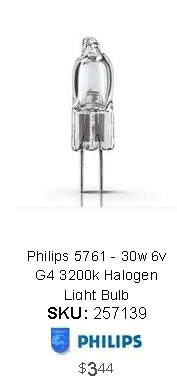
6 volt 30 watts ? 36/30 is only ~1.2 ohm, sounds low and might blow if dimmer ever got turned all the way up.
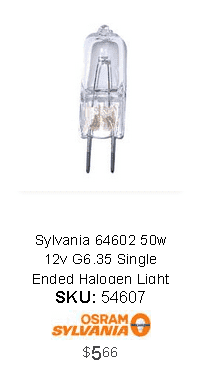
12 volts 50 watts 144/50 = 2.9 ohms , not bad...
At your 3 volts or so it'll just glow orange.
You already figured out how to calculate resistance and power. There's how to figure your resistance for the high and low sides.
.
Keep on experimenting. Lamps are good for a cheap power resistor where you don't need precision.
have fun, foremost.
old jim
A lamp filament is just a resistor. But since resistance in most substances is a function of temperature, and since the filament goes from room temperature to maybe 4,500 degF, there's quite a resistance change.
Resistance cold is typically 1/10th what it is hot.
That can be a handy characteristic to use . It'll help your thyristor meet holding current.
You know that a 40 watt lamp worked okay. Can you try a 20 ?
Power = E2 / R
a 40 watt 230 volt lamp is nominally
40 = 2302 / R so R = 1322 ohms , probably somewhat less at your 130 volts.
20 watts would be twice that many of course.
A 40 watt resistor will cost a lot more than a light bulb.
I only leapt at automotive lamps because they're so ubiquitous. Spend a few minutes in a hardware store perusing bulbs and sockets.
There exist small halogen 6 and 12 volt bulbs for outdoor, undercounter and reading lamps , from just a few to 100 watts. I use them for troubleshooting car electrical problems. A dead lamp salvaged from a thrift shop will provide a socket .
On the low side of your transformer you'd divide those ohms above by square of the turns ratio. 240V in 12V out is ratio of about 20...
1322 / 202 = about 3.3 ohms
6 volt 30 watts ? 36/30 is only ~1.2 ohm, sounds low and might blow if dimmer ever got turned all the way up.
12 volts 50 watts 144/50 = 2.9 ohms , not bad...
At your 3 volts or so it'll just glow orange.
You already figured out how to calculate resistance and power. There's how to figure your resistance for the high and low sides.
.
Keep on experimenting. Lamps are good for a cheap power resistor where you don't need precision.
have fun, foremost.
old jim
marcophys
- 152
- 20
Thanks Jim!
Yes... development engineering is most definitely fun.
Fine to take a drawing and bring it to life... that hits a different pleasure receptor.
... but creating something, and solving the problems that are encountered, is simply unbeatable.
The final stages are upon us.
The turntable and control system is now operational.
We are left only with the desire to develop the parallel resistance, to improve the package.
On this matter... I am re-examining the concept of 'modding' the transformer.
... by placing the resistance loads in association with the input control system, and the output to the motor.
This will leave the battery charger untouched.
Applying a lamp to the DC side seems to make no difference whatsoever.
I tried using a 24V 50mA lamp.
It glowed.
Yes... development engineering is most definitely fun.
Fine to take a drawing and bring it to life... that hits a different pleasure receptor.
... but creating something, and solving the problems that are encountered, is simply unbeatable.
The final stages are upon us.
The turntable and control system is now operational.
We are left only with the desire to develop the parallel resistance, to improve the package.
On this matter... I am re-examining the concept of 'modding' the transformer.
... by placing the resistance loads in association with the input control system, and the output to the motor.
This will leave the battery charger untouched.
Applying a lamp to the DC side seems to make no difference whatsoever.
I tried using a 24V 50mA lamp.
It glowed.
Science Advisor
Homework Helper
Dearly Missed
- 9,864
- 4,896
That's only 2.5 ma at the primary where the dimmer is.marcophys said:I tried using a 24V 50mA lamp.
Transformer steps primary voltage DOWN from 230-ish to 12, and current UP from 2.5 ma to 50 ma.
You'll need a 12 volt two to four amp lamp..
Wattage comparable to what works on primary side.
Can you borrow one from an automobile? Brake, turn signal or headlamp ? Dome light won't do.
Don't despair , this is Edison's '99% perspiration' complement to his '1% inspiration' .
Mother Nature likes to see us sweat.
old jim
Asymptotic
- 781
- 529
Difficult to be certain, but 5A may be 'just right', or perhaps even too high. Problem is, the motor was designed for low duty cycle, intermittent operation from a DC battery source, and has been re-purposed to serve in a high duty cycle design fed from a rectified power source. Ultimately, both fuse elements and motor windings fail due to excessive heating, and for sustained overload protection the trick is to select a fuse that will clear before motor windings are damaged. Off-the-shelf, general purpose, continuous duty motors are typically rated for a 40°C temperature rise. You'll probably be OK by closely monitoring motor heating until you are comfortable it isn't about to become a flambé.marcophys said:I can get the speed down to 29 rpm @ 5.3V 4.7A (using the slow charge switch on the charger).
35 rpm @ 6V 5.1A (using fast charge switch)
(It looks like that 5A fuse is too light)
I haven't looked up the clearing curve for a BS 1362, 5A fuse, but came across this interesting article comparing 3 amp and 13 amp fuses, and learned a 3A fuse will hold on indefinitely at 4.5 amps. My guess is for a 5A fuse it'll be on the order of 7.5 amps.
I vaguely recall IEC standards having something similar, but NEMA DC motor ratings include a "power code". Power code A is battery powered (PWM output is between A and C, although close to A than C), code C (nearly all the motors I worked with were code C) is DC derived from a full wave bridge, and code D is rectified DC from a half wave bridge. One way to overheat a DC motor is to feed it voltage with an 'uglier' waveform that what it was designed for. For example, I've seen FHP (fractional horsepower) motors cook when their drives lost an SCR, and effectively morphed from code C to code D.
Given this, my guess is part of your motor heating is a consequence of the supply waveform. If you have a largish (in the 100 to 330 uF range) electrolytic capacitor handy, temporarily clip it across the battery charger output, and see what happens. The motor ought to run cooler, and provide smoother low speed operation.
It looks like your project is coming along nicely. Kudos.
Science Advisor
Gold Member
- 5,661
- 4,509
Hey guys, after sleeping on it I realized the added resistive load must at least equal, preferably exceed, the inductive load; and will probably be more effective when connected to the dimmer. What say @jim hardy , how much must the resistive load exceed the inductive load to keep the TRIAC on? Taking account of both phase shift (power factor) and leakage inductance of a very low cost transformer
If put on the xformer secondary there is still the leakage inductance etc. on the primary side. If put across the motor (after the rectifier), there is the additional problem of not being connected around zero crossing. Those may be enough to upset the dimmer.
Yea, the above is weasel-worded. That's because I've never tried the resistive load on the secondary and would be interested in the result. On the primary we know it works. If you care to teach all of us, try it on the secondary and enlighten us. (Some oscilloscope traces would be nice if you have access.) If you just want to get the project done, keep the resistance on the primary.
If put on the xformer secondary there is still the leakage inductance etc. on the primary side. If put across the motor (after the rectifier), there is the additional problem of not being connected around zero crossing. Those may be enough to upset the dimmer.
Yea, the above is weasel-worded. That's because I've never tried the resistive load on the secondary and would be interested in the result. On the primary we know it works. If you care to teach all of us, try it on the secondary and enlighten us. (Some oscilloscope traces would be nice if you have access.) If you just want to get the project done, keep the resistance on the primary.
Science Advisor
Homework Helper
Dearly Missed
- 9,864
- 4,896
All above is true.Tom.G said:how much must the resistive load exceed the inductive load to keep the TRIAC on? Taking account of both phase shift (power factor) and leakage inductance of a very low cost transformer
If put on the xformer secondary there is still the leakage inductance etc. on the primary side. If put across the motor (after the rectifier), there is the additional problem of not being connected around zero crossing. Those may be enough to upset the dimmer.
Resistive load need only pass holding current of triac at end of trigger pulse
and since we don't know what is value of that holding current or duration of trigger it'll have to be found by experiment what size lamp does the job.
He has an advantage in not needing full AC voltage, that's easier on the transformer (remember volt-seconds and saturation) .
Trial and error is the approach for this one. See if a 40 watt 12 V lamp on secondary behave noticeably different from a 40watt 240 volt lamp on primary ?
To avoid rectifier drop he could connect it here
old jim
Last edited:
marcophys
- 152
- 20
Pauses in development are useful.
They are usually caused by external forces, but in fact they are anyway required.
I must clear up something else tomorrow, and then I'll get back on this.
I'll implement the fuse as suggested, and then look again at resistive loads.
I have the typical 240V lamps and 12V auto lamps.
Thanks for the considered thoughts.
They are usually caused by external forces, but in fact they are anyway required.
I must clear up something else tomorrow, and then I'll get back on this.
I'll implement the fuse as suggested, and then look again at resistive loads.
I have the typical 240V lamps and 12V auto lamps.
Thanks for the considered thoughts.
marcophys
- 152
- 20
Asymptotic said:I haven't looked up the clearing curve for a BS 1362, 5A fuse, but came across this interesting article comparing 3 amp and 13 amp fuses, and learned a 3A fuse will hold on indefinitely at 4.5 amps. My guess is for a 5A fuse it'll be on the order of 7.5 amps.
Okay, the 5A is implemented

Asymptotic said:Given this, my guess is part of your motor heating is a consequence of the supply waveform. If you have a largish (in the 100 to 330 uF range) electrolytic capacitor handy, temporarily clip it across the battery charger output, and see what happens. The motor ought to run cooler, and provide smoother low speed operation.
Found a 330 µF 25v capacitor on the PC PSU board.
It was difficult to desolder.
The solder cooled instantly before the solder pump could work

... but got it out.
330 µF 25v capacitor across DC output
This had a similar noise reduction effect to the lamp across the dimmed mains supply.
IE. buzzing reduction
I then added the 40 watt lamp to the dimmed mains suppy.
The noise reduced even further.
It was already only a slight hum with the lamp (as per video), but clearly, both primary and secondary sides can be cleaned up.
However - having just wired it in the capacitor 'popped'!
So it failed.
This renders some of the questions (below) irrelevant at this time.
Q. Capacitor safety?
When removing the capacitor... should I simply short the two connectors across metal?
It sparks of course.
... but is that the correct procedure?
Q. Is the capacitor the superior option to Jim's concept of the lamp?
IE. should I solder it internally, and will it be fine for normal battery charging use?
Q. If the capacitor option works on the secondary side, should it be considered for the primary?
I have a large range of capacitors of varying voltages etc.
Last edited:
marcophys
- 152
- 20
Further thoughts... and note that the capacitor failed in the edit above.
Transformer Sound Clarification
With the ear on the transformer chassis:
When powered by standard mains supply
The transformer hums.
In addition: there is also an inconsistent minor ticking
When powered by dimmed mains supply
The transformer hums.
In addition: there is also a 'fast' consistent ticking - 'loudest volume'
When the lamp is applied, the ticking 'slows' - noise volume reduces
There appeared to be a similar effect with the capacitor, but I had no time to reconfirm before it failed.
While awaiting thoughts on the capacitor... I will test Jim's idea of a 40 watt lamp across the DC output.
Result
If the primary has no lamp in parallel... there is a reduction in the transformer ticking.
However... when a 40 watt lamp is across the primary
... placing another 40 watt lamp across the secondary makes no difference.
I think that an oscilloscope would be really useful for these tests.
Hopefully though, the results might enlighten.
The fact is that the lamp and capacitor had a noise/ticking reduction effect and
the lamp and lamp didn't.
Transformer Sound Clarification
With the ear on the transformer chassis:
When powered by standard mains supply
The transformer hums.
In addition: there is also an inconsistent minor ticking
When powered by dimmed mains supply
The transformer hums.
In addition: there is also a 'fast' consistent ticking - 'loudest volume'
When the lamp is applied, the ticking 'slows' - noise volume reduces
There appeared to be a similar effect with the capacitor, but I had no time to reconfirm before it failed.
While awaiting thoughts on the capacitor... I will test Jim's idea of a 40 watt lamp across the DC output.
Result
If the primary has no lamp in parallel... there is a reduction in the transformer ticking.
However... when a 40 watt lamp is across the primary
... placing another 40 watt lamp across the secondary makes no difference.
I think that an oscilloscope would be really useful for these tests.
Hopefully though, the results might enlighten.
The fact is that the lamp and capacitor had a noise/ticking reduction effect and
the lamp and lamp didn't.
Last edited:
marcophys
- 152
- 20
Notes on the popped capacitor
LTEC LZG 105 deg PET 8628D
http://www.compostar.com/Ltec/LZG.pdf
It had seen use in a PC PSU.
The top was flat when tried.
I'm wondering if I could have damaged it during soldering.
I'll look for an alternative.
LTEC LZG 105 deg PET 8628D
http://www.compostar.com/Ltec/LZG.pdf
It had seen use in a PC PSU.
The top was flat when tried.
I'm wondering if I could have damaged it during soldering.
I'll look for an alternative.
marcophys
- 152
- 20
SAMXON 680 µF 200v LP (M) 85 deg (has polarity)
This was a major success vis a vis visible effect.
Test Method - Lamp & Capacitor
With 40 watt lamp across the primary
The motor was slowed to the absolute minimum.
If stopped... the motor could just restart.
The capacitor was placed across the DC output... the vibrating hum noise of the motor subsided to just a hum.
IE. the motor sounded better.
Without the 40 watt lamp and without the capacitor
The motor would not start.
The capacitor was placed across the DC output... the motor started.
Conclusion
Having a capacitor across the DC motor supply allows the motor to run better!
The SAMXON capacitor (22mm D x 41mm L) is physically much larger than the LTEC capacitor (8mm D x 16mm L).
It is 200v compared to 25v.
Also it has polarity.
The LTEC capacitor got hot.
The SAMXON capacitor remained cool.
Test Method - Lamp & Lamp
The same as above.
The primary lamp was removed... the motor would not start.
The secondary lamp was applied... the motor would not start.
To confirm... the capacitor was applied... the motor started.
Therefore it appears that the 40 watt lamp across the secondary, has no effect.
Whereas the capacitor across the secondary has a strong positive effect.
Questions
Was the choice of lamp incorrect... or is it simply the case that the capacitor provides the correct solution?
Is there any reason to test different capacitors... or has the objective been achieved?
This was a major success vis a vis visible effect.
Test Method - Lamp & Capacitor
With 40 watt lamp across the primary
The motor was slowed to the absolute minimum.
If stopped... the motor could just restart.
The capacitor was placed across the DC output... the vibrating hum noise of the motor subsided to just a hum.
IE. the motor sounded better.
Without the 40 watt lamp and without the capacitor
The motor would not start.
The capacitor was placed across the DC output... the motor started.
Conclusion
Having a capacitor across the DC motor supply allows the motor to run better!
The SAMXON capacitor (22mm D x 41mm L) is physically much larger than the LTEC capacitor (8mm D x 16mm L).
It is 200v compared to 25v.
Also it has polarity.
The LTEC capacitor got hot.
The SAMXON capacitor remained cool.
Test Method - Lamp & Lamp
The same as above.
The primary lamp was removed... the motor would not start.
The secondary lamp was applied... the motor would not start.
To confirm... the capacitor was applied... the motor started.
Therefore it appears that the 40 watt lamp across the secondary, has no effect.
Whereas the capacitor across the secondary has a strong positive effect.
Questions
Was the choice of lamp incorrect... or is it simply the case that the capacitor provides the correct solution?
Is there any reason to test different capacitors... or has the objective been achieved?
Science Advisor
Homework Helper
Dearly Missed
- 9,864
- 4,896
I'd say your capacitor works.
When the triac "fires" it injects a large and brief pulse of current into the capacitor to replace the charge that the motor consumed since last charging interval in the immediately previous sine wave.
. Short but intense bursts of current have high heating value, look up "Crest Factor RMS" .
Here's first hit i got and it's a pretty good explanation.
http://www.programmablepower.com/support/FAQs/DF_Crest_Factor.pdf
I suspect the "Ripple Current Rating" of your small capacitor was exceeded and that's why it got hot.
Keep an eye on the bigger one's temperature for a while. If it stays cool you're fine.
This is how we learn !
old jim
Feel the new one for heatingmarcophys said:The LTEC capacitor got hot.
When the triac "fires" it injects a large and brief pulse of current into the capacitor to replace the charge that the motor consumed since last charging interval in the immediately previous sine wave.
. Short but intense bursts of current have high heating value, look up "Crest Factor RMS" .
Here's first hit i got and it's a pretty good explanation.
http://www.programmablepower.com/support/FAQs/DF_Crest_Factor.pdf
I suspect the "Ripple Current Rating" of your small capacitor was exceeded and that's why it got hot.
Keep an eye on the bigger one's temperature for a while. If it stays cool you're fine.
This is how we learn !
old jim
marcophys
- 152
- 20
Final test of this session
Confirm the need for the dimmed mains supply 'solution'.
With the capacitor wired in parallel with the DC output & the 40 watt lamp in parallel with the dimmed mains supply ...
... the motor was slowed to absolute minimum, yet could be stopped and started.
By removing the lamp... the motor would not start.
The test was repeated.
With the lamp... the motor would start.
Without the lamp... the motor would not start.
Conclusion
A solution is required for both the AC supply to the transformer, AND the DC supply to the motor.
Notes
I note that Jim concurs that the capacitor is the correct solution for the transformer DC output.
The capacitor seems to remain very cool - no apparent change in temperature.
I have justed tested the minimum rpm... 8 rpm.
It is the lowest yet recorded!
When you think we started with the lowest rpm at 54 rpm.
... we now have fingertip control down to 8 rpm
What Next?
Here's the 'motor speed control panel':
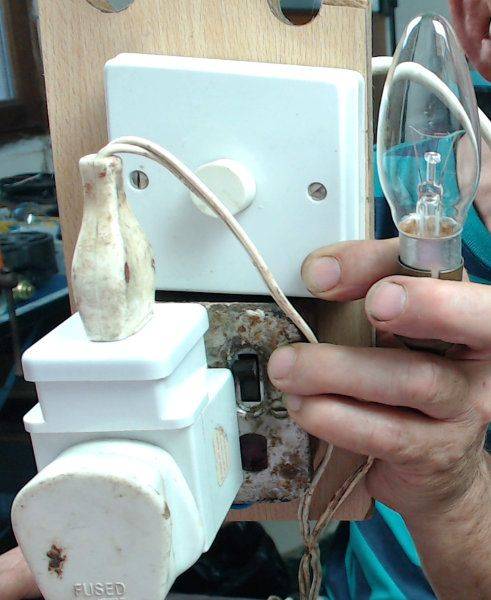
For test purposes, a two way adaptor allowed a two pin socket to be placed in parallel with the dimmed mains supply.
This was an excellent solution.
The lamp holder, cable, and plug are ancient (and filthy)... but they worked perfectly, and provided a constant for all the tests that followed.
To test with, or without the lamp... the lamp plug could be easily inserted or withdrawn.
It seems that, while we can love the lamp solution because it works (and has character)... can it be replaced with something more robust?
A smaller lamp could be found, and mounted in the transformer to provide a protected environment.
... but I'm thinking that it does not provide closure.
Clearly, running at 130 volts AC it is unlikely to fail.
However, there must be a replacement that is more suitable.
I think that it is worth trying because, we no longer need to have the option for insertion and withdrawal.
It's the final leg of the development process.
However... if the lamp concept proves to be the best... perhaps an oven lamp is the ideal option:
http://www.ebay.co.uk/itm/2-x-25w-240v-Clear-300-Degree-High-Temperature-Oven-Lamp-SES-E14-Light-Bulb/401347623192
14mm screw thread and the lamp is short and narrow.
It appears to be one of the smallest 240v bulbs available.
Confirm the need for the dimmed mains supply 'solution'.
With the capacitor wired in parallel with the DC output & the 40 watt lamp in parallel with the dimmed mains supply ...
... the motor was slowed to absolute minimum, yet could be stopped and started.
By removing the lamp... the motor would not start.
The test was repeated.
With the lamp... the motor would start.
Without the lamp... the motor would not start.
Conclusion
A solution is required for both the AC supply to the transformer, AND the DC supply to the motor.
Notes
I note that Jim concurs that the capacitor is the correct solution for the transformer DC output.
The capacitor seems to remain very cool - no apparent change in temperature.
I have justed tested the minimum rpm... 8 rpm.
It is the lowest yet recorded!
When you think we started with the lowest rpm at 54 rpm.
... we now have fingertip control down to 8 rpm
What Next?
Here's the 'motor speed control panel':
For test purposes, a two way adaptor allowed a two pin socket to be placed in parallel with the dimmed mains supply.
This was an excellent solution.
The lamp holder, cable, and plug are ancient (and filthy)... but they worked perfectly, and provided a constant for all the tests that followed.
To test with, or without the lamp... the lamp plug could be easily inserted or withdrawn.
It seems that, while we can love the lamp solution because it works (and has character)... can it be replaced with something more robust?
A smaller lamp could be found, and mounted in the transformer to provide a protected environment.
... but I'm thinking that it does not provide closure.
Clearly, running at 130 volts AC it is unlikely to fail.
However, there must be a replacement that is more suitable.
I think that it is worth trying because, we no longer need to have the option for insertion and withdrawal.
It's the final leg of the development process.
However... if the lamp concept proves to be the best... perhaps an oven lamp is the ideal option:
http://www.ebay.co.uk/itm/2-x-25w-240v-Clear-300-Degree-High-Temperature-Oven-Lamp-SES-E14-Light-Bulb/401347623192
14mm screw thread and the lamp is short and narrow.
It appears to be one of the smallest 240v bulbs available.
Last edited:
Asymptotic
- 781
- 529
Whoops. I ought to have mentioned the same waveform ugliness the capacitor helps to filter from DC output necessitates a higher voltage rated capacitor than what one might at first expect. @jim hardy pointed out the culprit is crest factor, which can be thought of as a measure of the ugliness of an AC waveform.
Shorting poses two problems - 1. very rapid discharge rate doesn't do a capacitor any favors in terms of longevity, and 2. particularly true of capacitors used in larger equipment, enough energy is stored to melt terminals and screwdriver tip, and splash molten metal about. For cap discharging, a useful piece of kit is an insulated 50 ohm, 50W resistor with leads and alligator clips soldered to it.marcophys said:Q. Capacitor safety?
When removing the capacitor... should I simply short the two connectors across metal?
It sparks of course.
... but is that the correct procedure?
I wouldn't say either is superior to the other. Using a lamp (resistor) and capacitor in tandem should yield better results than either one alone, since each of them are attacking different aspects of the problem of low speed control quality.marcophys said:Q. Is the capacitor the superior option to Jim's concept of the lamp?
IE. should I solder it internally, and will it be fine for normal battery charging use?
marcophys
- 152
- 20
Yes... that halogen lamp is even smaller, and would sit rigid between solid cores :)
Alternative to the lamp concept
CGS HSA50 1.8k Ω resistor
Typically used as demister heating elements in camera housings, beneath the glass face of the housing.
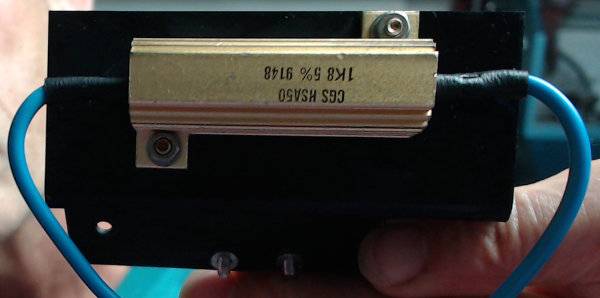
I do believe that somewhere I have a spare.
Annoyingly, I had to raid this one from a perfectly good housing
... but they are readily available if another is needed.
I calculate that @ 130V it is consuming 9.4 watts 0.072 amps
I believe that the 40 watt lamp at 130V is consuming 11.7 watts 0.09 amps
Therefore very similar.
I wired it to another two pin plug; allowing a perfect test comparison with the lamp.
Result
It does the same job.
Both start and turn the motor at slowest speed.
The advantage is that it can be easily and securely mounted to the chassis, which in turn will dissipate the generated heat.
It would appear that this is the correct solution.
----------------------------
Wow!
I think that's it.
What a journey - started in complete confidence that we would arrive
.. I had to, just now, load the first post.
All we had was a window winder motor as the core element, and a concept.
Everything was then fabricated from what I could find.
Nothing was purchased (saving weeks of time).
18 days, from start to finish.
... and the turntable is entirely functional, and safe.
It lacks nothing of importance... the talk of a tachometer was just talk... it's not needed.
It is a serious 'working product'.
Either way... It was a great team effort.
... and it is all documented.
Hopefully it will help the next generation.
Sincere thanks to all contributors... it's a shared victory, and it was a pleasure.
Alternative to the lamp concept
CGS HSA50 1.8k Ω resistor
Typically used as demister heating elements in camera housings, beneath the glass face of the housing.
I do believe that somewhere I have a spare.
Annoyingly, I had to raid this one from a perfectly good housing
... but they are readily available if another is needed.
I calculate that @ 130V it is consuming 9.4 watts 0.072 amps
I believe that the 40 watt lamp at 130V is consuming 11.7 watts 0.09 amps
Therefore very similar.
I wired it to another two pin plug; allowing a perfect test comparison with the lamp.
Result
It does the same job.
Both start and turn the motor at slowest speed.
The advantage is that it can be easily and securely mounted to the chassis, which in turn will dissipate the generated heat.
It would appear that this is the correct solution.
----------------------------
Wow!
I think that's it.
What a journey - started in complete confidence that we would arrive
.. I had to, just now, load the first post.
All we had was a window winder motor as the core element, and a concept.
Everything was then fabricated from what I could find.
Nothing was purchased (saving weeks of time).
18 days, from start to finish.
... and the turntable is entirely functional, and safe.
It lacks nothing of importance... the talk of a tachometer was just talk... it's not needed.
It is a serious 'working product'.
Wouldn't it be nice if the banks would support engineers?
The chances of them funding a stock purchase of base engine components is slim to nonexistent.
The chances of them funding a stock purchase of base engine components is slim to nonexistent.
Either way... It was a great team effort.
... and it is all documented.
Hopefully it will help the next generation.
Sincere thanks to all contributors... it's a shared victory, and it was a pleasure.
Asymptotic
- 781
- 529
I don't know why, either.jim hardy said:I actually like the combination though i don't quite understand why it works so well .
View attachment 207884
old jim
1970's era Reliance Electric MaxPak engineered DC drives had a resistor (12K/25W springs to mind, but it could have been something else) wired across the S-6 bridge upstream from a definite purpose (DC) contactor. Don't recall seeing them in later iterations (MaxPak Plus), or used by other drive manufacturers, and don't know for sure why one was used in the older design. My guess is it acted as a minimum load to prevent armature feedback voltage from reading high due to normal SCR leakage current after the motor armature was switched out of circuit by the DP contactor.
The 12K resistor didn't provide enough load to scope SCR operation without a motor connected (although a series pair of 240V/500W tubular heaters worked a treat) so that wasn't its purpose.
Asymptotic
- 781
- 529
This 50W wire wound resistor ought to work just fine ...marcophys said:Yes... that halogen lamp is even smaller, and would sit rigid between solid cores :)
CGS HSA50 1.8k Ω resistor
Typically used as demister heating elements in camera housings, beneath the glass face of the housing.
... and for the project overall, Huzzah!
marcophys
- 152
- 20
marcophys said:Wow!
I think that's it.
... or is it?
Tidying The Loose Ends
The 2 speed motor
We never discovered how the motor reduced speed when it's polarity changed.
Jim put it down to mechanical or electrical wizardry
That's a perfect holding position for the moment.
The spare motor/drive will be opened in the near future
... It looks like the screws will fail, so it will become a major job.
If I take it apart, I must then put it together again... so I'll leave that for the moment.
The battery charger
We never analysed it.
I always assumed that everybody else understood it... and everything seemed straightforward.
... but came the time to begin modifications, and everything was not as it seemed (to me).
I had been metering only DC voltage
... but in fact, everything appears to be AC voltage.
I also found that 'apparently' with the addition of a switch (slot already provided)
... the charger can also provide an output of circa 6 volts DC
OR
circa 12V AC
OR
circa 24v AC
Q. Did everybody know that already?
According to the meter... anything outputted, metered as DC, is doubled when metered as AC.
The suggested wiring contacts for the lamp (by Jim) shows 0 volts DC & 14V AC.
(so it is not just a case of doubling or halving the metered voltage)
I'm just wondering why we didn't attempt to rectify the AC voltage output?
I'll make a video of all the metered results, but what are everybody's thoughts on this?
It certainly seems that with the addition of a single switch, the charger can provide 6V
Here's the wiring diagram against the charger image:
Note the marking of the 6V & 12V outputs metered as DC.
Science Advisor
Homework Helper
Dearly Missed
- 9,864
- 4,896
marcophys said:I had been metering only DC voltage
... but in fact, everything appears to be AC voltage.
...
Q. Did everybody know that already?
Not I. Looks to me like it'd be DC. Unfiltered DC which has a LOT of AC content, but DC. Those two heatsinks look like a rectifier.
I expected that, it's why i picked that spot. It's upstream of the rectifier.marcophys said:The suggested wiring contacts for the lamp (by Jim) shows 0 volts DC & 14V AC.
Try this...
With no load and no dimmer,
read charger output voltage with DMM set to DC. You should read around 14 volts DC.
Switch DMM to AC volts. It should read less maybe 1/3 as many volts
Now connect your capacitor across charger output + to -.
Read voltage again with DMM set to DC. You ought to read nearly 18 volts.
Switch DMM to AC volts. You should read one volt or less.
If all that happens then i understand the charger. Mother Nature loves to fool me, though.
Going back to this image for a moment
(even though likely it's upside down- dimmer is probably in the hot wire ? )
Your charger and motor are connected in place of the lamp.
When Triac fires the dimmer becomes an effective short circuit, ie voltage across it collapses.
Inductance of the motor postpones current rise so triac may misfire , as we described earlier.
I've noticed that myself using treadmill motors with a bridge and a lamp dimmer. They won't start at low settings.
Your capacitor across the motor accepts a big gulp of current at instant triac fires so i understand that part.
The resistor across transformer primary also accepts current, though less of it, so that's why Tom.G's lamp worked. I understand that.
There's probably an optimal combination of R and C. But don't argue with your success.
What i don't understand is your statement
marcophys said:everything appears to be AC voltage.
It contains both an AC voltage component and a DC voltage component.
Most DMM's will read them separately depending on what they're set to- AC or DC.
But SOME high quality True RMS meters will report just that, the true sum of both DC and AC components, when set to AC. That'll fool you if you have one of those and aren't aware
Place a small capacitor, maybe 0.1 or .0.01 uf , in series with your meter's red lead and see whether that affects its reporting of AC volts.
That's why old analog meters like Simpson 260 have their "Output Jack" , to block the DC component out of a waveform that has one. It places a 0.047 (i think) capacitor in series.
I'm probably all wet on that one but it should be checked. It's fooled me before.
Ya Juat Gotta know your test equipment..
old jim
marcophys
- 152
- 20
Thanks Jim.
I was merely reading the meter @ AC & DC settings.
... but let's see what happens with your tests.
All readings below taken on
AC output = 29.1 V
AC output = 44.8 V
--------------------------------
Okay Jim... I'll stop there, because the recorded AC voltages are unrelated to your theoretical projections.
Perhaps the results may indicate a different understanding.
I thought that the heat sink was a capacitor
Check my drawing for details.
(-ve to -ve & +ve to +ve show no connection when metered for resistance)
I was merely reading the meter @ AC & DC settings.
... but let's see what happens with your tests.
jim hardy said:With no load and no dimmer,
read charger output voltage with DMM set to DC. You should read around 14 volts DC.
Switch DMM to AC volts. It should read less maybe 1/3 as many volts
All readings below taken on
- Mains supply
- fast charge setting
- no load
AC output = 29.1 V
jim hardy said:Now connect your capacitor across charger output + to -.
Read voltage again with DMM set to DC. You ought to read nearly 18 volts.
Switch DMM to AC volts. You should read one volt or less.
- capacitor connected across output
AC output = 44.8 V
--------------------------------
Okay Jim... I'll stop there, because the recorded AC voltages are unrelated to your theoretical projections.
Perhaps the results may indicate a different understanding.
I thought that the heat sink was a capacitor
Check my drawing for details.
(-ve to -ve & +ve to +ve show no connection when metered for resistance)
Similar threads
- bal_jop
- · Replies 15 ·
- Mechanical Engineering
- Replies
- 15