Digital Electronics- logic gates problem

Click For Summary

Discussion Overview

The discussion revolves around a logic gates problem involving a bulb controlled by two switches located on different floors. Participants explore the logic behind how the bulb can be turned ON or OFF independently by either switch, examining the implications for truth tables and logic states.

Discussion Character

  • Debate/contested, Technical explanation, Mathematical reasoning

Main Points Raised

  • One participant describes a scenario where a bulb can be controlled by two switches, suggesting that the logic of switching must allow for independent control.
  • Another participant proposes that there are two cases for the truth table: both switches in the same state result in the bulb being ON, while opposite states result in the bulb being OFF.
  • A different participant challenges the truth table presented, indicating that it does not accurately reflect the requirement for independent control of the bulb's state.
  • One participant suggests a modification to the truth table to correct the logic presented.

Areas of Agreement / Disagreement

Participants express disagreement regarding the accuracy of the truth table and the logic it represents. There is no consensus on the correct formulation of the truth table or the underlying logic.

Contextual Notes

Limitations include potential misunderstandings of the logic gate configurations and the implications of switch states on the bulb's operation. The discussion does not resolve these issues.

anand raj
Messages
17
Reaction score
0
Warning! Posting template must be used for homework questions.
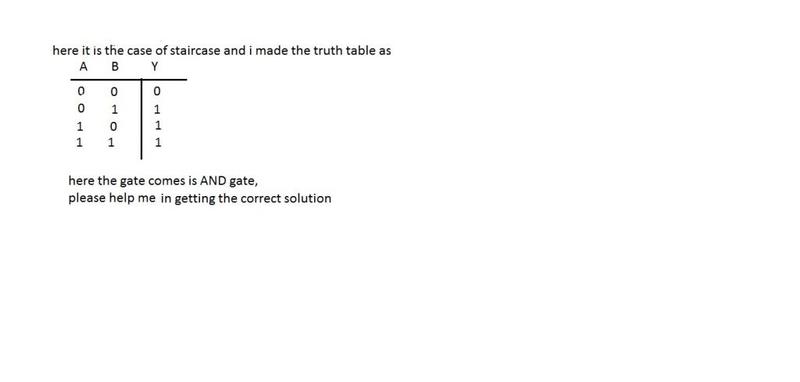
A bulb in a staircase has two switches , one at the ground floor and the other one at the first floor. The bulb can be turn ON and also OFF by any of the two switches irrespective of the state of the other switches, then what is the logic of switching of the bulbs
solution_zpsc83ee55f.jpg

 
Physics news on Phys.org
There can be two cases and truth table can be formed in two ways.If both the switches are in same state the output can be "ON State" or if both the output are in opposite state the output can be in "OFF State".

Truth table does not seems to be correct.
 
Last edited:
Your truth table shows that if A=1 there is no way that B can turn the bulb off, yet specs say bulb status should be able to be set independent of other switch.
 
Change one line in your truth table.
 
Last edited:

Similar threads

  • · Replies 2 ·
Replies
2
Views
3K
  • · Replies 5 ·
Replies
5
Views
3K
  • · Replies 6 ·
Replies
6
Views
19K
  • · Replies 33 ·
2
Replies
33
Views
5K
  • · Replies 7 ·
Replies
7
Views
8K
Replies
5
Views
3K
Replies
2
Views
2K
  • · Replies 10 ·
Replies
10
Views
4K
  • · Replies 7 ·
Replies
7
Views
4K
Replies
16
Views
2K