Effect of suction flow rate over flow separation

Click For Summary

Discussion Overview

The discussion revolves around the design of an experimental setup to study the effect of suction flow rate on flow separation over a flat plate. Participants explore theoretical approaches and empirical relationships related to flow separation, suction, and vortex generators in the context of fluid dynamics and boundary layer control.

Discussion Character

  • Exploratory
  • Technical explanation
  • Conceptual clarification
  • Debate/contested
  • Experimental/applied

Main Points Raised

  • One participant seeks documentation on the effect of suction flow rate on flow separation, noting a lack of detail in existing papers.
  • Another participant suggests that the adverse pressure gradient from the diffuser might cause separation without suction and proposes the need for an empirical relationship to predict separation location.
  • Some participants argue that theoretical estimates can be made using equations from boundary layer theory, specifically referencing the Hartree beta parameter and Falkner-Skan equations.
  • There is a suggestion that using tiny holes for blowing air instead of suction might be more effective for separating the boundary layer.
  • One participant emphasizes the importance of using an actual flat plate rather than the wind tunnel floor to avoid a fully turbulent boundary layer before testing vortex generators.
  • Another participant mentions the need for specific suction distribution to apply certain theoretical solutions and questions the necessity of a theoretical comparison for testing vortex generators.

Areas of Agreement / Disagreement

Participants express differing views on the theoretical and empirical approaches to understanding flow separation and the effectiveness of suction versus blowing. There is no consensus on the best method to achieve flow separation or the theoretical framework to apply.

Contextual Notes

Participants note limitations in existing literature regarding the specific effects of suction flow rate and diffuser angle on flow separation. The discussion also highlights the dependency on specific geometries and conditions for theoretical solutions.

Who May Find This Useful

Researchers and students interested in fluid dynamics, boundary layer theory, and experimental design related to flow separation and control mechanisms.

bdcrown007
Messages
15
Reaction score
0
Dear all,

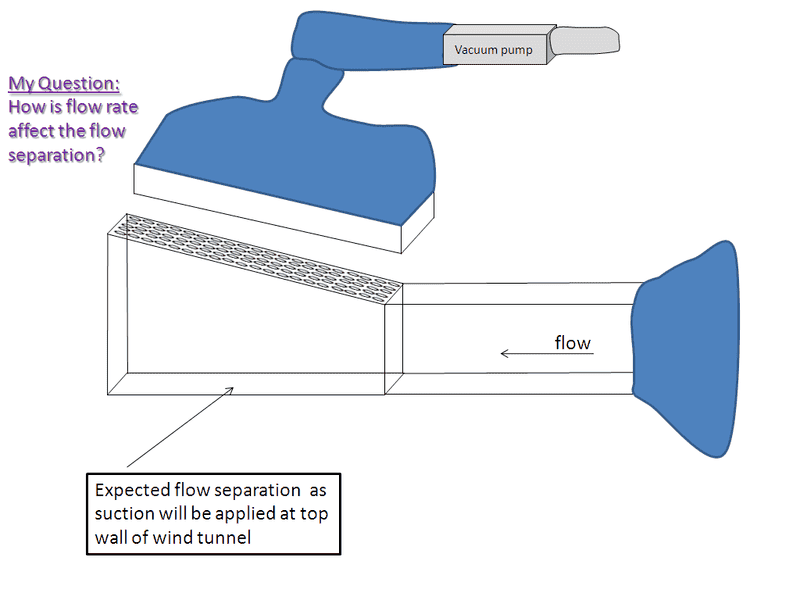
Take my best wishes. I am facing a problem designing my experimental setup for my research. I want to produce flow separation over a flat plate. Here is my experimental setup:
33l3137.jpg


Diffuser angle is 16deg. I need some documentation/text book regarding the effect of suction flow rate over the flow separation. I read some papers those were describing flow separation on flat plate in wind tunnel, authors said that they applied suction over top plate to separate flow on bottom flat plate but I didn't find any more details on those papers...Can anyone help me? I need some theoretical approach and then based on that I will finalize my design. Help me please ASAP.

Thanking you
 
Last edited:
Engineering news on Phys.org
sorry I couldn't reduce the size of my experimental setup attached here, admin please re-size the image to match well. I am sorry for that.
 
This isn't going to be an easy thing to do theoretically. Are you trying to control the separation location? Because the adverse pressure gradient that results from the diffuser could be enough to cause separation without the suction. If you are looking for a way to predict the separation location my guess is that you would need an empirical relationship between the suction rate and separation location.
 
RandomGuy88 said:
This isn't going to be an easy thing to do theoretically. Are you trying to control the separation location? Because the adverse pressure gradient that results from the diffuser could be enough to cause separation without the suction. If you are looking for a way to predict the separation location my guess is that you would need an empirical relationship between the suction rate and separation location.
Dear RandomGuy88, thanks for your reply. I thought so, but my professor suggest to do something based on theory so that we can compare...What should I do?
 
RandomGuy88 said:
This isn't going to be an easy thing to do theoretically. Are you trying to control the separation location? Because the adverse pressure gradient that results from the diffuser could be enough to cause separation without the suction. If you are looking for a way to predict the separation location my guess is that you would need an empirical relationship between the suction rate and separation location.

That isn't true at all. You can definitely get a reasonable estimate through theory. I would need to look up the exact equation in Schlichting when I get to the lab later, but you can basically get the boundary layer over a flat plate with pressure gradient added in in the form of the Hartree beta - the parameter that shows up in the Falkner-Skan equations. This isn't a trivial thing to do, but it can be done and just requires a bit of programming. Of course, that won't give you the result for suction or blowing, but that isn't even the easiest way to separate the boundary layer on a flat plate. The easy way would be to just put the plate at an angle of attack.

bdcrown007 said:
Dear RandomGuy88, thanks for your reply. I thought so, but my professor suggest to do something based on theory so that we can compare...What should I do?

So why are you trying to do suction at the wind tunnel wall? It would be much more effective to have tiny holes in your flat plate and have a small amount of blowing air coming out of these holes. That would separate your boundary layer in a hurry for sure.
 
Thank you boneh3ad . Actually we are trying to separate flow over flat plate and then we will test our own designed vortex generator to check how can it control flow separation. As we planned to use bottom plate as test section, so giving an angle isn't possible. I read some research paper, in which author use curved shape at top wall of wind tunnel to separate flow at bottom plate, some were use diffuser type top wall as I showed in my figure and apply suction through porous topwall which separate flow on bottom plate of wind tunnel and then they tested their VG's to find its contribution on flow separation control. Based on these theme we are planning to use same procedure. But those paper didn't explain about the suction flow rate or diffuser angle effect on separation...Anyway, I am waiting for your next idea and suggestion.
 
Last edited:
Do you actually have a flat plate in the tunnel or are you just using the bottom of the test section? You really should use an actual flat plate and not the wind tunnel floor if that was your plan. The bottom line is that separation is generally caused by an adverse pressure gradient. The easiest way to get this is simply by putting the plate at angle of attack. There have been plenty of separation control experiments based on this method of causing separation. I don't really know off the top of my head how you would effect separation on one side of a test article by having wall suction on the test section wall on the other side, but I suppose if you could engineer it to have an adverse pressure gradient that way, you could get it to work.

A little bit on using an actual flat plat instead of the floor: if you use the floor, the boundary layer will be fully turbulent by the time your flow even gets to you test section so your VGs will not do anything for you. They work on the principle that they trip the flow to turbulence and therefore make it much less susceptible to separation. If your boundary layer is already turbulent, the VGs no longer have a function. I would also think that placing the VGs near the first neutral point on your plate would make them most effective and lead to turbulence faster, though as long as it is turbulent by the time it gets to your separation point I guess the gains would be minimal.

Anyway, checking out Ch. 11 in "Boundary Layer Theory" by Schlichting ought to help you a bunch on the theory side of things. There are similarity solutions for blowing and suction when that blowing/suction is done on your actual test article as opposed to the wall of the wind tunnel. It boils down to two differential equations which aren't too bad to solve numerically:

[tex]f^{\prime \prime \prime} + f f^{\prime \prime} + \beta (1-f^{\prime 2}) = 0[/tex]
[tex]\frac{1}{\mathrm{Pr}} \vartheta^{\prime \prime} + f \vartheta^{\prime} - \frac{2n}{m+1} f^{\prime} \vartheta = 0[/tex]

With boundary conditions:
[itex]\eta = 0[/itex]:
[itex]f = f_w[/itex], [itex]f^{\prime} = 0[/itex], [itex]\vartheta = 1[/itex]

[itex]\eta \rightarrow \infty[/itex]:
[itex]f^{\prime} = 1[/itex], [itex]\vartheta = 0[/itex]

You can find the definition of the variables in the book.
 
thanks a lot for detail explanation. Now I am at my room, tomorrow I will give you the paper from which I got the idea. Which edition of BL theory book do you have? I am using 7th edition and found 1st eqn at ch. 14 but didn't find the second one? Would you please mention the title of chapter 11?
 
I have the 8th edition sitting in front of me. The chapter is titled Boundary-Layer Control (Suction/Blowing).
 
  • #10
boneh3ad said:
I have the 8th edition sitting in front of me. The chapter is titled Boundary-Layer Control (Suction/Blowing).
thank you, I have the 7th edition so little bit difference :(

I found the idea from
Canepa, E., Lengani, D., Satta, F., Spano, E., Ubaldi, M., Zunino, P., “Boundary Layer Separation on a Flat Plate
with Adverse pressure Gradients Using Vortex Generators”, ASME Paper n° GT-2006-90809, 2006.
 
  • #11
I am not sure that is the correct approach either. The solution that boneh3ad suggested doesn't exactly correspond to your geometry and it requires a specific distribution of the suction. In that same chapter Schlichting mentions a similarity solution for diffuser flow which is closer to what you have. But the existence of a similarity solution to the boundary layer equations requires that the suction satisfy a certain distribution along the wall. Is there any reason you need some theoretical answer to compare to? If you are testing the effect of the vortex generators you just need to know if they delay separation and by how much. The theory is certainly not going to be applicable when the vortex generators are present. So you could try to use the theory discussed in Schlichting but I don't think it really applies here and there isn't much use in comparing something to theory just to compare it to the theory.

I do completely agree about not using the tunnel floor as your flat plate though. Like boneh3ad said the BL will be turbulent and then theory is going to be even more wrong.
 
  • #12
RandomGuy88 said:
I am not sure that is the correct approach either. The solution that boneh3ad suggested doesn't exactly correspond to your geometry and it requires a specific distribution of the suction. In that same chapter Schlichting mentions a similarity solution for diffuser flow which is closer to what you have. But the existence of a similarity solution to the boundary layer equations requires that the suction satisfy a certain distribution along the wall. Is there any reason you need some theoretical answer to compare to? If you are testing the effect of the vortex generators you just need to know if they delay separation and by how much. The theory is certainly not going to be applicable when the vortex generators are present. So you could try to use the theory discussed in Schlichting but I don't think it really applies here and there isn't much use in comparing something to theory just to compare it to the theory.

I do completely agree about not using the tunnel floor as your flat plate though. Like boneh3ad said the BL will be turbulent and then theory is going to be even more wrong.
thanks. But it was my supervisor decision to use bottom plate as test section, how can I deny?

In http://www.scribd.com/doc/52161988/apostolis-20mek-fm-ep-2010-07>>> the author discuss about BL suction. Although such suction is not at top wall. It is through bottom wall.

"The quantity of fluid sucked away can be expressed by the ratio of the suction velocity
at the wall over the free stream velocity Cq = |uw|/U0 . The transition delay and the separation prevention should be achieved with the minimum suction flow rate possible in order to reduce
the power needed for the suction. According to [4] separation on a symmetrical airfoil can be prevented for Cq = 1. 12ReL-0. 5
when distributed suction is implemented, whereas for discrete..."

I don't have 8th edition of BL theory, that's why I couldn't study "Boundary-Layer Control (Suction/Blowing)."
 
  • #13
You can deny it by respectfully pointing out that your vortex generators won't be able to do what you want them to in a turbulent flow. Is your supervisor not a fluid dynamicist? He/she should know better. That is a cardinal sin.
 
  • #14
thank you so much. I will discuss with him in next meeting on Monday.
 

Similar threads

  • · Replies 5 ·
Replies
5
Views
8K
Replies
8
Views
2K
  • · Replies 3 ·
Replies
3
Views
3K
  • · Replies 19 ·
Replies
19
Views
6K
  • · Replies 7 ·
Replies
7
Views
2K
Replies
0
Views
2K
  • · Replies 15 ·
Replies
15
Views
3K
Replies
3
Views
5K
Replies
5
Views
4K
  • · Replies 4 ·
Replies
4
Views
3K