Heat and internal energy of gas

Click For Summary
SUMMARY

The discussion focuses on the thermodynamic properties of an ideal diatomic gas during a transition from state a to state c. The change in internal energy is calculated as -4987 J, while the heat added along the indirect path abc is determined to be 5013 J. The analysis confirms that the heat added is path-dependent, as demonstrated by the differing results for direct path ac and indirect path abc. The calculations utilize the first law of thermodynamics and specific heat capacities for diatomic gases.

PREREQUISITES
  • Understanding of the first law of thermodynamics
  • Familiarity with ideal gas laws and properties
  • Knowledge of specific heat capacities for diatomic gases
  • Ability to perform thermodynamic calculations involving internal energy and work
NEXT STEPS
  • Study the first law of thermodynamics in detail
  • Learn about the properties of ideal gases and their specific heat capacities
  • Explore the concept of path dependence in thermodynamic processes
  • Investigate the derivation and application of the equation for internal energy change
USEFUL FOR

Students and professionals in thermodynamics, mechanical engineers, and anyone studying the behavior of gases under various thermodynamic processes.

akoma714
Messages
9
Reaction score
0
One mole of an ideal diatomic gas at room temperature undergoes a transition from a to c along the diagonal path in Figure 19-23.
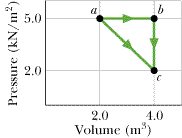
hrw7_19-23.gif

(a) During the transition, what is the change in internal energy of the gas?
-4987 J
(b) How much energy is added to the gas as heat?
____ J
(c) How much heat is required if the gas goes from a to c along the indirect path abc?
5013 J

I got part a and c right. I found the energies for path abc and added them together, because I couldn't find a way with path ac. Does the path I took matter for the heat? How do I find it using path ac?
 

Attachments

  • hrw7_19-23.gif
    hrw7_19-23.gif
    2.2 KB · Views: 638
Physics news on Phys.org
For path ac, ##\Delta (PV)=nR\Delta T$=-2000J##. The change in internal energy is ##\Delta U=nC_v\Delta T=n\frac{5}{2}R\Delta T=\frac{5}{2}(-2000)=-5000J##

The work in going from a to c is ##\int{PdV}=7000J##, so from the first law, ##Q=\Delta U+W=-5000+7000=2000J##

Along path ab, the expansion is at constant pressure, so ##Q=\Delta H=nC_p\delta T=n\frac{7}{2}R\Delta T=\frac{7}{2}\Delta (PV)=10000=35000J##

Along path bc, the change is at constant volume, so ##Q=nC_v\Delta T=n\frac{5}{2}R\Delta T=\frac{5}{2}\Delta (PV)=\frac{5}{2}(-12000)=-30000J##

So the heat added along path abc is Q = (35000)-(30000)=5000J

So the heat added along path abc is different from that for the direct path ac. Of course, this confirms that heat added is a function of path.
 

Similar threads

  • · Replies 10 ·
Replies
10
Views
2K
  • · Replies 4 ·
Replies
4
Views
3K
  • · Replies 1 ·
Replies
1
Views
3K
Replies
5
Views
1K
  • · Replies 5 ·
Replies
5
Views
1K
  • · Replies 12 ·
Replies
12
Views
7K
Replies
5
Views
2K
Replies
5
Views
3K
Replies
1
Views
2K
  • · Replies 3 ·
Replies
3
Views
2K