How can I calculate the elongation of a steel rod in an amusement park ride?

Click For Summary
SUMMARY

The discussion focuses on calculating the elongation of a steel rod used in an amusement park ride, specifically a rod measuring 14.5 m in length and 8.25 cm² in cross-sectional area. The Young's modulus is given as Y = 2.00×10¹¹ Pa, and the total weight of the ride's cargo is 1930 N. The maximum angular speed of the ride is 8.50 rev/min, and participants are guided to use free body diagrams (FBD) to analyze the forces acting on the car, particularly the tension in the rod and gravitational force, to derive the centripetal force equation.

PREREQUISITES
  • Understanding of Young's modulus and its application in material science.
  • Familiarity with centripetal force and angular velocity concepts.
  • Ability to perform trigonometric calculations related to force components.
  • Knowledge of the formula for length expansion under load.
NEXT STEPS
  • Study the derivation of the centripetal force equation in terms of angular velocity (ω).
  • Learn how to apply Young's modulus to calculate elongation in materials under load.
  • Explore free body diagram techniques for analyzing forces in mechanical systems.
  • Investigate the effects of angular speed on tension in structural components.
USEFUL FOR

Mechanical engineers, physics students, and amusement park ride designers will benefit from this discussion, particularly those involved in analyzing the structural integrity and safety of ride components under dynamic loads.

superdave
Messages
149
Reaction score
3
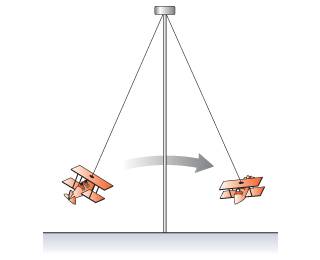
An amusement park ride consists of airplane-shaped cars attached to steel rods. Each rod has a length of 14.5 m and a cross-sectional area of 8.25 {\rm cm}^{2}.
yf_Figure_11_51.jpg


When operating, the ride has a maximum angular speed of 8.50 rev/min. How much is the rod stretched then?
Take the Young's modulus for the rod to be Y = 2.00×10¹¹ Pa and the free fall acceleration to be g = 9.80 m/s^2

Assume that each car plus two people seated in it has a total weight of 1930 N.

Now, I somehow need to find theta or r using only omega. I'm not really sure how to do this.
 
Physics news on Phys.org
Hint: The only two forces acting on a plane with its cargo are the tension in the rod and gravity. The vector sum of these two forces is horizontal and that force is causing the plane to go in a circle.
 
superdave said:
An amusement park ride consists of airplane-shaped cars attached to steel rods. Each rod has a length of 14.5 m and a cross-sectional area of 8.25 {\rm cm}^{2}.

yf_Figure_11_51.jpg


When operating, the ride has a maximum angular speed of 8.50 rev/min. How much is the rod stretched then?
Take the Young's modulus for the rod to be Y = 2.00×10¹¹ Pa and the free fall acceleration to be g = 9.80 m/s^2

Assume that each car plus two people seated in it has a total weight of 1930 N.

Now, I somehow need to find theta or r using only omega. I'm not really sure how to do this.
you should take a FBD of the car ,and examine the forces acting on it. In the y direction, there is no movement. In the x direction, the horizontal component of the tension force provides the centripetal acceleration. Write the centripetal force equation in terms of omega (where omega =v/r), do a little trig, and solve for T. Show your work, please. I then presume you are familiar with the formula for length expansion under load?
 

Similar threads

  • · Replies 5 ·
Replies
5
Views
2K
Replies
1
Views
6K
Replies
1
Views
3K
  • · Replies 1 ·
Replies
1
Views
2K
  • · Replies 2 ·
Replies
2
Views
6K
Replies
9
Views
3K
  • · Replies 2 ·
Replies
2
Views
6K
  • · Replies 4 ·
Replies
4
Views
2K
  • · Replies 7 ·
Replies
7
Views
9K
Replies
7
Views
3K