Is it possible to convert a DC motor to a Stepper motor?

Click For Summary

Discussion Overview

The discussion centers around the feasibility of converting a DC motor into a stepper motor, exploring the characteristics of both types of motors and the potential methods for such a conversion. Participants address theoretical and practical aspects of motor design and application.

Discussion Character

  • Debate/contested
  • Technical explanation
  • Conceptual clarification

Main Points Raised

  • One participant questions the possibility of converting a DC motor to a stepper motor and asks for procedures.
  • Another participant notes that stepper motors have distinct features, such as "teeth" on the rotor and pairs of windings, which are absent in standard DC motors.
  • A different viewpoint asserts that conversion is not feasible, suggesting that while some multi-pole synchronous motors can mimic stepper motors, they are not practical for most applications.
  • Several participants recommend acquiring actual stepper motors from old hardware like hard drives, printers, and photocopiers, citing their low cost and availability.
  • One participant shares an alternative approach, proposing that a DC servo motor could be adapted to function like a stepper motor by replacing the control circuit and using a quadrature encoder for position tracking.
  • This participant emphasizes that a DC servo motor system could outperform stepper motors in terms of load handling and power efficiency.

Areas of Agreement / Disagreement

Participants express differing opinions on the feasibility of converting a DC motor to a stepper motor, with some asserting it is not possible while others suggest alternative methods or components. No consensus is reached regarding the conversion process.

Contextual Notes

Participants highlight the importance of motor characteristics and control systems, indicating that assumptions about motor types and applications may vary. The discussion does not resolve the technical complexities involved in motor conversion.

Who May Find This Useful

Individuals interested in motor design, robotics, or electronics may find the insights shared in this discussion relevant to their projects or understanding of motor functionalities.

Vijayent
Messages
9
Reaction score
0
I have doubt. Is it possible to convert DC motor to Stepper ? If yes then what is the procedure ?
 
Engineering news on Phys.org
A key feature of stepper motors is the "teeth" that make the rotor look like a gear and the pairs of windings. A normal DC motor does not have those.

By Wapcaplet; Teravolt. The original uploader was Teravolt at English Wikipedia - Transferred from en.wikipedia to Commons by Fastilysock using CommonsHelper. said:
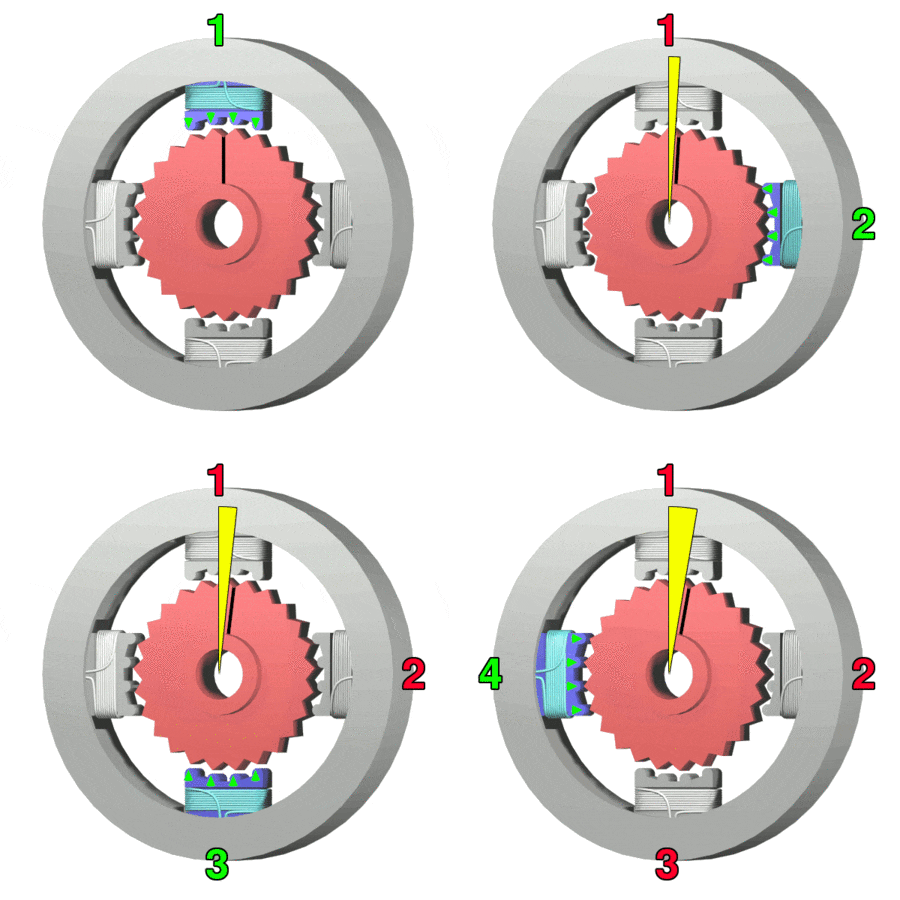
StepperMotor.gif
 

Attachments

  • StepperMotor.gif
    StepperMotor.gif
    113.3 KB · Views: 1,555
Last edited:
  • Like
Likes   Reactions: davenn
It is not possible.

Some multi-pole synchronous (AC) motors can be used like a (very) low performance stepper motors, but it is like plowing with dogs. Slightly interesting, but not really useful or fun...

Better to get a real stepper. As components from old (really old) HDDs, they are cheap.
 
  • Like
Likes   Reactions: russ_watters
Rive said:
Better to get a real stepper. As components from old (really old) HDDs, they are cheap.

yup and ...
also printers, photocopiers and similar electronics are an awesome source of stepper motors
 
  • Like
Likes   Reactions: dlgoff and phinds
I tore down my last printer and was surprised not a stepper in the set - almost all were DC with optical encoders for positioning feedback... which begs the question to the OP ... why do you want a stepper?

SparkFun page seems to be pretty good reference for basic understanding.
 
  • Like
Likes   Reactions: berkeman
A DC servo motor is better than a stepper motor for most applications. Only low power, minimum complexity systems use stepper motors. The easiest way to convert a DC servo motor to behave like a stepper motor would be to replace the control circuit, not modify the motor.

I would mount a quadrature encoder on the DC motor shaft. Next I would pass those encoder signals to a microcontroller so it could keep track of where the motor is now. That microcontroller would also receive the phased control signals so it could know where a stepper motor should now be. By comparing those actual and wanted positions the microcontroller would drive an H-bridge to control the DC motor and bring it to zero error.

The advantages of that DC servo motor system is that it will fight big loads without missing steps. It will also only draw sufficient power to maintain tracking.

The controller is best programmed as a state machine that is indexed by the two incoming pairs of phase signals. It then checks the two next critical phase signals so is not confused by encoder vibration noise.
 
  • Like
Likes   Reactions: dlgoff and anorlunda

Similar threads

Replies
2
Views
2K
Replies
21
Views
3K
Replies
11
Views
3K
  • · Replies 19 ·
Replies
19
Views
3K
  • · Replies 15 ·
Replies
15
Views
2K
Replies
12
Views
3K
  • · Replies 27 ·
Replies
27
Views
1K
  • · Replies 3 ·
Replies
3
Views
2K
Replies
13
Views
4K
Replies
17
Views
2K