Projectile Motion in 2D: Solving for Maximum Range in Inclined Planes

Click For Summary

Homework Help Overview

The discussion revolves around a problem in projectile motion, specifically focusing on determining the maximum range of a projectile on inclined planes. The original poster explores the implications of varying the angle of inclination (α) and questions the validity of a conventional method when α is set to zero.

Discussion Character

  • Exploratory, Assumption checking, Conceptual clarification

Approaches and Questions Raised

  • The original poster attempts to understand why a conventional method fails in the case of α=0, questioning the consistency of the answer across different values of α. Participants discuss the equality of initial speeds (u1 and u2) in the flat case and seek clarification on this point.

Discussion Status

The discussion is ongoing, with participants exploring various interpretations of the problem. Some guidance has been offered regarding the geometric relationship between ranges R1 and R2, which has helped one participant gain clarity on the equality of speeds in the α=0 case.

Contextual Notes

There is a mention of a specific condition regarding the minimum possible speed for the projectiles, which may influence the outcomes being discussed. Additionally, the original poster notes a lack of restrictions on α, raising questions about the assumptions underlying the problem.

kshitij
Messages
218
Reaction score
27
Homework Statement
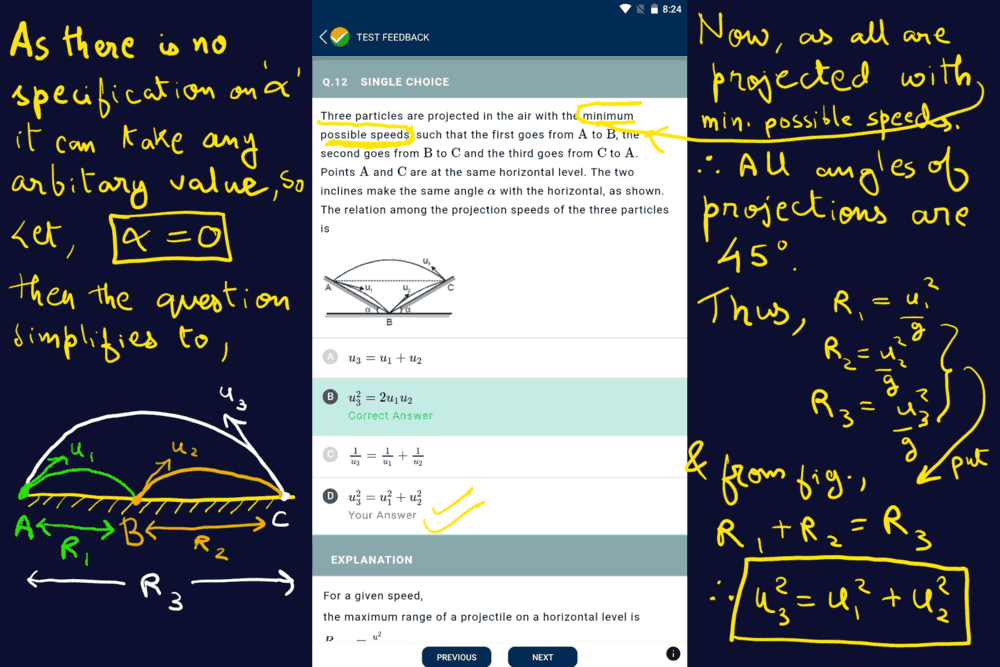
Three particles are projected in the air with the minimum possible speeds (particle at point A with u1,at B with u2 and at point C with u3), such that the first goes from A to B, the second goes from B to C and the third goes from C to A. Points A and C are at the same horizontal level. The two inclines make the same angle α with the horizontal, as shown. The relation among the projection speeds of the three particles is
(see attachment)
Relevant Equations
Range of a projectile=(u^2*sin2α)/g
I know the conventional method for solving this question using the formula for maximum range of a projectile in an inclined plane, but since it is an objective problem, if we consider a non general case where α=0, then clearly we can see that (see attachment) only one option matches which unfortunately isn't the right answer. I would like to know that why doesn't this method work since in the given question there is no restriction on α, it could take any value, so the given answer must be consistent for all values of α. What am I missing, is there a catch in the part that they are projected with minimum possible speed, if so then what should be the condition so that we get the correct answer for the α=0 case?
2020-12-05 15_23_48.423cropped.png
 
Physics news on Phys.org
In the flat case, u1 and u2 are the same, so answers B and D both fit.
 
  • Like
Likes   Reactions: kshitij
haruspex said:
In the flat case, u1 and u2 are the same, so answers B and D both fit.
That's interesting, but I still don't get why they should be the same?
 
kshitij said:
That's interesting, but I still don't get why they should be the same?
Why what are the same? u1 and u2 in the α=0 case?
 
  • Like
Likes   Reactions: kshitij
haruspex said:
Why what are the same? u1 and u2 in the α=0 case?
Yes, I was asking why is u1 and u2 same in the α=0 case? But know I get it as from geometry R1 and R2 are equal so their speeds must be same. Thank you so much, I was stuck with this problem for quite some time 😅
 
Last edited:

Similar threads

Replies
9
Views
2K
  • · Replies 3 ·
Replies
3
Views
3K
  • · Replies 4 ·
Replies
4
Views
3K
  • · Replies 5 ·
Replies
5
Views
2K
Replies
19
Views
3K
Replies
4
Views
2K
  • · Replies 4 ·
Replies
4
Views
1K
  • · Replies 1 ·
Replies
1
Views
2K
  • · Replies 8 ·
Replies
8
Views
2K
Replies
4
Views
3K