berkeman said:
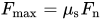
If the bearings are frictionless, then the rotation will happen with any torque, just more slowly for higher moments of inertia. The relevant equation is
If I take an angular acceleration of 3 rad/s^2, the torque needed is:
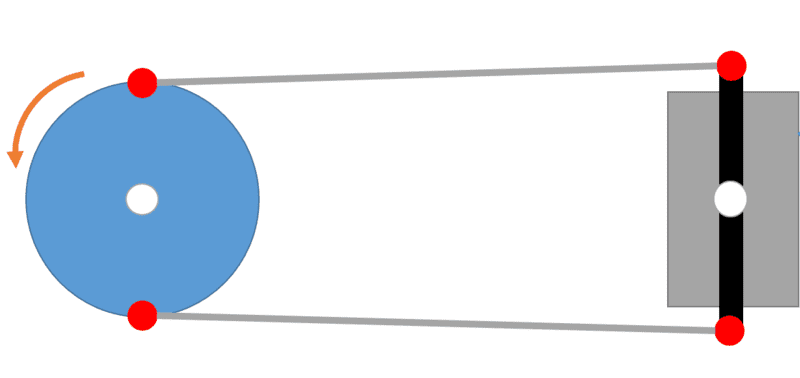
I= 0.5m*r^2 = 0.5*7.5*100^2 = 50000 kg*mm^2
α = 3 rad/s^2
τ= I*α = 0.05 (kg*m^2) * 3 (rad/s^2) = 0.15 Nm
Ok, this is frictionless.
Can I calculate the angular acceleration to RPM? I can't imagine 3 rad/s^2 yet.
berkeman said:
However, if there is bearing friction, you need to overcome the static bearing friction to start the disk rotating. Have you measured the friction of the loaded bearings? Are you using the right type of bearings for the way you are loading the axle?
I have measured the friction of the bearings yet, this was just a concept. I wanted to know what amount of torque I roughly need for the motor. Maybe as a nice learning process for me I can calculate the static bearing friction for a plain bearing and angular contact bearings?
Using the following reference:
Bearing friction coefficients
Angular contact bearings: .0020
Now calculate the torque:
P = 7.5kg * 10 = 75 N
μ= 0.0020
dm = 10 mm = 0.01 m (assumption)
Torque = (75N*0.002*0.01m)/2
Torque = 7.5*10^-4 Nm
Do I need to add the torque values for the total torque needed?