Transformers - Variation in Current, EMF and Magnetic FLux

Click For Summary
SUMMARY

The discussion centers on the behavior of current, voltage, and magnetic flux in transformers, particularly focusing on ideal transformers. Participants confirm that in an ideal transformer, the primary voltage (Uprimary) is in phase with the input current, while the magnetic flux lags the voltage by 90 degrees. The output voltage is considered to be 180 degrees out of phase with the input voltage, although practical applications may vary. The conversation emphasizes the importance of understanding the turn ratio and the relationship between voltage and current in both primary and secondary coils.

PREREQUISITES
  • Understanding of sine and cosine waveforms in electrical engineering
  • Familiarity with Faraday's law of induction
  • Knowledge of transformer theory, including ideal vs. non-ideal transformers
  • Basic concepts of electrical phase relationships
NEXT STEPS
  • Study the principles of Faraday's law of induction in detail
  • Learn about the differences between ideal and non-ideal transformers
  • Explore the implications of phase relationships in AC circuits
  • Investigate the mathematical relationships between voltage, current, and magnetic flux in transformers
USEFUL FOR

Students in electrical engineering, physics enthusiasts, and anyone interested in understanding transformer operation and AC circuit behavior.

  • #31
Nice, Carl.

Gerbi's example in #20 of the bifilar winding is a good reference point to keep thinking straight.

I was taught ~1961 about a phase reversal but for the life of me can't recall why.
Unloaded, Flux will be integral of primary voltage and secondary voltage the derivative of Flux.

Does taking the derivative of an integral not simply get you back where you started?
Volts = sin
∫(sin) = -cos
d(-cos) = +sin

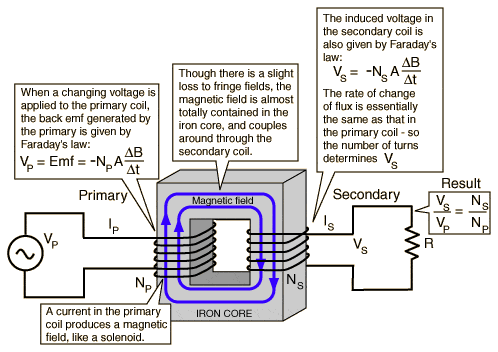
I wonder if the confusion stems simply from drawing a transformer with windings shown on opposite sides of the window as in this hyperphysics link.
http://hyperphysics.phy-astr.gsu.edu/hbase/magnetic/transf.html
transf.gif


Observe flux leaves the dotted end of primary but enters dotted end of secondary. [EDIT oops no dots on that drawing but wrap your right-hand fingers around core in same direction as current through winding and thumb points in direction of MMF]

In your mind's eye flip that secondary over so it's just above the primary and observe it's wound in opposite direction.
From the TOP view primary is THEN wound CCW and secondary is wound CW.

old jim
 
Engineering news on Phys.org
  • #32
Jim,

Those were my thoughts as well. There clearly is a phase shift on the primary coil...but there is also a phase shift on the secondary coil which must put it back. Don't know that math...but it must be true because sure enough the voltage is in phase with the current on any oscilliscope thru a purely resistive load. Starting with a power factor of 1
is most convenient.
 
  • #33
The polarity of a transformer can be determined from which direction the wire enters the core.
In the picture Jim place above, Ip could be replaced with a polarity dot.
Is could be replaced with a polarity dot.
The polarity dots would be correct.

In the picture above, if the secondary conductor entered from the back of the core and exited from the front of the core (opposite to that shown), the secondary polarity mark would be near Ns.

Assuming a perfect transformer and a resitive load, could the confusion be because the transformer primary is a load, so the current and voltage have to be in phase.
In the other case the transformer is a power source so the current in the secondary has to be 180 degrees out of phase with the voltage in the secondary.
 
  • #34
elemis said:
Could someone also confirm if voltage = rate of change of current with time ?

no, voltage can not be equal to the rate of change of current with time.as it will violate the ohm's law. according to which the current flowing in a conductor is directly proportional to the voltage across it.
 
  • #35
elemis said:
This question about the variation of the aforementioned quantities in a transformer.

Now according to me and my knowledge of electricity this is how I feel it should play out :

If the input current were a sine curve that varies with time then :

Input voltage = cosine curve i.e. it is ahead of input current by 90 degrees.

Magnetic Flux = sine curve with same period as input voltage but LARGER amplitude.

Output voltage = out of phase with input voltage by 180 degrees.

Output current = this is where I'm faltering and I'm having issues...

Could someone please confirm what I've said is correct and help me with the bit in bold ?

but what do you want to ask in it?
 
  • #36
i m not getting your quesn...??
 
  • #37
elemis said:
Now according to me and my knowledge of electricity this is how I feel it should play out :

If the input current were a sine curve that varies with time then :

Input voltage = cosine curve i.e. it is ahead of input current by 90 degrees.

Magnetic Flux = sine curve with same period as input voltage but LARGER amplitude.

Output voltage = out of phase with input voltage by 180 degrees.

Output current = this is where I'm faltering and I'm having issues...

Could someone please confirm what I've said is correct and help me with the bit in bold ?
Hi elemis. Just look what you've started! http://img196.imageshack.us/img196/3295/qvk34.png

In one post you suggested that you might be considering a transformer with no load. I don't think so, because if there is no load on the secondary, there will be no secondary current. With no secondary current, there will be no primary current (for an ideal transformer).

For your purposes, you should think of the transformer as transforming resistances (or impedances). So imagine the secondary is connected to a light globe. A light globe is a resistor, so the secondary current will be in phase with the secondary voltage because that is the defining V-I characteristic for a resistance.

The transformer transforms impedances, as a consequence of transforming voltages and currents, so a light globe load in the secondary means the primary current will be in phase with the primary voltage. (The load on the secondary is a resistor, and in turn that load as seen on the primary side will also be resistive.)

You already understand that the primary voltage is N × the secondary voltage, where N = Nº of turns on primary ÷ Nº of turns on secondary,
and that the primary current is 1/N × the secondary current,
∴ the impedance seen at the primary is V/ I = N² × the secondary load impedance
https://www.physicsforums.com/images/icons/icon2.gif So a resistor of R ohms in the secondary draws power from the mains equivalent to connecting a resistor of N² × R ohms in place of the primary and not having a transformer at all.

I hope that addresses your question. :smile:

Feel free to post another. :wink:
 
Last edited by a moderator:

Similar threads

Replies
8
Views
2K
Replies
64
Views
8K
  • · Replies 8 ·
Replies
8
Views
2K
Replies
3
Views
1K
  • · Replies 4 ·
Replies
4
Views
2K
  • · Replies 8 ·
Replies
8
Views
3K
  • · Replies 4 ·
Replies
4
Views
7K
  • · Replies 5 ·
Replies
5
Views
5K
  • · Replies 3 ·
Replies
3
Views
3K
  • · Replies 13 ·
Replies
13
Views
3K