Vertical Load on a Purlin - find x and y force components

Click For Summary
SUMMARY

The discussion focuses on calculating the force components acting on a roof purlin due to a 300 lb vertical snow load. The perpendicular component is determined using the formula 300 lb * cos(inverseTan(4/12)), while the parallel component is calculated with 300 lb * sin(18.43°). The key to solving this problem lies in understanding the geometry and trigonometry involved, specifically the relationship between the slope of the rafter and the load distribution.

PREREQUISITES
  • Understanding of trigonometric functions, specifically sine and cosine.
  • Familiarity with free body diagrams (FBD) in structural analysis.
  • Basic knowledge of load distribution on structural elements.
  • Ability to interpret slope ratios in geometric contexts.
NEXT STEPS
  • Study trigonometric identities and their applications in structural engineering.
  • Learn how to create and analyze free body diagrams for various loading scenarios.
  • Research load distribution techniques for roof structures.
  • Explore the principles of geometry related to angles and slopes in construction.
USEFUL FOR

Structural engineers, architects, and students studying civil engineering who need to understand load calculations and force distribution on structural elements.

KV-1
Messages
16
Reaction score
1
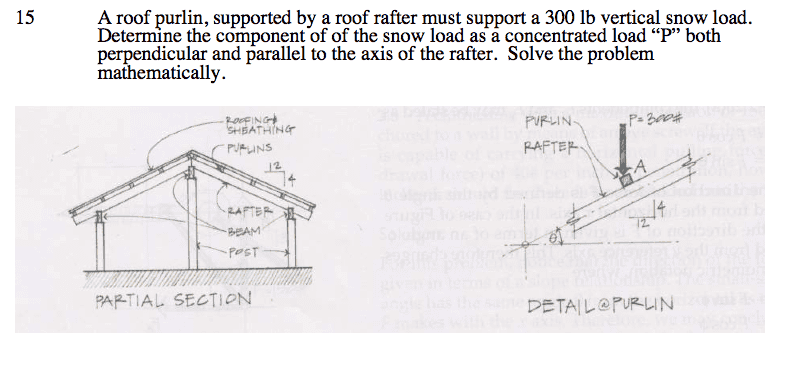
A roof purlin, supported by a roof rafter must support a 300 lb vertical snow load.
Determine the component of of the snow load as a concentrated load “P” both perpendicular and parallel to the axis of the rafter.
3VDlT0E.png
I read that the perpendicular component of the 300lb force can be figured out by 300lb*cos(inverseTan(4/12)) and the parallel component can be figured out by 300lb*sin(18.43*)

I do not understand why this is so. My attempt at the solution is to draw an FBD, but I suppose I am drawing the wrong one.
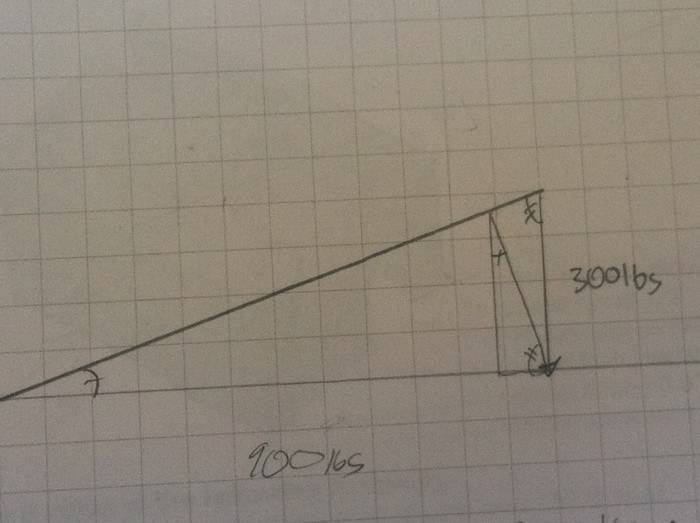
1Msd7qJ.jpg
 
Physics news on Phys.org
A free body diagram is nice, but what you really want to do is draw a triangle where the hypotenuse has a slope of 4:12 and then work out the angles normal and tangential to this slope. It's more a matter of geometry (and trigonometry) than anything else.
 

Similar threads

  • · Replies 1 ·
Replies
1
Views
3K
  • · Replies 3 ·
Replies
3
Views
8K
  • · Replies 9 ·
Replies
9
Views
3K
  • · Replies 2 ·
Replies
2
Views
2K
  • · Replies 2 ·
Replies
2
Views
3K
Replies
1
Views
2K
  • · Replies 2 ·
Replies
2
Views
3K
  • · Replies 18 ·
Replies
18
Views
3K
  • · Replies 3 ·
Replies
3
Views
6K
  • · Replies 18 ·
Replies
18
Views
3K