Help solving this Heat Equation please

Click For Summary
SUMMARY

The discussion focuses on solving the heat equation using separation of variables and spherical Bessel functions. The expression for \( q_n = \frac{2}{R} \int_0^R q \cdot \sin(k_n r) \cdot r \, dr \) is derived from expanding the step function \( q(r) \) in terms of the orthogonal functions \( \frac{\sin(k_n r)}{r} \). The orthogonality condition is established, confirming that the integral is non-zero only when \( k_n = k_m \), leading to the conclusion that \( q(r) \) can be expressed as a series involving \( q_m \) and \( \sin(k_m r) \).

PREREQUISITES
  • Understanding of heat equations and boundary value problems
  • Familiarity with spherical Bessel functions
  • Knowledge of orthogonality in function spaces
  • Proficiency in integration techniques, particularly with trigonometric functions
NEXT STEPS
  • Study the properties of spherical Bessel functions and their applications
  • Learn about orthogonal functions and their role in solving differential equations
  • Explore the method of separation of variables in partial differential equations
  • Investigate the derivation and applications of Fourier series in heat conduction problems
USEFUL FOR

Mathematicians, physicists, and engineers involved in solving differential equations, particularly those focused on heat transfer and boundary value problems.

Karl Karlsson
Messages
104
Reaction score
12
Homework Statement
***
Relevant Equations
***
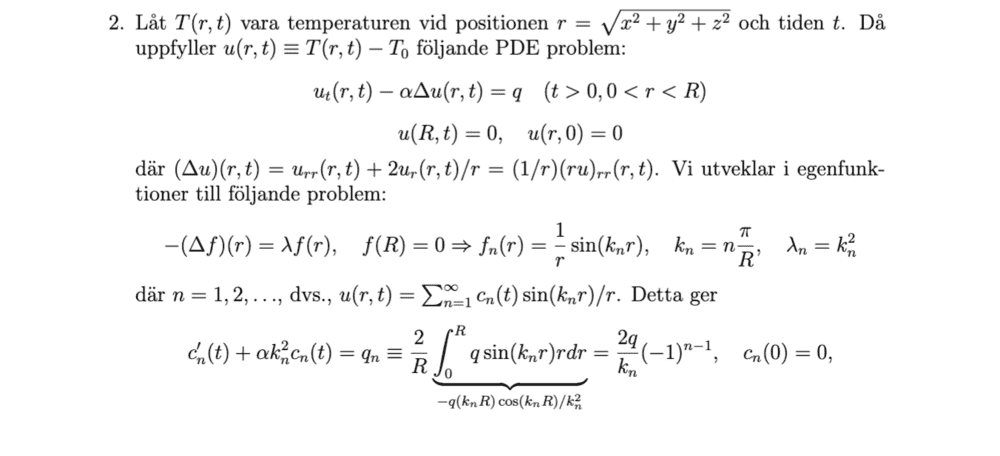
I want to solve the heat equation below:
sk.png

I don't understand where the expression for ##2/R\cdot\int_0^R q\cdot sin(k_nr)\cdot r \, dr## came from. The r dependent function is calculated as ##sin(k_nr)/r## not ##sin(k_nr)\cdot r##. I don't even know if ##sin(k_nr)/r## are orthogonal for different ##k_n## values. Why is ##q_n = 2/R\cdot\int_0^R q\cdot sin(k_nr)\cdot r \, dr## ?
 
Physics news on Phys.org
I think you're expanding a step function ##q(r) = q## for ##r = [0,R]## and ##q(r)=0## for ##r > R## in terms of the ##\sin(k_nr)/r## functions. You're using separation of variables. The functions ##\sin(k_nr)/r## are the spherical Bessels.
 
As is indicated by the \equiv sign, this is a definition of q_n. From the line immediately above, we can infer that <br /> q(r) = \sum_{m=1}^\infty \frac{q_m}{r} \sin(k_mr).<br /> Now multply by r \sin(k_n r) and integrate between 0 and R: <br /> \int_0^R q(r) \sin (k_nr) r\,dr = \sum_{m=1}^\infty q_m \int_0^R \sin(k_mr) \sin(k_nr)\,dr. You should recognise that the integral on the right is zero unless k_n = \frac{n\pi}{R} = \frac{m\pi}{R} = k_m (ie. n = m), in which case it is R/2 as you are integrating \sin^2 (k_n r) = \frac12(1 - \cos (2k_n r)) over a whole number of periods.
 
Last edited:
  • Like
Likes   Reactions: Karl Karlsson
pasmith said:
As is indicated by the \equiv sign, this is a definition of q_n. From the line immediately above, we can infer that <br /> q(r) = \sum_{m=1}^\infty \frac{q_m}{r} \sin(k_mr).<br /> Now multply by r \sin(k_n r) and integrate between 0 and R: <br /> \int_0^R q(r) \sin k_nr\,dr = \sum_{m=1}^\infty q_m \int_0^R \sin(k_mr) \sin(k_nr)\,dr. You should recognise that the integral on the right is zero unless k_n = \frac{n\pi}{R} = \frac{m\pi}{R} = k_m (ie. n = m), in which case it is R/2 as you are integrating \sin^2 (k_n r) = \frac12(1 - \cos (2k_n r)) over a whole number of periods.
Thanks!
 
  • Like
Likes   Reactions: berkeman

Similar threads

Replies
3
Views
2K
  • · Replies 14 ·
Replies
14
Views
2K
  • · Replies 5 ·
Replies
5
Views
2K
  • · Replies 2 ·
Replies
2
Views
1K
Replies
2
Views
2K
Replies
0
Views
1K
  • · Replies 1 ·
Replies
1
Views
2K
Replies
7
Views
2K
  • · Replies 6 ·
Replies
6
Views
3K
  • · Replies 5 ·
Replies
5
Views
2K