Practicing for SAT Math and had my first four part miserable failure sequence

Click For Summary

Discussion Overview

The discussion revolves around a series of SAT math practice problems, focusing on algebraic expressions, geometry, and functions. Participants seek assistance in solving these problems and clarify their understanding of the underlying concepts.

Discussion Character

  • Homework-related
  • Technical explanation
  • Exploratory
  • Debate/contested

Main Points Raised

  • One participant asks for help with a problem involving the equivalence of two polynomial expressions, specifically how to find the value of k given the equation x² + kx + 7 = (x + 1)(x + h).
  • Another participant suggests multiplying out (x + 1)(x + h) and equating it to x² + kx + 7, prompting a discussion about the implications of the coefficients.
  • There is a discussion about the geometry problem involving triangle ABC, with participants noting the need to consider the ratio of the legs and the Pythagorean theorem.
  • Participants discuss a function defined as f(x) = 2x - 1 and how to solve for t given the equation (1/2)f(√t) = 4, with some suggesting plugging in values.
  • In the context of identifying even integers, participants explore the representation of twice an odd integer and the implications of different expressions involving k.
  • Some participants express confusion about the first problem and seek clarification on the relationships between the variables involved.
  • There are multiple corrections and refinements of earlier claims, particularly regarding the polynomial coefficients and their implications for the values of k and h.

Areas of Agreement / Disagreement

Participants do not reach a consensus on all problems, with some expressing ongoing confusion, while others provide insights and corrections. The discussion remains unresolved in certain areas, particularly regarding the initial problem.

Contextual Notes

Some participants note that the clarity of expressions and the importance of parentheses in mathematical notation are crucial for solving the problems. There is also mention of potential overthinking regarding the limits of variables h and k.

Who May Find This Useful

Students preparing for the SAT math section, educators looking for examples of student problem-solving discussions, and individuals interested in algebra and geometry concepts.

UltimateSomni
Messages
62
Reaction score
0
For these four practice problems, I had little idea what the hell to do (plugging in seemed worthless), could anyone help? Sorry if this isn't what the board is suppose to be used for. Answers in spoiler tags.

If k and h are constants and x2+kx+7 is equivalent to (x+1)(x+h), what is the value of k?
Answer:
8
-----------------------------------------------------------------
t688c5.jpg


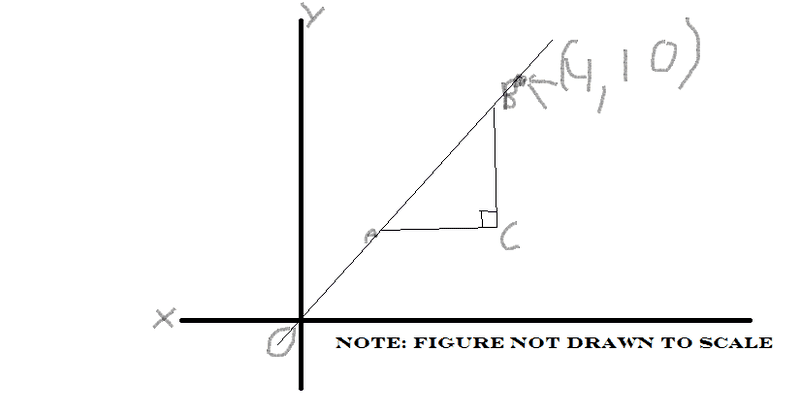
In the figure above, if the legs of the triangle ABC are parallel to the axes, which of the following could be the lengths of the sides of triangle ABC?

2,5,sqrt 29
2,5,7
3,3,3 sqrt2
3,4,5
4,5, sqrt41

Answer:
2,5 sqrt 29
-------------------------------------------------------

Let the function f be defines as f(x)=2x-1. If 1/2f(sqrt t)=4, what is the value of t?

3/sqrt 2
7/2
9/2
49/4
81/4


Answer:
81/4
----------------------------------------------------------

If k is a positive integer, which of the following must represent an even integer twice the value of the odd integer?

2k
2k+3
2k+4
4k+1
4k+2

Answer:
4k+2

It would be a great help if anyone could even point me into the right direction on these
 
Mathematics news on Phys.org
1) Multiply out (x+1)(x+h) by FOILing and equate it to x2+kx+7. What's the first conclusion you must make? What's the second conclusion?

2) The most important thing here is the slope of that line. Take into account that the slope of the line is rise/run. What's a possibity for the value of rise? run? (looking at the answers) Once you have those two values, how do you find the hypotenuse?

3) Judging from the answer, it looks like you mean (1/2)f(sqrt t)= 4, not 1/[2f(sqrt t)]= 4. The use of parentheses here is very important. If f(x) = 2x - 1, what's f(sqrt(t))? Once you have this, plug it into (1/2)f(sqrt t)= 4 and solve for t.

4) Something is missing from this problem, but I think what you meant to say is define an odd integer (call it j) as j = 2k+1, where k is a positive integer. If this is the case, how do we represent twice the odd integer?
 
UltimateSomni said:
If k and h are constants and x2+kx+7 is equivalent to (x+1)(x+h), what is the value of k?
Multiply out (x+1)(x+h) and the answer is obvious.

In the figure above, if the legs of the triangle ABC are parallel to the axes, which of the following could be the lengths of the sides of triangle ABC?
There are two conditions here. First, the ratio of the two legs has to equal 0.4, because the line goes through the origin and (4, 10). The second condition is the Pythagorean theorem.
-------------------------------------------------------

Let the function f be defines as f(x)=2x-1. If 1/2f(sqrt t)=4, what is the value of t?
This one CAN be solved just by plugging in: plug the definition of f into the equation, then solve for t.

If k is a positive integer, which of the following must represent an even integer twice the value of the odd integer?
For any integer k, 2k is even, and 2k+1 is odd. To be twice the value of an odd integer, just double that.
 
pmsrw3 said:
Multiply out (x+1)(x+h) and the answer is obvious.


There are two conditions here. First, the ratio of the two legs has to equal 0.4, because the line goes through the origin and (4, 10). The second condition is the Pythagorean theorem.
-------------------------------------------------------


This one CAN be solved just by plugging in: plug the definition of f into the equation, then solve for t.


For any integer k, 2k is even, and 2k+1 is odd. To be twice the value of an odd integer, just double that.

2. Got it, 2,5 sqrt 29 is the only one that fits the 4:10 ratio

3. Didn't realize it was that obvious

4. Okay the makes sense.


Still no idea what to do on the first one
 
UltimateSomni said:
Still no idea what to do on the first one
(x+1)(x+h)
x(x+h) + 1(x+h)
x^2 + xh + x + h
x^2 + x(h+1) + h

Does that help?
 
I still cannot figure it out.
 
UltimateSomni said:
I still cannot figure it out.
Sure you can. Compare these two expressions:

x2 + (h+1)x + h

x2 + kx + 7

What values of h and k make them the same?
 
I don't see why there is a limit to what h and k can equal.
 
UltimateSomni said:
I don't see why there is a limit to what h and k can equal.
You may be overthinking this a little. Just LOOK at the expressions

x2 + (h+1)x + h

x2 + kx + 7

Don't they look similar to you? What would it take to make them look identical? (And you know the answer, too -- try plugging that in and see what happens.)
 
  • #10
okay I get it now
 
  • #11
It might help if you know that for two polynomials (of equal degree), for the two polynomials to be equal for every x, each of the coefficients must be equal for every x. Your two polynomials are x2+kx+7 and x2+(h+1)x+h. Setting these two equal, with x2+kx+7=x2+(h+1)x+h, we can equate the coefficents of every power of x:

1=1 (the two coefficients of x2)
k=h+1 (the two coefficients of x)
7=h (the two coefficients of the constant term x0)

From there it's easy to conclude that k=8.
 
  • #12
Char. Limit said:
It might help if you know that for two polynomials (of equal degree), for the two polynomials to be equal for every x, each of the coefficients must be equal for every x. Your two polynomials are x2+kx+7 and x2+(h+1)x+h. Setting these two equal, with x2+kx+7=x2+(h+1)x+h, we can equate the coefficents of every power of x:

1=1 (the two coefficients of x2)
k=h+1 (the two coefficients of x)
7=h (the two coefficients of the constant term x0)

From there it's easy to conclude that k=8.

O_O This is great. Thank you.
 

Similar threads

  • · Replies 10 ·
Replies
10
Views
3K
  • · Replies 3 ·
Replies
3
Views
2K
  • · Replies 60 ·
3
Replies
60
Views
13K
  • · Replies 17 ·
Replies
17
Views
5K
  • · Replies 114 ·
4
Replies
114
Views
12K
  • · Replies 4 ·
Replies
4
Views
2K
  • · Replies 51 ·
2
Replies
51
Views
11K
  • · Replies 100 ·
4
Replies
100
Views
13K
  • · Replies 48 ·
2
Replies
48
Views
12K
  • · Replies 61 ·
3
Replies
61
Views
10K