School Projectile Motion Problem

Click For Summary
SUMMARY

The discussion centers on solving a projectile motion problem involving a parabolic path. The key equation derived is t = u cosec(θ)/g, which represents the time at which the particle moves at a right angle to its previous direction. The solution utilizes both vector analysis and geometric principles to confirm the result. Participants emphasize the importance of understanding slopes in relation to tangents and perpendicular lines in this context.

PREREQUISITES
  • Understanding of projectile motion principles
  • Familiarity with parabolic equations
  • Knowledge of vector analysis in physics
  • Basic geometry concepts related to slopes and tangents
NEXT STEPS
  • Study the derivation of projectile motion equations
  • Learn about the properties of parabolas in physics
  • Explore vector decomposition in motion analysis
  • Investigate the relationship between slopes and tangents in calculus
USEFUL FOR

Students studying physics, educators teaching projectile motion, and anyone interested in the mathematical principles of motion and geometry.

jaysinghrath
Messages
1
Reaction score
0
If a point of the parabolic path the velocity be u and the inclination to the horizon be θ, at what time the particle is moving at right angle to its former direction.
I was trying to solve it using vectors.
My friend gave me a clue of applying some geometry to the parabolic path given below:-
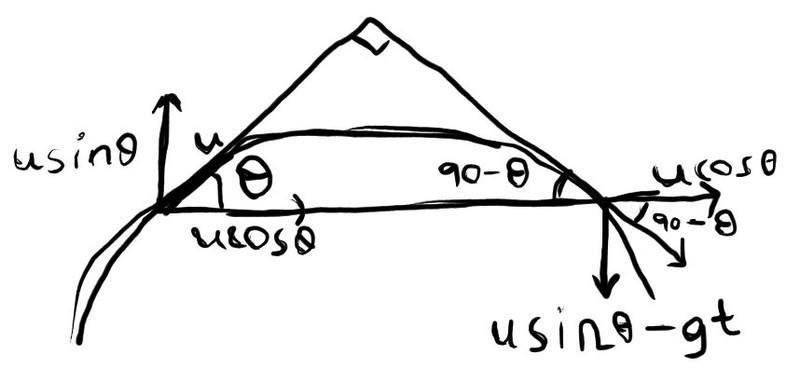
attachment.php?attachmentid=63307&stc=1&d=1382802353.jpg

He is definite that he solver it and the answer is = ucosec(θ)/g which is matching with the answer solving via vectors. Now he is not in contact, I was trying to solve this question.
PLZ help me
 

Attachments

  • paint.jpg
    paint.jpg
    20.6 KB · Views: 417
Physics news on Phys.org
You are required by the forum's rules to show your attempt to get help here.
 
If you recall your functions classes, a line perpendicular to a line with slope m has slope - 1/m. What 's the slope of the line tangent to the first point on your diagram? So what should be the slope of the second point?

Can you write another expression for the slope at the second point?
 

Similar threads

Replies
9
Views
2K
Replies
19
Views
3K
  • · Replies 42 ·
2
Replies
42
Views
3K
Replies
4
Views
2K
Replies
15
Views
3K
  • · Replies 1 ·
Replies
1
Views
2K
  • · Replies 23 ·
Replies
23
Views
4K
  • · Replies 4 ·
Replies
4
Views
5K
  • · Replies 3 ·
Replies
3
Views
3K
  • · Replies 4 ·
Replies
4
Views
2K