Statics: Direction of Vertical/Horizontal Components

Click For Summary

Discussion Overview

The discussion revolves around determining the direction of vertical and horizontal components in free body diagrams (FBDs) for statics problems, particularly in the context of analyzing forces in a pin-supported structure. Participants explore methods for identifying these directions and the role of mathematical analysis in confirming assumptions.

Discussion Character

  • Exploratory
  • Technical explanation
  • Conceptual clarification
  • Debate/contested
  • Mathematical reasoning

Main Points Raised

  • One participant expresses difficulty in determining the directions of forces in FBDs, particularly for member EC, and questions the possibility of analytically determining these directions.
  • Another participant suggests that once a direction is known, it should be denoted appropriately and emphasizes the importance of Newton's third law in determining force directions.
  • A later reply reiterates the need to assume directions for forces and highlights that summing moments can reveal the correct direction for certain forces, such as Ey acting down.
  • One participant acknowledges the realization that reaction forces can be used to infer directions for other members, questioning whether there is a way to determine directions without mathematical analysis.
  • Another participant mentions that intuitive reasoning can sometimes help in determining directions, but emphasizes the necessity of mathematical verification, particularly for less intuitive components.

Areas of Agreement / Disagreement

Participants do not reach a consensus on whether there is a purely analytical method to determine force directions without using math. Some suggest that intuition can guide direction determination, while others stress the importance of mathematical analysis.

Contextual Notes

The discussion reflects varying levels of confidence in using intuition versus mathematical methods for determining force directions, highlighting the complexity of statics problems and the reliance on both conceptual understanding and mathematical verification.

Elfrid Payton
Messages
6
Reaction score
0
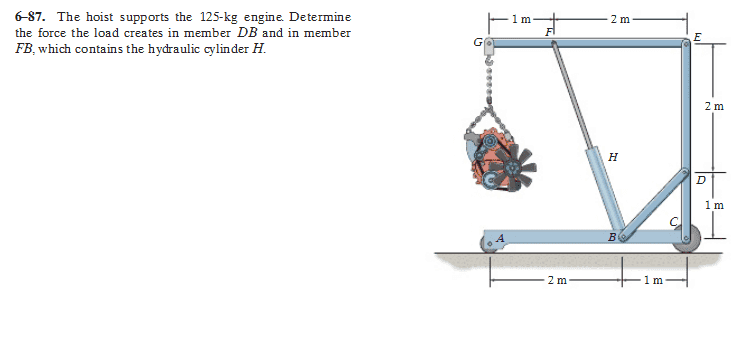
1. The Problem
pTn8woF.png


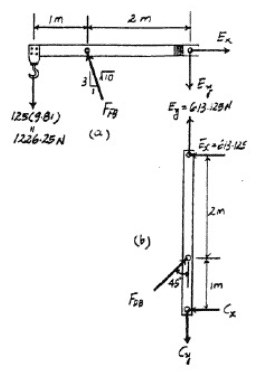
2. The Free Body Diagram
6gGXOel.png
3. The Question

I've always had trouble determining the direction of the vertical and horizontal components in FBDs for statics problems, especially for a pin. Prior to looking at the solution, I wasn't sure on almost all of the directions of the vertical and horizontal components of forces. For member GE, I was sure that the mass of the engine would be pointing down, so I could just use equations of forces and moments to fix signs for the directions of the other forces. But for member EC, I wasn't sure on the directions of any of the forces, which meant that using equations of forces and moments would be of no purpose. Is there any way to analytically determine the direction of forces in statics problems?
 
Physics news on Phys.org
When you are sure of a direction, denote it appropriately, always. Assume a direction of other forces in your step by step fbd's. Then once you know a direction, use it, and don't forget Newtons 3rd law when doing so.

In your first FBD, you know the weight force of the engine acts down...now you can assume the direction of the forces at E and F, but when summing moments about F, you quickly will discover that Ey must act down. So show it down. Then when summing forces in vert direction, you will quickly find that Fy must act up, and thus Fx must act left, and thus, Ex must act right. Then when looking at the next FBD , show force E directions in accord with Newton 3.

Your first step however is to determine what support reactions you can find, before taking frame apart.
 
PhanthomJay said:
When you are sure of a direction, denote it appropriately, always. Assume a direction of other forces in your step by step fbd's. Then once you know a direction, use it, and don't forget Newtons 3rd law when doing so.

In your first FBD, you know the weight force of the engine acts down...now you can assume the direction of the forces at E and F, but when summing moments about F, you quickly will discover that Ey must act down. So show it down. Then when summing forces in vert direction, you will quickly find that Fy must act up, and thus Fx must act left, and thus, Ex must act right. Then when looking at the next FBD , show force E directions in accord with Newton 3.

Your first step however is to determine what support reactions you can find, before taking frame apart.

Ah, I can use reaction forces for the other member! Damn, that should have been really obvious.

So there's no real way to determine direction without using math?
 
Elfrid Payton said:
Ah, I can use reaction forces for the other member! Damn, that should have been really obvious.

So there's no real way to determine direction without using math?
Well intuitively you can sometimes determine correct directions , like in your first FBD, the weight tends to rotate the member ccw about the piston, so the force at E vertically must act down to prevent that rotation . Not intuitive is the direction of the horiz comp of E. So do the math and don't forget Newton 3! And once you know the direction, be sure to note it correctly, or else the minus sign will drive you nuts.
 

Similar threads

  • · Replies 3 ·
Replies
3
Views
3K
  • · Replies 2 ·
Replies
2
Views
2K
  • · Replies 1 ·
Replies
1
Views
2K
  • · Replies 14 ·
Replies
14
Views
3K
Replies
9
Views
2K
  • · Replies 5 ·
Replies
5
Views
2K
  • · Replies 4 ·
Replies
4
Views
3K
  • · Replies 3 ·
Replies
3
Views
2K
  • · Replies 5 ·
Replies
5
Views
3K
  • · Replies 6 ·
Replies
6
Views
2K