Why is my homemade generator not working?

  • Context: Electrical 
  • Thread starter Thread starter nova_n
  • Start date Start date
  • Tags Tags
    Generator Homemade
Click For Summary

Discussion Overview

The discussion revolves around the issues faced by a participant in constructing a homemade generator. The focus is on the design and functionality of the generator, particularly the coil configuration, magnet arrangement, and the resulting induced voltage. Participants explore potential reasons for the low voltage output and the mechanics of magnetic field interaction with the coil.

Discussion Character

  • Exploratory
  • Technical explanation
  • Debate/contested

Main Points Raised

  • The original poster describes the specifications of their coil, including wire gauge, coil dimensions, and number of turns, and notes the low voltage induced when using strong magnets.
  • One participant suggests that the orientation of the magnets may not be optimal for inducing voltage, as the axis of the magnets should change relative to the coil to produce a significant magnetic flux change.
  • Another participant emphasizes the importance of visualizing the setup and questions whether the magnets are spinning in a way that allows for effective magnetic field interaction.
  • The original poster considers whether the thickness of the coil might be affecting the magnetic field's ability to cut through enough turns to induce a higher voltage.

Areas of Agreement / Disagreement

Participants express differing views on the mechanics of the magnetic field interaction with the coil. There is no consensus on the exact cause of the low voltage output, and multiple hypotheses are presented regarding the setup and configuration.

Contextual Notes

Participants have not provided visual aids to clarify the setup, which may limit the understanding of the discussed mechanics. The discussion includes assumptions about the effectiveness of the coil's thickness and the orientation of the magnets that remain unresolved.

nova_n
Messages
2
Reaction score
1
Hello! first post!

help.png


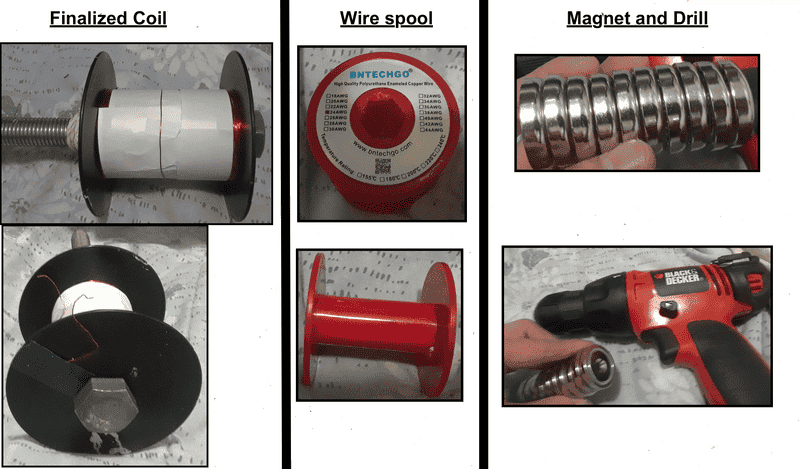
So my copper wire is 24 gauge, aka 0.51mm diameter. And the spool was filled to the full volume of the cylinder. In the finalized coil, the portion in between the walls is 7.75cm in length, and the coil(not the black walls) is 7.5 cm. I found that by taking the diameter of the walls and subtracting it from the length of a line that goes up from the red wire, all the way to the edge. The hole in the black spool is about 1.75 cm. Approximating the coil as many circles stacked onto each other, i have 112 layers, and 151 coils per layer. This means i have approximately 16912 turns.

I made sure the turns ALL go in the same direction

However, when i use my 90 lb pull force cup magnets, and make sure that the changing field is parallel to the coil, i can only induce 0.2 volts moving it slowly.


When he was building it, he only used 300 turns,didn't have an iron/steel core, and used weak ceramic magnets. And he even spun the magnets slowly, and managed to get 1.5-3 volts out of it.

I tried spinning my cup magnets with the power drill that can go 700 rpm max, and that actually induced less voltage.

I suspect there may be breaks in the enamel, but I couldn't see them. That wouldn't make sense though, because it could pick up a spoon when i turned it into an electromagnet with 18v running through Any input on what went wrong?
 

Attachments

  • help.png
    help.png
    82.6 KB · Views: 1,202
Last edited:
Physics news on Phys.org
You do not explain how the magnets move inside the coil. It appears that their axis spins along the axis of your external coil because you are "making sure that the changing field is parallel to the coil". If so, they will produce minimal magnetic flux change through the coils. If you look at the video that you posted, anyone of the magnets is spinning so that its north-south axis reverses direction relative to the coil axis after half a turn. That's very important and if it doesn't happen in your setup, would be the cause of the lack of induced voltage.
 
Last edited:
It is hard to visualize what @kuruman said without a picture. Do your magnets spin as shown in this picture?

Q4Qg1.png


If you spin this way, it won't work.
images?q=tbn:ANd9GcSRP7uc5wRf9iRBSER0cIun5iehfEzfz9Hqi7a7LihffyEtt-WAzQ.jpg
 

Attachments

  • Q4Qg1.png
    Q4Qg1.png
    2.8 KB · Views: 1,122
  • images?q=tbn:ANd9GcSRP7uc5wRf9iRBSER0cIun5iehfEzfz9Hqi7a7LihffyEtt-WAzQ.jpg
    images?q=tbn:ANd9GcSRP7uc5wRf9iRBSER0cIun5iehfEzfz9Hqi7a7LihffyEtt-WAzQ.jpg
    3.7 KB · Views: 955
  • Like
Likes   Reactions: kuruman
anorlunda said:
It is hard to visualize what @kuruman said without a picture. Do your magnets spin as shown in this picture?

View attachment 236343

If you spin this way, it won't work.
View attachment 236344
Yes, you said with pictures what I tried to say with just words.
 
yes. I spin it that way. I didnt put it in the icture. But basically, i put a screwdriver in the drill, and 5 magnets on each side. I find stuff to shove between the sides to separate them. So L1 would have 5 magnets, and L2 would also have 5 magnets. The axis is the screwdriver.

Is the magnetic field just not cutting through enough turns?, Like is my coil too thick, and the magnetic field doesn't cut through enough of the turns?
 
Last edited:
nova_n said:
I didnt put it in the icture.
Could you Upload a picture so we can see exactly what your setup is? Use the UPLOAD button in the lower right of the Edit window to Upload a PDF or JPEG image to a new Reply from you. Thanks. :smile:
 

Similar threads

  • · Replies 35 ·
2
Replies
35
Views
5K
  • · Replies 12 ·
Replies
12
Views
3K
  • · Replies 4 ·
Replies
4
Views
2K
  • · Replies 10 ·
Replies
10
Views
5K
Replies
4
Views
2K
  • · Replies 1 ·
Replies
1
Views
5K
  • · Replies 9 ·
Replies
9
Views
3K
  • · Replies 25 ·
Replies
25
Views
7K
  • · Replies 28 ·
Replies
28
Views
17K
  • · Replies 6 ·
Replies
6
Views
2K