Finding diameter of pins from allowable shear stress

Click For Summary

Discussion Overview

The discussion revolves around determining the diameter of pins based on allowable shear stress, focusing on the forces acting on a frame structure. Participants explore various methods for calculating forces, particularly at joint B, and the implications of treating certain members as zero-force members.

Discussion Character

  • Technical explanation
  • Debate/contested
  • Mathematical reasoning

Main Points Raised

  • One participant expresses confusion about their calculated force at joint B, suspecting they are missing a factor affecting their results.
  • Another participant suggests that if moments are taken at the joint where a force is applied, the force in member BC must be zero, leading to a discussion about the nature of the members in the frame.
  • Some participants clarify that the structure is a frame, not a truss, which affects the analysis of forces acting on the members.
  • There is a debate about whether member BC can be considered a zero-force member, with some arguing it cannot be, while others provide reasoning for why it might be treated as such.
  • One participant calculates a force in member BC using moments and finds a satisfactory result, questioning why their earlier sum of forces approach did not yield the same outcome.
  • Another participant explains that for static equilibrium in three-force members, the forces must be concurrent or parallel, which was not the case in the participant's free body diagram (FBD).
  • There are suggestions to use a combination of force and moment summations for analysis, emphasizing the importance of choosing the easiest method for the situation.
  • A participant mentions the importance of understanding the reasons behind the failure of certain methods to deepen their comprehension of static analysis.

Areas of Agreement / Disagreement

Participants do not reach a consensus on whether member BC can be treated as a zero-force member. There are multiple competing views regarding the application of force and moment summation methods, and the discussion remains unresolved on the best approach to analyze the forces in the frame.

Contextual Notes

Participants note that the geometry of the FBD used in the sum of forces approach does not support static equilibrium, highlighting the complexity of analyzing frames compared to trusses. There is also mention of the need for careful labeling and neat calculations in analysis.

Who May Find This Useful

Individuals studying statics, particularly those interested in structural analysis of frames and the application of equilibrium principles in engineering contexts.

Saladsamurai
Messages
3,009
Reaction score
7
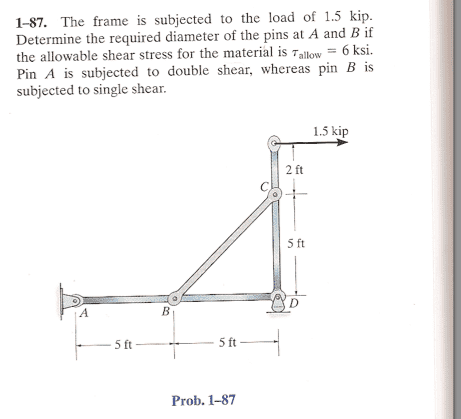
So I got the diameter of the pin at a no problem. For some reason I am screwing up the Force at B. I thought my reasoning was correct, but I am coming up short. The answer is larger then what I an getting, so my F_BC must be too small, thus I am not accounting for something.

Picture1-1.png


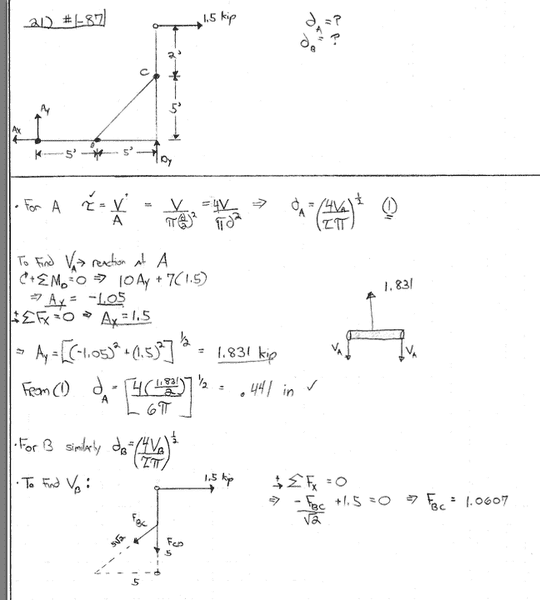
Here is my work:
Picture2-2.png
 
Physics news on Phys.org
Did you notice if you took moment at the joint where the 1.5 k force is applied in your last FBD, the force BC will have to be 0?
 
Cyclovenom said:
Did you notice if you took moment at the joint where the 1.5 k force is applied in your last FBD, the force BC will have to be 0?

Only now that you mention it. I don't understand. I see that by sum of moments, BC is indeed a zero-force member. But by sum of the forces, I cannot see how it could be.

Where did I err in my Sum of Forces rationale?

But I am also confused when I now look at the original picture in the text. Is ADC all ONE piece? Or is AD a member that is pinned at D to the vertical piece? If it is all one piece, I can see how BC is zero, but if the horizontal AD and the vertical D to the end (where 1.5 is applied) are two separate pieces pinned at D, then I cannot see it.
 
Last edited:
This is not a truss, this is a frame. Members in frames have 2 or more forces acting on them instead of just 2 like in trusses. To find the force along BC you could isolate member AD and take moment about D.
 
Saladsamurai said:
But I am also confused when I now look at the original picture in the text. Is ADC all ONE piece? Or is AD a member that is pinned at D to the vertical piece? If it is all one piece, I can see how BC is zero, but if the horizontal AD and the vertical D to the end (where 1.5 is applied) are two separate pieces pinned at D, then I cannot see it.

I've not seen the symbol used as a pin in this diagram before, but it looks to me like is not one piece.
 
BC cannot be a zero force member, else it all folds up like a card table. So, if you do sum of moments about D, what do you get for the horizontal component of BC? The horizontal and vertical pieces are single pieces, i.e., there are only 3 members in this problem.
 
TVP45 said:
BC cannot be a zero force member, else it all folds up like a card table. So, if you do sum of moments about D, what do you get for the horizontal component of BC? The horizontal and vertical pieces are single pieces, i.e., there are only 3 members in this problem.

Okay, yes I don't know why I said it was zero sonce there is a perendicular distance from C to the 1.5 force.

If I take the moment about D, I get that BC=2.97, which works like a charm. Thanks.

Can someone tell me though, why did my sum of the forces approach, fail? It really shouldn't?

If I make a horizontal cut through BC and CD like I did in the last FBD I drew and analyze the top half, I should get,

[tex]\sum F_x=0\Rightarrow -\frac{5\sqrt{5}}{5}F_{BC}+1.5=0\Rightarrow F_{BC}=2.12[/tex]

What happened?

Casey
 
You generally should use a combination of force summations and moment summations - just do what's easy.

So, by visual eamination Ax = - 1.5kip

Likewise, by visual examination, Cy = - Ay

Then, summing moments about A solves for Cy

You just have to work at it gently. If one joint doesn't work, move to another. And, when you're starting, standard angles help (although you really don't need them for this problem).
 
Okay, but I still do not see why sum of forces fails. And I chose to use that initially because it doesn't get much easier then that.

If either way, I have to make a cut to expose the internal force in BC, why should it matter if I take sum of forces or sum of moments? Why would one method take priority over the other?

Thanks for your help by the way! I know it's annoying, but I feel like if I can figure out exactly why some methods don't work as opposed to just using the ones that do work, I will have a deeper understanding of the methods of analysis.

Thanks,
Casey
 
  • #10
Well, you don't really have to cut BC. Just look for convenient pins that have lots of zero moment arms. The trick in analysis is to be lazy and always take the easiest path. Just remember to carefully label everything and be super neat in your calculation sheet(s). In almost every analysis, you have to use BOTH moments and forces, and there's no real understanding to be had except this: Static means not moving. Not translating. Not rotating.

Then, just work a few hundred problems and it will start to look OK to you.
 
  • #11
Saladsamurai said:
Okay, but I still do not see why sum of forces fails. And I chose to use that initially because it doesn't get much easier then that.

The reason the sum of forces "failed" if that for static equilibrium in 3 forces members, the forces if they are not parallel then they (the 3 forces) must be concurrent, but as you can see in the geometry on the FBD you used the forces were not concurrent or parallel therefore one of them had to be zero in order to maintain the sum of moments condition of equilibrium.

Saladsamurai said:
Thanks for your help by the way! I know it's annoying, but I feel like if I can figure out exactly why some methods don't work as opposed to just using the ones that do work, I will have a deeper understanding of the methods of analysis.

Btw, I'm happy you feel this way. What i was saying earlier that if we look closer at the "failed" FBD you will see there cannot be static equilibrium for the reasons already stated. Now i want you to remember again that in frames there can be more than 2 forces acting on a single member. What this means is that generally the forces wouldn't be directed along the members in which they act; their direction is unknown. This is not the case for trusses (i've the feeling you are familiar with them), so in the future for solving problems with frames consider the method described in your book, or the isolating each simple member and applying Newton's 3rd Law.
 
Last edited:
  • #12
Casey,
If you're teaching yourself statics, I might suggest the book Simplified Engineering for Architects and Builders, Harry Parker and James Ambrose, John Wiley & Sons. You can probably pick up a used copy off Amazon for less than $20 (US).
 
  • #13
Cyclovenom said:
The reason the sum of forces "failed" if that for static equilibrium in 3 forces members, the forces if they are not parallel then they (the 3 forces) must be concurrent, but as you can see in the geometry on the FBD you used the forces were not concurrent or parallel therefore one of them had to be zero in order to maintain the sum of moments condition of equilibrium.


Btw, I'm happy you feel this way. What i was saying earlier that if we look closer at the "failed" FBD you will see there cannot be static equilibrium for the reasons already stated. Now i want you to remember again that in frames there can be more than 2 forces acting on a single member. What this means is that generally the forces wouldn't be directed along the members in which they act; their direction is unknown. This is not the case for trusses (i've the feeling you are familiar with them), so in the future for solving problems with frames consider the method described in your book, or the isolating each simple member and applying Newton's 3rd Law.

Thanks Cyclovenom. I think things are making a little more sense, though I am still not sure now why Sum of Moments does work though I do understand why sum of forces does work which is a sterp in the right direction!


TVP45 said:
Casey,
If you're teaching yourself statics, I might suggest the book Simplified Engineering for Architects and Builders, Harry Parker and James Ambrose, John Wiley & Sons. You can probably pick up a used copy off Amazon for less than $20 (US).

I actually have a text. I was doing a directed study in which I met with my instructor only about five times over a 5-6 week period. So most of it was on me (and PF!) since I still had to take exams and what not. I still have one exam left and I'll tell you I can't wait until it's over! My regular semester started back up so I am at 5 classes right now, two of which are based on Statics. So I could really use that extra time!

Hey, I posted another engineering thread in the physics section, since it's the physics part that's really screwing with me. I thought it might get more traffic there.

If one of you guys happens to get a moment and wants to give me a nudge in the right direction, that would be rad.

Here it is https://www.physicsforums.com/showthread.php?t=212920.

Thanks for all of your guys!
Casey
 
  • #14
I think I figured it out now! You were right Cyclovenom, I have it in my head that the method of sections works on frames too. I don't use that method for frames, I am supposed to "take the frame apart" right? And analyze the the forces acting on each member right?

Casey
 
  • #15
Saladsamurai said:
Thanks Cyclovenom. I think things are making a little more sense, though I am still not sure now why Sum of Moments does work though I do understand why sum of forces does work which is a sterp in the right direction!

Frankly, you will understand more why as soon as you know that all systems can turn into (statically equivalency) a couple-resultant system, this is possible with a transport couple. Therefore, in order to have static equilibrium both the resultant force and the couple must be null.
 
  • #16
Saladsamurai said:
I think I figured it out now! You were right Cyclovenom, I have it in my head that the method of sections works on frames too. I don't use that method for frames, I am supposed to "take the frame apart" right? And analyze the the forces acting on each member right?

Casey

Yeah exactly :approve:
 

Similar threads

  • · Replies 2 ·
Replies
2
Views
1K
  • · Replies 2 ·
Replies
2
Views
2K
  • · Replies 1 ·
Replies
1
Views
2K
  • · Replies 6 ·
Replies
6
Views
2K
  • · Replies 1 ·
Replies
1
Views
2K
  • · Replies 1 ·
Replies
1
Views
2K
  • · Replies 36 ·
2
Replies
36
Views
6K
  • · Replies 8 ·
Replies
8
Views
3K
Replies
5
Views
2K
  • · Replies 3 ·
Replies
3
Views
2K