
Why the Tidal Bulge Doesn’t Exist – Tidal Theory Explained
There is no tidal bulge raised by the Moon on the Earth’s oceans, despite its widespread use to explain why the Moon is receding from the Earth. The real explanation relies on the dynamic theory of the tides, developed by Pierre-Simon Laplace and later extended by William Thomson (Lord Kelvin), George Darwin, and A.T. Doodson, which accounts for ocean depth, continental barriers, and the Coriolis effect to produce oceanic tides without any equilibrium bulge.
Contents
Key Takeaways
- Newton’s equilibrium tide theory predicts two tidal bulges, but high tides in most of the North Sea do not occur at the same time everywhere, which falsifies that theory.
- A tidal bulge wave would need to travel at roughly the Earth’s equatorial rotational speed of 465 m/s, but a shallow-water wave moves at approximately ##\sqrt{gd}##, giving only about 205 m/s at the mean ocean depth of 4267 m and about 330 m/s over the deepest oceanic trench.
- The North Atlantic accounts for 40% of the M2 tidal dissipation, and the North Sea contains two full M2 amphidromic points plus a partial one near the tip of Norway.
- A.T. Doodson, starting in 1919, applied a newer lunar orbital model and identified 388 harmonic tidal components, leading to the Doodson numbering scheme.
- Affholder and Valiron’s Descriptive Physical Oceanography (2001) states that an equilibrium tidal wave moving at 1600 km/h would require an ocean depth of 22 km, far more than the actual average depth of 3.9 km, so the equilibrium position required by Newton’s theory cannot be established.
What is the tidal bulge, and why is it invoked for the Moon’s recession?
Searches for explanations of why the Moon is gradually spiraling outward typically turn up a vague reference to tides raised by the Moon, or a more detailed picture built around the Earth’s tidal bulge.

Source: Wikipedia page on the tides
In this traditional picture, the Moon’s gravitation raises a pair of tidal bulges in the Earth’s oceans, one near the sublunar point and one on the opposite side of the Earth. The Earth’s rotation carries these bulges slightly ahead of and behind the Moon’s position. Both bulges exert gravitational pulls on the Moon: the closer, leading bulge accelerates the Moon, while the farther, trailing bulge decelerates it. Because the leading bulge is nearer, its pull dominates, and the net effect is to accelerate the Moon into a higher orbit.
There is only one problem with this simple picture: there is no tidal bulge.
Why doesn’t the tidal bulge exist?
Newton’s equilibrium theory is falsified by observation
Isaac Newton correctly derived the tidal forcing function but was wrong about how the oceans respond to it. His equilibrium theory, with its two tidal bulges, predicts that high tide should occur when the Moon is at zenith and again at nadir, spaced 12.421 hours apart. Most ocean locations do experience a high tide roughly every 12.421 hours, but whether that high tide coincides with the Moon’s zenith or nadir is essentially a matter of local circumstance, with a predictable, nonzero offset at most sites.
The North Sea, in Newton’s own backyard, is one of the clearest counterexamples. If equilibrium theory were correct, high and low tide would occur at roughly the same time across the entire North Sea. Instead, at any given moment, one location in the North Sea is experiencing high tide while another simultaneously experiences low tide. Tidal bulges are also not observed at coastal tide stations, from meteorological buoys, or from satellites.
Three physical reasons a bulge cannot exist
A tidal bulge spanning half the Earth’s circumference would form a wave far longer than the ocean is deep, making it a shallow-water wave. The speed of a shallow wave at a given location is approximately ##\sqrt{gd}##, where ##d## is the local ocean depth. At the equator, this limits the tidal wave to about 330 m/s over the deepest oceanic trench and about 205 m/s at the mean ocean depth of 4267 m, both slower than the Earth’s 465 m/s equatorial rotational speed. The bulge wave simply cannot keep pace with the Earth’s rotation.
Second, the Earth is not fully covered by ocean. The Americas and Afro-Eurasia form continuous north-south barriers that block any continuous bulge wave. As one example, the tides on Panama’s Pacific coast differ greatly in timing and form from the tides just 100 kilometers away on Panama’s Caribbean coast.
Third, because the Earth rotates at a different rate than the Moon orbits, the Coriolis effect would shear any bulge wave apart even on a hypothetical ocean-covered Earth of uniform, very great depth.
What do other sources say?
Lecture notes archived from the Virginia Institute of Marine Science ask whether water confined to a basin can engage in wave motion like the sweeping tidal bulges of equilibrium theory, and answer plainly: “The answer is – it can’t.”
Affholder and Valiron’s Descriptive Physical Oceanography (2001) introduces Newton’s equilibrium tide and then states that for the tidal wave to move at 1600 km/h, the ocean would need to be 22 km deep; with the actual average depth of 3.9 km, the tidal elevation can only move at 700 km/h, so “the equilibrium position at any instant required by this theory cannot be established.”
Doesn’t the bulge model successfully predict the Moon’s acceleration?
The tidal bulge model can be fit to reproduce the Moon’s observed acceleration, but this fit does not validate the model. The procedure starts from the invalid assumption that the bulge exists, then calculates a lag angle that best matches lunar laser retroreflector observations. Because the bulge’s 12.421-hour period matches the dominant 12.421-hour M2 tidal period that actually governs most ocean tides, the fit looks good even though the underlying assumption is wrong. An invalid assumption can still yield a good numerical fit; that does not make the assumption true.
What forces actually generate the tides?
Newtonian gravity on a test object
This section covers what Newton did get right: the underlying tide-generating forces. Newton originally presented this using synthetic geometry in the Principia, in part to avoid foregrounding his newly invented calculus. The derivation below instead uses modern vector notation and the gravitational constant ##G##, both of which postdate the Principia by roughly two centuries.
For a gravitating body ##B## with mass ##M_B## acting as a point mass (or a body with a radial mass distribution) on a small test object ##o## with mass ##m##, with ##\vec \rho## the vector from the test object to body ##B##, Newton’s universal law of gravitation gives the gravitational force on the test object as:
$$\vec F_{o,B} = \frac{G M_B \, m}{||\vec \rho||^3}\vec \rho\tag{1}$$
Dividing both sides of equation (1) by the test object’s mass ##m## yields the acceleration of the test object toward body ##B##:
$$\vec a_{o,B} = \frac{G M_B}{||\vec \rho||^3}\vec \rho\tag{2}$$
If ##\vec p## is measured relative to the center of mass of a primary body ##A##, and ##\vec r## is the vector between the centers of mass of bodies ##A## and ##B##, Newton’s law also gives the gravitational acceleration of body ##A## toward body ##B##:
$$\vec a_{A,B} = \frac{G M_B}{||\vec r||^3}\vec r\tag{3}$$
The test object’s position may be expressed as a vector ##\vec p## relative to the origin of body ##A##. A satellite orbiting the Earth, for instance, is naturally described in an Earth-centered inertial (ECI) frame, and is affected by gravitational acceleration toward the Earth, the Moon, the Sun, and in principle everything else. In this article, the test object is instead a small parcel of water at the ocean’s surface.
Expressing gravity in an accelerating, body-centered frame
An Earth-centered frame is not inertial; it is accelerating. To express the gravitational acceleration from equation (2) in a frame centered on body ##A##, one subtracts the gravitational acceleration of body ##A## toward body ##B## (equation 3) from the acceleration of the test object toward body ##B## (equation 2):
$$\vec a_{o,B;A} = \frac{G M_B}{||\vec \rho||^3}\vec \rho \,-\, \frac{G M_B}{||\vec r||^3}\vec r\tag{4}$$
Since ##\vec \rho = \vec r – \vec p##, substituting into equation (4) gives:
$$\vec a_{o,B;A} = \frac{G M_B}{||\vec r – \vec p||^3}(\vec r – \vec p) \,-\, \frac{G M_B}{||\vec r||^3}\vec r\tag{5}$$
Writing ##\vec p = p(\cos\theta \,\hat r + \sin\theta \,\hat t\,)## where ##p = ||\vec p||##, ##\theta## is the angle between ##\vec r## and ##\vec p##, ##\hat r## is the unit vector from body ##A## to body ##B##, and ##\hat t## is the unit vector orthogonal to ##\hat r## in the ##A-o-B## plane, equation (5) becomes:
$$\vec a_{o,B;A} = \frac{G M_B}{||(r-p\cos \theta)\hat r – p\sin\theta\,\hat t||^3}((r-p\cos \theta)\hat r – p\sin\theta\,\hat t)) \,-\, \frac{G M_B}{||\vec r||^3}\vec r\tag{6}$$
For ##p \ll r##, at values of ##\theta## that are integer multiples of 90°, this simplifies to first order to a form proportional to ##GMp/r^3##. This is the basis for describing tidal forces as inverse-cube forces, in contrast to the inverse-square law of Newtonian gravity.
A graphical depiction of tidal acceleration

Source: Tidal force asymmetry @ mercer.edu
A note on computation
Equation (5), computed naively, involves significant cancellations and can lose precision in a computer’s native floating-point representation. This can be addressed; Richard Battin’s An Introduction to the Mathematics and Methods of Astrodynamics (1999) covers such methods, though applied to satellites orbiting a primary body rather than ocean parcels. The mathematics is the same. In aerospace engineering, these tidal gravitational accelerations are called third-body effects, distinguishing them from tidal gravitation, the term used for how the Moon and Sun distort the Earth’s shape, which in turn affects satellites orbiting the Earth.
What is the dynamic theory of the tides?
The tidal forces shown above appear to stretch the Earth along the Earth-Moon line and compress it orthogonally, which is exactly how Newton’s bulge picture arises so naturally. But as established above, this bulge cannot and does not exist. What Newton got wrong, Pierre-Simon Laplace later corrected with the dynamic theory of the tides, which accounts for water’s fluid flow, varying ocean depths and shapes, seafloor friction, and resonance effects. This theory explains why it is always high tide somewhere in the North Sea, in Patagonia, and around New Zealand’s coast.
Horizontal forcing and amphidromic systems
Because water flows, it is the horizontal component of the tidal forcing function, not the vertical component, that drives ocean tides. Here, “vertical” means in the direction of the local inward gravitational gradient rather than strictly toward the Earth’s center. Rivers such as the Mississippi and the Mekong (downstream of the Manwan Dam) flow “uphill” in the sense of increasing distance from the Earth’s center, while still flowing “downhill” toward lower gravitational potential energy, since a plumb bob’s “down,” owing to the Earth’s equatorial bulge, does not generally point exactly toward the Earth’s center.
The horizontal components of the tidal forcing, combined with the Earth’s rotation, basin depth, continental outlines, and resonance, produce amphidromic systems: regions where tidal responses rotate about central points, called amphidromic points, that experience no tide for a given frequency component.
Who developed the dynamic theory?
Frequency-domain analysis of the tides, developed decades after Laplace, extended the dynamic theory of the tides through several key contributors:
| Contributor | Contribution |
|---|---|
| Pierre-Simon Laplace | Originated the dynamic theory of the tides, accounting for fluid flow, ocean depth and shape, and friction |
| William Thomson (Lord Kelvin) | Applied Fourier analysis to historical tidal data |
| George Darwin (son of Charles Darwin) | Extended Thomson’s work using then-available lunar orbit models; named harmonic components such as M2, the principal lunar semidiurnal tide |
| A.T. Doodson | From 1919, applied a newer lunar orbit model, identified 388 harmonic components, and devised the Doodson numbering scheme |
What are the main tidal harmonic components?
| Component | Period / frequency | Cause |
|---|---|---|
| M2 | 1 cycle per 12.421 hours | Dominant lunar tidal force at most locations |
| S2 | 1 cycle per 12 hours | Solar tidal force, about half as strong as the Moon’s |
| M1 | 1 cycle per 24.841 hours | Asymmetry from the Earth’s rotational axis not being orthogonal to the Earth-Moon line |
| S1 | 1 cycle per 24 hours | Corresponding solar asymmetry |
| Fortnightly/monthly | Two cycles and one cycle per anomalistic month | Elliptical lunar orbit (varying lunar influence between apogee and perigee) |
| Semiannual/annual | Varies with Earth’s orbital position | Elliptical Earth orbit (varying solar influence between aphelion and perihelion) |
| Spring/neap | Two cycles per synodic month | Combined lunar and solar alignment |
Each of these frequency components has its own distinct set of amphidromic systems.
How do amphidromic systems explain regional tides?
What is an amphidromic system?
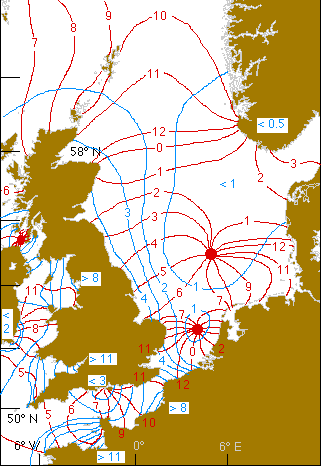
Each tidal harmonic component has its own set of amphidromic systems, each centered on an amphidromic point about which tides rotate. Focusing on the M2 component, the North Sea region contains three M2 amphidromic systems, which explains why its tides behave so unusually.

Source: Wikipedia article on tidal constituents
The M2 component is the roughly twice-daily response to the Moon’s tidal forcing and is the dominant tidal component in most of the world. At M2 amphidromic points, the M2 tidal response is zero, yet these points remain essential to modeling the overall tidal response. White “cotidal lines” radiating from each amphidromic point mark where high and low M2 tides occur simultaneously, and tidal amplitude increases with distance from the amphidromic point.

Source: archived from volkov.oce.orst.edu/tides/global.html.
Why are North Sea tides so unusual?
The North Atlantic accounts for 40% of the M2 tidal dissipation, and the North Sea is a hub of that dissipation. Two full M2 amphidromic points lie within the North Sea, with a partial M2 amphidromic point near the tip of Norway, which together account for the region’s chaotic tidal behavior.
Archived source: Archived from geog.ucsb.edu/~dylan/ocean.html
How does M2 tidal energy flow around the globe?
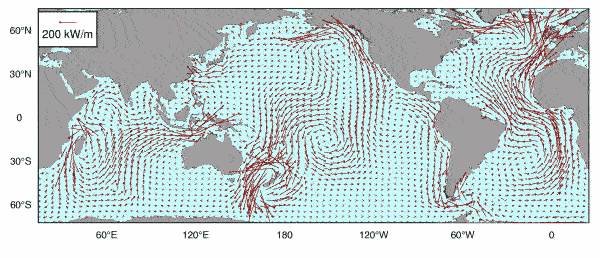
Tidal energy transfer, from sources to sinks, explains the unusual Patagonian tides, which largely result from energy transferred from the Pacific to the Atlantic. The same transfer accounts for the large flow of energy into the North Atlantic, where 40% of M2 tidal dissipation occurs.
Source: Archived from altimetry.info/thematic-use-cases/ocean-applications/tides/
How does this tidal energy transfer make the Moon recede?
This energy transfer is closely tied to the exchange of angular momentum between the Earth’s mantle/crust and its oceans, one measurable result being the gradual slowing of the Earth’s rotation, so that a day was shorter hundreds of millions of years ago than it is now. The same process also transfers angular momentum between the oceans and the Moon’s orbit, causing the Moon to recede gradually from the Earth. Every amphidromic system within every tidal harmonic component contributes to this transfer, with the M2 component making the largest single contribution.
This overall energy transfer can be described loosely as a “net tidal bulge,” though that framing is optional and somewhat misleading given everything established above.
How do ocean tides compare to tsunamis and solid-body tides?
Tsunamis versus tides
A tsunami is the response to a nearly impulsive driving event such as an earthquake, while tides are the response to a continuous, cyclical driving force. Even so, a tsunami’s impulse response is informative about the ocean’s response to cyclical tidal forcing.
| Property | Tsunamis | Ocean tides |
|---|---|---|
| Wave type | Shallow wave, “feels” the ocean bottom regardless of depth | Shallow wave, same behavior |
| Role of topography | Strongly affects wave speed | Shapes the amphidromic systems |
| Coriolis effect | Small, becomes apparent only in the long-term oceanic response | Contributes to the shape and extent of amphidromic systems |
An animation of the 2011 Tohoku, Japan earthquake tsunami is available on YouTube.
References: Dao, M. H., & Tkalich, P. (2007). Tsunami propagation modeling: a sensitivity study. Natural Hazards and Earth System Science, 7(6), 741-754. Eze, C. L., Uko, D. E., Gobo, A. E., Sigalo, F. B., & Israel-Cookey, C. (2009). Mathematical Modelling of Tsunami Propagation. Journal of Applied Sciences and Environmental Management, 13(3). Kowalik, Z., Knight, W., Logan, T., & Whitmore, P. (2005). Numerical modeling of the global tsunami: Indonesian tsunami of 26 December 2004. Science of Tsunami Hazards, 23(1), 40-56.
Solid-body (Earth) tides
The Moon and Sun also raise tides in the solid Earth, called Earth tides or solid body tides, the latter term applying equally to other terrestrial bodies. Because waves propagate differently in solids than in liquids, and the core-mantle boundary lies far deeper than any ocean, an equilibrium tide model fits the Earth’s solid body tides reasonably well, unlike the ocean case.
Solid body tides and oceanic tides can fall out of sync, adding to or subtracting from oceanic tide heights at particular locations. Many researchers hypothesize that the Earth’s solid body tides can trigger earthquakes, though this remains an open question.
How is the tidal bulge used in teaching today?
Oceanographers still teach Newton’s equilibrium tide theory for several reasons: it correctly describes the tidal forcing function, and many students, along with some instructors and textbook authors, struggle to understand how a location can experience two tides a day. Some oceanography texts still attribute the outer bulge to a centrifugal force, a claim that frustrates geophysicists and geodesists. Over the last twenty years or so, some oceanography courses and references have begun teaching that gravitation alone explains the tides.
Laplace’s dynamic theory of the tides gives a truer picture of oceanic behavior, and local astronomical tide predictions at coastal sites worldwide rely on historical data to derive empirical, location-specific values for each tidal harmonic component. Though empirical and locally derived, these predictions match observations well once weather effects are filtered out, and they also inform the shape of local amphidromic systems.
Summary
The Moon, and to a lesser extent the Sun, whose tidal influence is less than half the Moon’s, drive the oceanic tides. Their combined forcing is best understood in the frequency domain, which yields distinct harmonic components; translating these back into the spatial domain produces separate amphidromic systems for each component. The tidal bulge survives in oceanography only as a simplified teaching device, openly flagged as such to students, while the dynamic theory of the tides is taught as the accurate model. For the Moon’s recession from the Earth, however, the tidal bulge is still commonly presented as literal fact rather than a simplification, without the caveat it deserves.
Glossary
- Tidal bulge: The hypothesized pair of ocean bulges raised directly by the Moon’s gravity under Newton’s equilibrium tide theory; shown in this article not to exist.
- Dynamic theory of the tides: Laplace’s model of oceanic tides accounting for fluid flow, ocean depth and shape, bottom friction, and resonance.
- Amphidromic point: A location where a given tidal harmonic component has zero amplitude, around which that component’s tidal response rotates.
- Amphidromic system: The full pattern of cotidal lines and rotating tidal response surrounding an amphidromic point.
- M2 tidal component: The principal lunar semidiurnal tide, with a period of 12.421 hours, the dominant tidal harmonic in most locations.
- Cotidal line: A curve along which high (or low) tide for a given component occurs at the same time.
- Doodson numbers: A numbering scheme devised by A.T. Doodson to catalog the 388 tidal harmonic components he identified starting in 1919.
Frequently Asked Questions
Does the Earth really have a tidal bulge raised by the Moon?
No. Observations such as the inconsistent timing of high tide relative to the Moon’s zenith and nadir, the simultaneous high and low tides across the North Sea, and the absence of any observed bulge from tide stations, buoys, or satellites all contradict Newton’s equilibrium tide theory.
Why can’t a tidal bulge wave keep up with the Earth’s rotation?
A tidal bulge would form a shallow-water wave limited to roughly 205 m/s at the mean ocean depth of 4267 m, or about 330 m/s over the deepest trench, both slower than the Earth’s 465 m/s equatorial rotation speed, so the bulge cannot track the Moon’s position.
What theory correctly explains the ocean tides?
Laplace’s dynamic theory of the tides explains ocean tides by accounting for water’s fluid flow, varying ocean depth and shape, seafloor friction, and resonance, producing amphidromic systems rather than a simple equilibrium bulge.
What is an amphidromic point?
An amphidromic point is a location where a particular tidal harmonic component, such as M2, has zero amplitude, with the tidal response for that component rotating around it via radiating cotidal lines.
Why are the tides in the North Sea so unpredictable?
The North Sea contains three M2 amphidromic systems, including two full amphidromic points and a partial one near the tip of Norway, which causes high and low tide to occur at different times across the region simultaneously.
How does the ocean tide cause the Moon to recede?
Angular momentum transfers between the Earth’s oceans and the Moon’s orbit through the combined effect of all tidal harmonic amphidromic systems, with the M2 component contributing the most, gradually pushing the Moon to a higher orbit while slowing the Earth’s rotation.
Are ocean tides the same as tsunamis?
No. Tsunamis result from a nearly impulsive event like an earthquake, while tides respond to a continuous cyclical force, though both are shallow waves affected by ocean topography and the Coriolis effect.





[QUOTE=”roufeng_yang, post: 7245724, member: 760634″]
solid earth is mechanically elongated by a combination of the Moon’s gravitational force and the centrifugal force due to the Earth’s rotation around the barycenter of the Earth-Moon system.
[/QUOTE]
What prevents the water itself from ‘bulging’ under tidal forces?
[QUOTE=”roufeng_yang, post: 7245724, member: 760634″]
Ocean water (as a fluid) is continuous, any location within it will not simply respond to any force that applies to it
[/QUOTE]
Why?
[QUOTE=”Ken G, post: 7141798, member: 116697″]
It certainly looks like this is not a “lie to children,” it’s just a “lie.” I’m not a big fan of lying to students, it smacks of “truthiness,” and science is supposed to be pretty close to the [I]opposite[/I] of that.
[/QUOTE]
The equilibrium tide theory (I’m using theory here in the mathematical sense: a body of knowledge, as in string theory or knot theory) has some validity for some tides, but not in the Earth’s oceans, where it has no validity. Educators consider it to be too big of a jump to go from the tidal forcing functions directly to the dynamic theory of the tides. Many students do not comprehend how there can be two bulges, one centered on the zenith point and the other on the antipodal (nadir) point. Those instructors tend to follow Newton’s derivation, calling the outer bulge due to a centrifugal force that is constant all across the world. (That is not a centrifugal force. Also, it is not needed. I did not invoke that concept in the article.)
There are bodies where the equilibrium tide model is approximately correct. The solid body tides are one example. Tidally-locked bodies with a liquid covering are another. These are bodies where the perturbations on top of the zero frequency tides are small. Most frequency analyses will inevitably yield a zero frequency response. The zero frequency response in the Earth’s oceanic tides is ridiculously small. It is considerably larger in the Earth’s solid body tides, and is presumably ridiculously large in Europa’s world spanning ocean that lies under the ice.
However, as used for Earth’s oceans, the equilibrium tide theory simply does not apply.
[QUOTE=”Ken G, post: 7141798, member: 116697″]
But this raises two deeper questions. It is often said that the Moon is getting farther from the Earth because the closest “point of the football” is rotated (by the lag in moving the oceans around) so it leads the Moon a little. In the Laplace approach, there must be a similar kind of effect, so should we use the Newtonian tidal deformation argument to understand why the Moon is gaining orbital angular momentum, or is that just as wrong as the phase information you mention?
[/QUOTE]
No. We should use the observed tidal energy dissipation that represents a transfer of angular momentum between the solid Earth and the oceans. These are quite observable and stand in as a proxy for the transfer of angular momentum between the oceans and the Moon. Or one can calculate the gravitational effects of all of the various amphidromic systems on the Moon. I don’t know whether this has been done.
One thing that has been done is to look at tidal rhythmites, ancient tidal patterns now locked in rock. These tidal rhythmites provide yet another death by a million cuts for the equilibrium tide theory. The Moon’s current recession rate extrapolated over the last billion years or so would result in a Moon much younger than the solar system. Tidal rhythmites show that this is not the case’ the Moon’s current recession rate is considerably higher than it has been on average over the last two billion years. The North Atlantic exhibits considerable resonances with regard to the tidal driving forces. These resonances are nicely explained by the dynamic theory of the tides — but not by the equilibrium tides.
[QUOTE=”Ken G, post: 7141798, member: 116697″]
Another question I have wondered about is, I recall hearing that Io is volcanic because it is “kneaded like bread” by the changing tidal deformation of its (very slightly) elliptical orbit.
[/QUOTE]
Io allegedly undergoes an interesting hysteresis loop; I’ll try to find the seminal paper that describes this. The tidal forces and responses to it tend to make Io’s orbit less eccentric. The resonant forces due to Io’s orbital resonances with Ganymede and Europa tend to make Io’s orbit more eccentric. Which predominates varies over time. the responses to the tidal forcing from Jupiter, or the response to the resonant forces? The answer is, it depends. When its eccentricity is very low, Io’s inner core becomes more solid, thereby reducing the tidal energy losses, which are already low due to the low eccentricity. This enables Ganymede and Europa to dominate, making Io’s orbit become more elliptic. At this point, the tidal forces start “kneading Io like bread”, making the interior more liquid. Now the tidal forces dominate, making Io’s orbit less eccentric and eventually making Io less active. Rinse and repeat. It’s a very interesting hysteresis.
[QUOTE=”Ken G, post: 7141798, member: 116697″]
But there are deeper issues here, because Io’s orbit is less than 2 days, yet the orbit itself evolves on timescales longer than a year. So immediately we must wonder if the “kneading” is the 2-day effect of its eccentricity, or much longer timescale changes in the eccentricity. The reason the latter is relevant is that if we are dealing with longer variations than one orbit, how do we know the real heating that matter happens during much larger changes in its eccentricity over time, such that the current eccentricity plays almost no role at all in keeping Io volcanically active? (This paper: [URL]https://agupubs.onlinelibrary.wiley.com/doi/epdf/10.1029/2019GL082691[/URL] suggests that volcanic eruptions do vary on the ~480 day period of orbital changes, but it leaves open the question of whether there are much longer period changes that are more important for keeping the moon’s interior molten in the first place.)
[/QUOTE]
[QUOTE=”pines-demon, post: 7141835, member: 744598″]
Ok let’s say that the whole equilibrium tide model is FALSE. What does the dynamic theory of tides predicts for perfect sphere covered with water, circular orbit, tidally-locked, and how does that compare to the equilibrium theory?
[/QUOTE]
If we have only circular orbits and tidally locked bodies, then there are no ocean tides at all to understand, and also no dynamical tide model because there are no dynamics. That was my point, the Newtonian model works perfectly in that situation, but it explains nothing but the shape of the object. The situation where Newton’s equilibrium tide model is correct, is also the situation where it has no explanatory value toward understanding ocean tides, because there are none to explain, and the dynamical model also has no usefulness there. It’s just an irrelevant test, the idealization has removed the purpose of the explanation.
[QUOTE=”pines-demon, post: 7141767, member: 744598″]
I am trying to figure out how to classify the Newtonian water tidal theory.
[/QUOTE]
Aside: It’s called the equilibrium tide model rather than Newtonian water tidal theory. There is at least one aspect that Newton did get right and is still used, which is the tidal forcing function. That said, it is best to discard the vertical component of that forcing function, as Laplace did. The response of the Earth’s oceans to that forcing, the equilibrium tide: Newton got that completely wrong. So, falsified. It is nowhere close to being universally true, even in a Newtonian sense. Moreover, it has been falsified on the one planet in the entire universe that matters most to humankind, which is of course the Earth.
If you’re looking for an analogy, I would classify it somewhere between the phlogiston and caloric theories of heat, both of which have been tossed onto the big pile of discarded scientific theories. Phlogiston theory is completely off. Caloric theory has some truth to it. For example, Carnot’s heat engine concepts are deeply rooted in caloric theory. Modern thermodynamics has very little in common with caloric theory. Just because a model is wrong does not mean some aspects of that model are not useful.
[QUOTE=”pines-demon, post: 7141451, member: 744598″]
Maybe does not validate Newtonian theory but makes it a good first approximation to learn (maybe with a warning “but it is more complicated due to continents”). I mean we still teach Newtonian gravitation and we do not go straight into general relativity for a reason. For many practical purposes Newtonian gravitation is enough and the same could be said about the Newtonian tide model.
[/QUOTE]
Not really. It is used as a “[URL=’https://en.wikipedia.org/wiki/Lie-to-children’]lie-to-children[/URL]” as a first step in learning how the ocean tides work. The next step is to teach oceanography students that this model is indeed a “lie to children”, that it doesn’t describe the oceanic tides at all.
[QUOTE=”pines-demon, post: 7141451, member: 744598″]
Edit: the Newtonian tide model is not in the ensemble of obsolete theories that are clearly wrong, like for example the [URL=’https://en.wikipedia.org/wiki/Emission_theory_(vision)’]emission theory of vision[/URL].
[/QUOTE]
While the equilibrium tide model is not universally falsified, it is falsified as an explanation for oceanic tides on the Earth. The equilibrium tide model is a fairly good model for the solid body tides in the Earth and in the Moon. It is also presumably a fairly good model for tidally-locked moons.
[QUOTE=”bob012345, post: 7141567, member: 575631″]
I would be surprised if this hasn’t been simulated many times.
[/QUOTE]
Not just many times, but many times over, at least from the perspectives of [I]Europa Clipper[/I] failure detection & handling thereof, robustness against radiation, thermal control, GNC *guidance, navigation & control), and many other aspects. NASA has a very strong tendency to simulate things to death. Regarding what the [I]Europa Clipper[/I] will observe — that’s a different question. The instruments aboard the vehicle were designed to detect phenomena based on predictions, but also detect where those predictions might be wrong. I didn’t do scientific instrument design in my long aerospace career, but I suspect they too heavily rely on simulations.
[QUOTE=”bob012345, post: 7141567, member: 575631″]
BTW, what would we call that big wave in the movie [I]Interstellar[/I]?
[/QUOTE]
Something made up to make a movie more dramatic? Movies, sci-fi movies in particular, make stuff up all the time.
[QUOTE=”pbuk, post: 7141658, member: 385977″]
In practice, this is exactly what is done. See for example [URL=’https://science.nasa.gov/moon/tides/’]NASA[/URL] and the [URL=’https://oceanservice.noaa.gov/education/tutorial_tides/tides03_gravity.html’](US) National Oceanographic and Atmospheric Administration[/URL].
[/QUOTE]
That is the “lie-to-children” (and in the case of the NASA site, also a “lie-to-adults”) I mentioned earlier (and in the article) regarding the modeling of the oceanic tides. Other than frequency (1 cycle per 12.421 hours), the oceanic tides do not follow the predictions of this lie-to-children. The frequency of 1 cycle per 12.421 hours is exactly the same as that of the M[SUB]2[/SUB] tidal constituent. The M[SUB]2[/SUB] tidal constituent from the dynamic theory of the tides does a very good job of predicting the tides while the equilibrium tide model does not.
[QUOTE=”Ken G, post: 7141705, member: 116697″]
It sounds to me like the Newtonian picture is really not of much value for understanding what gets called “ocean tides” (the way the ocean goes up and down a beach), quite frankly. Note that is quite a bit different from what we might call “tidal deformation”, for which the Newtonian picture applies quite well for simple tidally locked systems.
[/QUOTE]
I wholeheartedly agree. If one goes to the National Oceanic and Atmospheric Administration’s [URL=’https://tidesandcurrents.noaa.gov/tide_predictions.html’]tide prediction page[/URL] and chooses a tide station locations (make sure to pick stations that are listed as “harmonic” rather than “subordinate”) and looks at the harmonic constituents for those locations, one will see that the phase angle for the M[SUB]2[/SUB] tidal constituent takes on all values between 0° and 360°. This phase angle would be close to the same value for all sites if the equilibrium tide model was anywhere close to correct.
[QUOTE=”Ken G, post: 7141705, member: 116697″]
But a simple tidally locked system doesn’t have “ocean tides” at all, so the only situation where the Newtonian picture is good is when you have nothing to understand in the first place (if you are a surfer or a boater).
[/QUOTE]
While not quite right, what you wrote is very close to right. None of the tidally locked moons of Jupiter have a perfectly circular orbit. Their orbits are instead very slightly elliptical. That slight ellipticity is enough to create time-varying tides. Those moons are more or less tidally locked, where “more or less” in this case means “on average”. The tides on those moons can be viewed as small time-varying perturbations on top of a very large permanent tide. Those small variations are large enough to make Io the most volcanically active object in the solar system and to make Europa’s supposedly thin ice layer on top of a global ocean geologically young. I wrote “supposedly” because that is the best scientific guess without actually going there. [I]Europa Clipper[/I] is going there.
It sounds to me like the Newtonian picture is really not of much value for understanding what gets called “ocean tides” (the way the ocean goes up and down a beach), quite frankly. Note that is quite a bit different from what we might call “tidal deformation”, for which the Newtonian picture applies quite well for simple tidally locked systems. But a simple tidally locked system doesn’t have “ocean tides” at all, so the only situation where the Newtonian picture is good is when you have nothing to understand in the first place (if you are a surfer or a boater).
[QUOTE=”bob012345, post: 7141310, member: 575631″]
If the Earth were a perfect sphere covered with a uniform ocean, then would there be?
[/QUOTE]
We’ll perhaps have a clearer picture of a tidally-locked terrestrial object with an ocean that covers the globe beginning in April 2030. That’s when the [I]Europa Clipper[/I] will arrive in orbit around Jupiter with a strong focus on developing a clearer picture of what’s happening in Europa.
[QUOTE=”pines-demon, post: 7141309, member: 744598″]
Is the Newtonian tidal bulge an approximation of Laplace dynamics theory of tides in some limit?
[/QUOTE]
In the limit of a water planet tidally-locked to its principal moon, whose rotational angular velocity vector aligns with the moon’s orbital angular velocity vector, and the orbital eccentricity is very small, then yes, there is no need for the dynamics theory of the tides (at least not for the moon. The only thing the dynamics theory carries over from the equilibrium model is the tidal forcing function, and then only the horizontal components. The dynamics theory is a component replacement for the equilibrium theory.
[QUOTE=”pines-demon, post: 7141309, member: 744598″]
Edit: I mean if I just take the predominant mode or something like that does everything correspond with Newtonian theory?
[/QUOTE]
The predominant mode of the dynamics theory is the one cycle per 12.421 hours M[SUB]2[/SUB] tidal. The predominant mode of the equilibrium tide model is the tidal bulge moving at one cycle per 12.421 hours around the Earth. That however does not validate the Newtonian theory.
Thanks DH! Just in time to make the member awards!