
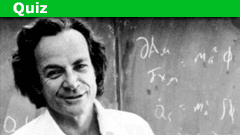
Richard Feynman Quiz: Test Your Knowledge of the Physicist
Richard Feynman won the 1965 Nobel Prize in Physics for his work on quantum electrodynamics and is known for inventing Feynman diagrams, contributing to the Manhattan Project at Los Alamos National Laboratory, and writing “Surely You’re Joking, Mr. Feynman!” This quiz tests specific facts about his career, publications, and teaching approach. Richard Feynman remains one of the most widely recognized physicists of the twentieth century. Test your knowledge of his work and life with the quiz below.
Table of Contents
Key Takeaways
- Richard Feynman shared the 1965 Nobel Prize in Physics for contributions to quantum electrodynamics (QED).
- Feynman worked at Los Alamos National Laboratory as part of the Manhattan Project during World War II.
- Feynman diagrams are graphical representations of subatomic particle interactions that he introduced to the field.
- “The Feynman Lectures on Physics” is based on lectures he delivered at the California Institute of Technology (Caltech).
- Feynman also proposed the parton model, a contribution to particle physics.
Nobody ever figures out what life is all about, and it doesn’t matter. Explore the world. Nearly everything is really interesting if you go into it deeply enough. — Richard P. Feynman

Ready for your next quiz? Read How Well Do You Know Stephen Hawking?
Who Was Richard Feynman?
Richard Feynman was an American theoretical physicist known for his work on the path integral formulation of quantum mechanics, the theory of quantum electrodynamics (QED), and the physics of superfluidity in supercooled liquid helium. In particle physics, he proposed the parton model, a framework describing the internal structure of hadrons.
Feynman was also known for a distinctive teaching style and a colorful public personality that made him a popular figure well beyond academic physics circles.
What Is Richard Feynman Most Famous For?
Richard Feynman is most famous for his contributions to the development of quantum electrodynamics (QED), the quantum field theory describing how light and matter interact. He introduced Feynman diagrams, a graphical method for representing the interactions of subatomic particles, which became a standard tool in quantum physics. Feynman shared the Nobel Prize in Physics in 1965 for this work.
Did Richard Feynman Contribute to the Manhattan Project?
Richard Feynman was a key member of the Manhattan Project, the United States government research program during World War II that produced the first atomic bombs. He worked at Los Alamos National Laboratory in New Mexico, where he made significant contributions to the project’s development work.
What Are Feynman’s Notable Publications?
Feynman’s notable publications include “The Feynman Lectures on Physics,” a comprehensive textbook based on lectures he delivered at the California Institute of Technology (Caltech). His other works include “QED: The Strange Theory of Light and Matter,” which introduces quantum electrodynamics to a general audience, and “Surely You’re Joking, Mr. Feynman!,” a collection of autobiographical anecdotes.
What Was Richard Feynman’s Teaching Philosophy?
Feynman’s teaching philosophy centered on making complex concepts accessible and engaging rather than obscure. He believed in understanding fundamentals deeply rather than memorizing advanced material without grasping its basis. His teaching style was marked by clarity, simplicity, and humor.
How Did Richard Feynman Impact the Field of Physics?
Richard Feynman significantly shaped physics through his work in quantum mechanics and quantum electrodynamics (QED). His methods, including Feynman diagrams, became standard tools in theoretical physics for visualizing particle interactions. His contributions helped simplify and solve complex problems across many areas of quantum physics.
Frequently Asked Questions
What award did Richard Feynman win in 1965?
Richard Feynman shared the Nobel Prize in Physics in 1965 for his contributions to the development of quantum electrodynamics (QED), the quantum theory describing interactions between light and charged particles.
What is a Feynman diagram?
A Feynman diagram is a graphical representation of the mathematical expressions describing the behavior and interaction of subatomic particles. Richard Feynman introduced these diagrams, and they remain a standard tool in theoretical particle physics today.
Where did Richard Feynman work during the Manhattan Project?
Richard Feynman worked at Los Alamos National Laboratory in New Mexico, contributing to the United States government’s World War II research project that produced the first atomic bombs.
What university is associated with “The Feynman Lectures on Physics”?
“The Feynman Lectures on Physics” is based on lectures Richard Feynman delivered at the California Institute of Technology (Caltech), later compiled into a widely used physics textbook.
What is “Surely You’re Joking, Mr. Feynman!” about?
“Surely You’re Joking, Mr. Feynman!” is a book compiling autobiographical anecdotes from Richard Feynman’s life, covering topics from his scientific career to personal adventures, written in a conversational, humorous style.
What did Feynman propose in particle physics besides QED?
Beyond his quantum electrodynamics (QED) work, Richard Feynman proposed the parton model, a theoretical framework for understanding the internal structure of hadrons such as protons and neutrons.

I have a BS in Information Sciences from UW-Milwaukee. I’ve helped manage Physics Forums for over 22 years. I enjoy learning and discussing new scientific developments. STEM communication and policy are big interests as well. Currently a Sr. SEO Specialist at Shopify and writer at importsem.com







7 but I actually knew the answers to 6. I got the same score for the scientists where I guessed lucky.
i got 5. i was not sure about the guide of feynamann. i made a random guess. i got it correct surprising.
Only 6/12.
“I got 4 and failed:smile:.
By the way I don’t know about him as he is not talked about in high school as Einstein is talked about.
Just took the quiz for seeing my luck.
2 answers I knew, other were guesses.
There is error in question 5 of “what condition he had”
It’s showing the wrong answer that I have chosen but not the correct one.”
“Post your scores :)”
11 out of 12 :)
8
‘Satisfactory’ 6/12 despite having read two biogs and an autobiography, his essays, QED and parts of Lectures.
But some of those fails don’t worry me. Too bad sister didn’t leave vivid impression on me. Those numbers were just a guess. What’s syneasthesia? Why did he need a van?
scored 3 :(
“Feynam said that he saw equations flying around in all sorts of colors.”
I need chapter and verse from Feynman’s mouth. I want to know the context.
“10/12
#2 needs to be changed to “drawing”. And I’ll need a citation for #5. I know that Richard Cytowic thinks Feynman had synesthesia, but I don’t believe Feynman, himself, made any such claim.”
Feynam said that he saw equations flying around in all sorts of colors.
I got 8, having read the books about ten years ago.
10/12
Just finished the audiobook of the Lawrence Krauss bio. Krauss uses the 1/200 number for Challenger
Got 3 wrong… I don’t know his IQ…
I can’t believe my score. I read so many of his books….
“I think I found it on his wiki page”
Ah, another illustration of how Wikipedia can’t always be trusted. :wink: I see the “1 in 200” figure there, but the only source given is Appendix F to the commission report, which I linked to, and which does not contain that figure anywhere. The only figure I think is justified by that document (which is the correct primary source) is “1 in 100”. The two key quotes from that document are, first, from the opening paragraph:
“The estimates range from roughly 1 in 100 to 1 in 100,000. The higher figures come from the working engineers, and the very low figures from management.”
Second, from the conclusion:
“They [the Shuttles] therefore fly in a relatively unsafe condition, with a chance of failure of the order of a percent (it is difficult to be more accurate).”
(The Wiki page does mention Feynman’s book, What Do You Care What Other People Think, the second half of which is his telling the story of the Challenger investigation. It’s possible that the “1 in 200” figure is given somewhere in there; I don’t have my copy handy to check. Even if it is, though, I would say the “official” primary source is still the Appendix F document, so I should still get 1 more point of credit for this quiz, which is of course my real agenda here. :wink: )
“What is the source for that number?”
I think I found it on his wiki page
8/12, would have been 10/12 if I had trusted my first instinct on two questions (Brazil and Professor).
Also I’m not sure about question 10. I answered 1 in 100, while the “correct” answer is given as 1 in 200. What is the source for that number? In his famous [URL=’http://science.ksc.nasa.gov/shuttle/missions/51-l/docs/rogers-commission/Appendix-F.txt’]Appendix F[/URL] to the commission report (famous enough for me to have borrowed its last sentence for my sig, anyway :wink: ), the final estimate is given as “on the order of a percent” (i.e., 1 in 100). The number 1 in 200 doesn’t appear anywhere.
8/12. I never knew he had synethesia. You think that would have been mentioned somewhere in his bios.
I’ve read/listened/watched almost all there is regarding Feynman, and I scored a 7.
Congratulations – you have completed Richard Feynman Quiz.
You scored 11 points out of 12 points total.
Your performance has been rated as Excellent.
Ah, didn’t know he taught at Cornell.
Some brilliant peoples here…. judging by score they are getting :nb):nb)
5…:oldtongue:
9/12.
11/12! I missed the one about the odds of catastrophic failure in the Challenger investigation. Clearly, there’s some stuff stuck in the dim corners of my memory.
(ETA: And it’s not like he’s a hero of mine either. So I don’t even know where that stuff came from.)
9….. and he is still my favorite physicist of all time.
8/10, no guesses. I read SYAJMF some years ago.
10 out of 12 for this test — I got the question about his favourite place to travel wrong which I should have answered right (Mexico, instead of Brazil). Ouch! :eek:
8, including a couple of guesses.
2/12…. Seems I heard about him first time. One Confession: I forgot quantum mechanics long ago:biggrin:
“8.
I read his autobiographies a long time ago, so I knew a few things, e.g that he was a painter. But the questions were very difficult. It’s not that easy to know the exact year he won the Nobel (I actually guessed that one right), or that probability that he estimated. It would probably have been better to ask what he got the price for, or who he shared it with, and to ask what investigation he was involved in.”
Too easy :)
10/12
#2 needs to be changed to “drawing”. And I’ll need a citation for #5. I know that Richard Cytowic thinks Feynman had synesthesia, but I don’t believe Feynman, himself, made any such claim.
8/12
I’ve read Gleick’s Genius and Surely You Must Be Joking …
These covered family (Joan), Wheeler, Manhattan and locks, Cornell, Brazil, painting, FD’s on the van. Couldn’t quite recalll IQ, off by 5. Knew Challenger failure odds were low, but thought 1:100. Never read about the synaesthesia, and couldn’t be bothered to look up the exact year for QED.
5/12 – the only thing I was fairly sure of was his doctoral advisor.
“No option is coming correct for question 5.
I’ve tried the quiz 4 times for seeing the correct answer.”
Fixed, thanks
No option is coming correct for question 5.
I’ve tried the quiz 4 times for seeing the correct answer.
“He doesn’t quite reach the level of pop sci fame that Einstein does.”
That’s true.
“Post your scores :)”
I got 4 and failed:smile:.
By the way I don’t know about him as he is not talked about in high school as Einstein is talked about.
Just took the quiz for seeing my luck.
2 answers I knew, other were guesses.
There is error in question 5 of “what condition he had”
It’s showing the wrong answer that I have chosen but not the correct one.
Post your scores :)
5/12. Fun quiz. His daughter published a book of his letters to her.
I got a 4, but I didn't think I knew him that well.
7! Woo! I might be below average at physics but at least I'm a "satisfactory" fan-girl. :)
10/12
Well, I just know his name. I havent read so much about scientists. So, all the questions I left unanswered. But the comment says I must read about him :)
Scored 8. Honestly, I guessed on a couple, so let's say 6.
10/12, his books are so inspirational in my opinion,
6/12
12/12 unbeatable yes!!
Though I knew he painted some, but wasn’t he passionate about drumming?
All Guesses.
6 – it’s been a long time since I read his excellent autobiography.
5/12, which is 1.3 sigma above a completely random result. Will wait a bit more before claiming I know something about Feynman : )
10 / 12.
10-very good!
9. I do better on the trivia than I do understanding the damn physics! Thats why I am here
10, I've read most of his books and the ones about him.
I got 5, but I really knew only 3.
Einstein was also humorous.
I did completely terrible, (as I thought I would) but did enjoy learning some new facts about the Dick himself! I also remember hearing that he was very fond of strippers. And enjoyed learning new facts about the legend himself. 5/12
10 out of 12
10/12 guessed the 1/200 given I knew his IQ test was 125 and they were gonna be mutually exclusive middle answers.. really thought it'd be barber though given it was kind of the odd one out
8 but I had luck on 5 of my guesses :-)
9/12 woo . got the date and IQ wrong because numbers are hard to remember.
6 out of twelve, but that's what you get for guessing. Fun quiz.
That being said, it was very informative. Didn’t know he had synesthesia.
9. Woohoo… Told you I’d do better on Feynman than on Einstein.
I read his autobiographies a long time ago, so I knew a few things, e.g. that he was a painter. But the questions were very difficult. It’s not that easy to know the exact year he won the Nobel (I actually guessed that one right), or that probability that he estimated. It would probably have been better to ask what he got the prize for, or who he shared it with, and to ask what investigation he was involved in.
I kinda like Feynman more than Einstein. Feynman seems real. Colorful. Human.
5. I read his autobiography about 25 years ago, so I’m not surprised.
6, all guesses except picking locks, I’ve only read a bit of him, but seen a fair bit of video / lectures, and yeah he is great! I really enjoyed his take on the discovery inquiry, as sincere as he is bright I guess. Hmmm…makes me wonder if there are Einstein lecture videos?
10/12. I don’t know if I am ashamed or proud of this.
I got 11/12 and in my opinion Richard Feynman is my favorite scientist.
I didn’t know any of these. Guessed on all of them and got 3/12, as one might expect.
8/12
6/12
Odd. It’s been only 20 years since I’ve read his biography.
He doesn’t quite reach the level of pop sci fame that Einstein does.