
Why We Don’t Discuss Perpetual Motion Machines (PMM)
Table of Contents
Authorship
Authorship Contributions From Anorlunda
Introduction
You may want to believe the article you read, or the video you saw, or you may be very proud of your PMM invention. It can be very difficult to analyze what is inside the box to find the flaw. Maybe we can’t find it. Maybe nobody can find it. If we can’t find the flaw, does that mean it will work? No, it does not. If you want to understand why read this article.
The PF guidelines explicitly list Perpetual Motion and Free Energy as forbidden topics. Why? They are certainly popular topics. Almost every day we get new posts about articles that people read elsewhere, or from creative inventors.
The short answer is that a PMM would violate either conservation of energy, the 2nd law of thermodynamics, or both. To a scientist or engineer, that is enough. Case closed, thread closed. But that may sound insufficient, dismissive, or even rude to the posters. So a longer explanation follows.
What are perpetual motion machines?
Perpetual motion machines (PMMs), also known as perpetual motion devices or perpetual motion generators, are hypothetical machines that are designed to operate indefinitely without the need for an external source of energy. In other words, they are machines that can supposedly produce more energy (or do useful work) than they consume, in violation of the fundamental laws of physics, particularly the law of conservation of energy.
The Meaning of Impossible in Natural Language
The human spirit requires that we reject the word impossible. Any coach in a locker room pep talk tells his team that they can beat any other team today. Our most celebrated inventors make the impossible possible. Delivery of a terminal prognosis to a patient is traumatic, so we frequently present undue optimism and say that survival is possible.
But there is a difference between what we might call Impossible (with a capital I) or merely impossible (small I meaning difficult). Wikipedia says it well. “Epistemic impossibility” describes things that absolutely cannot occur within our current formulation of the physical laws. This interpretation of the word “impossible” is what is intended in discussions of the impossibility of perpetual motion in a closed system. For clarity, we simply use Impossible with the capital I for A and impossible with small i for B.
Faster-than-light (FTL) travel is Impossible but many or most people believe it is only impossible.
PMMs and Free Energy are more than impossible—they are Impossible.
Conservation of Energy
Energy has many forms, mechanical potential, kinetic, electric, chemical, nuclear, heat, light, and many more. We convert one form of energy to other forms all the time. The bookkeeping of where the energy goes and in what forms can be difficult. Nevertheless, the fact that energy is conserved is well proven by theory and by observation. Energy can not be created from anything.
In theory, we have The Principle of Least Action, and Noether’s Theorem that shows that the conservation of energy is a consequence of time translation symmetry. There is even a quantum mechanical equivalent.
There is no wiggle room for you to challenge the conservation of energy.
2nd Law of Thermodynamics
https://en.wikipedia.org/wiki/Second_law_of_thermodynamics
The second law of thermodynamics states that the total entropy of an isolated system can never decrease over time, and is constant if and only if all processes are reversible.
The second law has a statistical foundation rather than a theoretical one. It is more difficult to understand than the conservation of energy. For one thing, entropy itself is a difficult concept for most people. How entropy relates to PMMs is even more obscure. But to make an analogy that non-technical people can understand, we can look at a related principle of thermodynamics. Heat spontaneously flows from the hot source to the cold source. Heat continuously spontaneously flowing the other way is Impossible.
Some PMMs can be analyzed using Carnot’s Theorem. That is the link between PMMs and the 2nd Law.
The Engineer’s Tool, The Black Box
An engineer would analyze a PMM idea as follows. Imagine the PMM to be enclosed in a black box. We can’t see inside, so we can’t see what the PMM is or what it does.
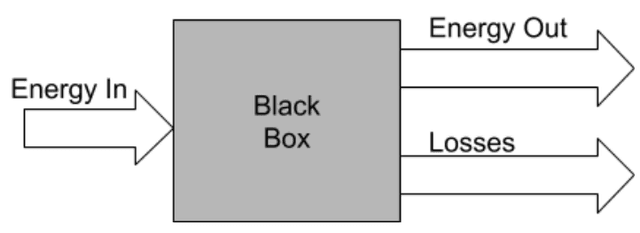
Energy conservation tells us that Energy In=Energy Out + Losses. Statistical arguments similar to thermodynamics tell us that Losses are greater than zero for macro objects. That is true no matter what is in the box. What is in the box doesn’t matter.
PMM thread posters always want us to examine the details of what is inside the box (i.e. the PMM) to find a logical flaw. The engineer says, “Nope. What is in the box doesn’t matter.” That’s not being rude, it is being confident in our analysis methods and the laws of physics.
What if the box contained a battery? Doesn’t that refute the analysis? That is where the word perpetual comes in. A battery (or other energy storage) in the box could produce energy out with zero energy in, but only until the battery runs down. It can not do it perpetually. Therefore, we could say that Energy In = Energy Out + Losses + Change in energy stored. Energy stored can not be infinite, hence the change in energy stored must eventually reduce to zero.
We should mention that in particle physics, energy losses are normally zero. When we use a Feynman Diagram to describe any particle event, energy and momentum are conserved. Losses due to friction, air drag, or electrical resistance, happen only at the macro level, as do temperature and entropy. PMMs are macro-level devices. A photon traveling in a vacuum is not a PMM.
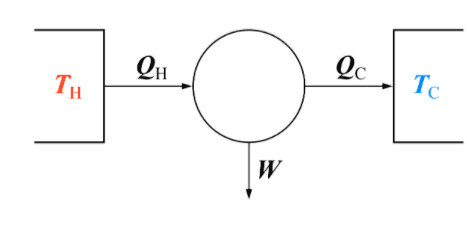
The black box representation of a Carnot Heat Engine looks like this, except that the black box is shown as a circle. The same arguments apply to the above black box. It doesn’t matter what’s in the box, the efficiency can not exceed Carnot’s efficiency.
Looking Deeper, PMMs Defined
It is important to recognize that perpetual motion isn’t a scientific term, so you won’t necessarily find a clear consensus in the scientific community about what it means. Part of that is an ambiguity between the terms “perpetual motion” and “perpetual motion machine,” which are sometimes used interchangeably but can be read differently.
The term “perpetual motion”, if read literally, sounds a lot like the second half of Newton’s First Law of motion; Objects in motion will continue in motion forever unless acted upon by an external force. In Newton’s time this was a profound realization, but today it is mundane. There are motions – celestial motions in particular – that are subject to very little external force, and as such can continue pretty much forever. For example, the orbit of the Earth around the sun will continue for billions of years, until the sun burns low, expands, and devours it. Even more long-lived; objects expelled from galaxies could theoretically continue traveling indefinitely — like this one: https://earthsky.org/space/black-hole-hurls-star-out-of-milky-way
That’s interesting, but it isn’t what this article is about. This article is about Impossible devices. A perpetual motion machine (PMM) is a machine that violates one or more of the laws of thermodynamics in its operation and as such is explicitly forbidden by the laws of thermodynamics and the rules of this forum. They are typically categorized by which law of thermodynamics they violate:
PMM Types
A Type 1 Perpetual Motion Machine violates the first law of thermodynamics(conservation of energy).
A Type 2 Perpetual Motion Machine violates the second law of thermodynamics(entropy).
“Thermodynamics, an Engineering Approach”, by Cengel and Boles (now in its Eighth Edition) dedicates a few pages to the subject and uses these categorizations.
The Wikipedia article on the subject includes a third type: a device that experiences no friction or dissipative forces. That is what would differentiate between a long-traveling object and one that is truly “perpetual”; the example of a star expelled from the galaxy is still subject to the force of gravity and a small but non-zero amount of drag. It may be “perpetually” moving for practical purposes, but does not qualify as the 3rd type. https://en.wikipedia.org/wiki/Perpetual_motion
The first type is the classic free energy machine and is the most common. Several common variants include:
Common Type 1 Variants
- Static energy machines
- Gravity motors/unbalanced wheels
- Unpowered magnetic motors
- Casimir effect generators
- Pressure machines
- Buoyancy motors
- Pulleys/gears
- A motor driving a generator (maybe with a pulley)
Notice that the first set has no input energy at all! These could be considered a sub-type of Type 1, violating conservation of energy with input energy of exactly zero.
Type 2 PMMs are less common, but one typical variety is a heat pump driving a heat engine or using a lens to focus infrared radiation. These rely on one or both cycles violating Carnot’s efficiency to provide excess energy. Note that this is also a Type 1 PMM — gaining excess energy is nearly always the goal of PMMs, regardless of the specifics of how it is achieved. Internal combustion, steam engines, or turbines with Impossibly high efficiency (above Carnot efficiency Betz’s law, etc.) would also be a violation of the 2nd law.
Identification/Analysis
Identification and analysis of a PMM is relatively easy: all you need to do is identify the input and output energy and compare them. In thermodynamics, nearly every analysis is conservation of energy statement: Ein=Eout. The main pitfall, as the first set of devices shows, is believing there is an energy input when in fact there is none. For Type 2 PMMs you need to compare the device’s efficiency with the Carnot efficiency but still, the ultimate claim is a first law violation. The energy analysis tells you it’s Impossible, but the thermodynamic cycle analysis is what tells you exactly why.
PMM Patents
Patent Offices around the world have special rules for patent applications seeming to claim perpetual motion. They do so because of the large number of such patent applications, and because of the difficulty of making a detailed analysis of the internal details. In part that mirrors PF’s special handling of PMM discussions.
Free Energy
The way we look at it, free energy and PMMs are the same things.
Energy In = Energy Out + Losses.
So if Losses are greater than zero, the efficiency Energy Out/(Energy In – Losses) must be less than 1. A PMM has an efficiency equal to 1, and free energy has an efficiency greater than 1.
Why are they Banned on PF? The Long Answer
The simple reason why the discussion of PMMs is banned on PF is that PF discusses accepted science only, and by definition, PMMs violate some laws of science. “But”, you might ask, “why don’t you try a relaxed rules sandbox where anything can be discussed?” Well, we tried that early in PF’s existence and there were several problems:
- It attracted very low-quality discussion.
- Despite the relaxed rules it required substantial moderator attention.
- Enthusiastic would-be inventors are largely immune to learning/being taught, so they accomplish very little.
- By definition, a PMM must violate some laws of physics, so we cannot analyze them.
The first two are practical reasons for the forum, but the 3rd and 4th are what might speak to PMM proponents. In 15+ years with PF, we interacted with many PMM “inventors” and we often continue to attempt to engage and teach them via private messages when moderating their activity. It’s rarely productive, in fact perhaps even impossible (not Impossible) to be productive. Some think the known laws of physics are wrong and some think they aren’t violating the laws of physics — but the two positions are functionally identical. Either way, almost all proponents of PMMs make their devices complicated enough that they are unable to analyze them, which is why they come to PF in the first place; They believe their device produces excess energy, they just can’t prove it and need our help. However, if they can’t point to a legitimate source of energy (“My device’s energy source is gravity”: nope!), then there’s no need to do a thorough analysis to prove it doesn’t work. Sometimes we do try to walk them through it to see how it goes. Almost always, the conversation seems productive until we get to the end, and then when the answer is reached, it must be wrong because we don’t understand their device and know what we’re talking about — or they disappear right before reaching the answer. The belief is stronger than the desire to learn. So the best we can do is to leave them with this: If the laws of physics are wrong, then we can’t help you analyze the device, since the laws of physics are all we know to apply. “So you’re on your own; your only real options are to invent the science yourself or better yet build a working prototype. Neither of which we can help you with here. Good luck and goodbye.”
A historical postscript: Most PMM “inventors” believe they’ve discovered/invented something new (or something is forgotten), despite how simple and obvious their devices are. None of them are much newer than the theory they violate. The Museum of Unworkable Devices provides some of that historical context and information about the common types of machines people have “invented” over and over again for the past several centuries: https://lockhaven.edu/~dsimanek/museum/unwork.htm
Conclusion
To circle back to the first paragraph of this article. If we can’t find the flaw, does that mean your PMM will work? No. We can use black-box analysis to be confident that PMMs can not exist and that what is in the box doesn’t matter. That is why we summarily refuse to discuss what is in the box, to even read your description or to view the video. Such discussions are pointless and a waste of time.
{
“@context”: “https://schema.org”,
“@type”: “WebPage”,
“headline”: “Why We Don’t Discuss Perpetual Motion Machines (PMM) | Physics Forums”,
“about”: [
{“@type”: “Thing”,”name”: “Discuss”,”sameAs”: “https://en.wikipedia.org/wiki/Conversation”},
{“@type”: “Thing”,”name”: “Physics”,”sameAs”: “https://en.wikipedia.org/wiki/Physics”},
{“@type”: “Thing”,”name”: “machines”,”sameAs”: “https://en.wikipedia.org/wiki/Machine”}
],
“mentions”: [
{“@type”: “Thing”,”name”: “conservation of energy”,”sameAs”: “https://en.wikipedia.org/wiki/Energy_conservation”},
{“@type”: “Thing”,”name”: “law”,”sameAs”: “https://en.wikipedia.org/wiki/Law”},
{“@type”: “Thing”,”name”: “thermodynamics”,”sameAs”: “https://en.wikipedia.org/wiki/Thermodynamics”},
{“@type”: “Thing”,”name”: “scientist”,”sameAs”: “https://en.wikipedia.org/wiki/Science”},
{“@type”: “Thing”,”name”: “article”,”sameAs”: “https://en.wikipedia.org/wiki/Article_(publishing)”},
{“@type”: “Thing”,”name”: “box”,”sameAs”: “https://en.wikipedia.org/wiki/Box”}
]
}







”
This is my failing with a persistent poster on another social site. I actually asked for hints on PF regarding his supposed internal combustion engine tech that runs on any fuel, at full torque, with no emissions…looks like magic, to me…but the thread was locked under the PMM rules :wink:
”
It is very difficult to moderate threads on such topics, even if the angle taken is the scientific one. This is why we usually don’t allow debunking threads, unfortunately.
However, some threads are accepted (it is always a judgement call on the part of the mentors). You can be successful by restricting the question to a specific aspect.
”, and explain that they can’t give you any details due to patent pending, or some such. We all have blinkers, but the self-deception required to genuinely believe you’ve invented a PMM seems a black hole of hubris.)
(I’m not disagreeing with the rule, BTW, and can see the rabbit holes it would take you down, because if this guy is typical, they don’t engage, they just moan about how wonderful their idea is and how it’s being “suppressed” by
”
People with that mindset will never listen to reason.
”
It was Professor Sir George Porter who said that when he became a bit of science populariser he got lots of communications from people sending him their designs for PPMs. In the early days, he replied to them all pointing out why their machines wouldn’t work but he had to give up doing this because it became too big of an imposition on his time.
”
We had the same issue and resolution in the early days of PF.
”
But it’s alright to post questions about pink unicorns, isn’t it?
”
Yes, as long as they aren’t invisible.
”
What about those self running 3 phase dual permanent magnet self running motors? They are legit right? Permanent magnets contain all the energies?
”
I’m not sure what you mean, but no. PM PMMs are not OK, no pun intended.
”
there’s quite a lot of scientific knowledge needed to explain in detail where the flaw in a PMM design is.
”
The article discusses exactly that. But the Feynman anecdote describes an entirely different approach to derail a demo of a fraudulent live prototype. Randi was skilled at figuring out how con men think, and from that how to derail their cons.
Actually, maybe in the article we should have distinguished between deliberate fraud, and innocent but naive “inventors.”
”
I’m fond of James Randi and his debunking methods. But as far as I know, Randi never turned his attention to PMMs.
”
I suspect it’s rather a different skill set. While I rather suspect the psychology is similar (genuine believers, puzzle designers, and scammers exist in both areas), there’s quite a lot of scientific knowledge needed to explain in detail where the flaw in a PMM design is. And even more to explain it in an engaging way – debunking PMMs is essentially the thrilling art of book-keeping, after all.
”
see [URL=’http://hoaxes.org/comments/papparticle2.html’]Feynman’s write up[/URL],
”
Interesting, and typical Feynman style. I’m fond of James Randi and his debunking methods. But as far as I know, Randi never turned his attention to PMMs.
”
Asking for a prototype also helps distinguish between inventors and outright scoundrels.
”
Worth noting that a man called Joseph Papp built a “perpetual motion machine”. Feynman was invited to see it and, knowing that it was a scam, disrupted the demo. The device exploded, killing one observer (see [url=http://hoaxes.org/comments/papparticle2.html]Feynman’s write up[/url], and [url=https://skeptics.stackexchange.com/questions/28530/did-richard-feynman-see-josef-papps-machine-explode]some discussion supporting its authenticity[/url]). It’s unlikely to happen with the genuine (if that’s the right word) inventors because their devices just won’t work, but scammers need their devices to “work” so they must contain some energy storage mechanism.
But aren’t we now discussing PMMs :oldconfused: o0)
First nice article. Great you mentioned Noether’s Theorem which for me really says it all.
Thanks
Bill
”
Now, if we could have this as a link in the Guidelines instead of (or in addition to) the wikipedia and skepdic links…
”
Good suggestion. I just edited the copy of the guidelines here:
[URL]https://www.physicsforums.com/threads/physics-forums-global-guidelines.414380/[/URL]
But there is a second copy of the guidelines that we need [USER=1]@Greg Bernhardt[/USER] ‘s help to edit here:
[URL]https://www.physicsforums.com/help/terms-of-service/[/URL]
Thanks for this. I was just thinking how we could use a more thorough explanation for this particular forum policy, since the Guidelines are rather skimpy in this respect.
It’s comprehensive, to the point, and not condescending.
Now, if we could have this as a link in the Guidelines instead of (or in addition to) the wikipedia and skepdic links…