
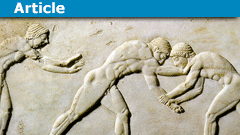
Hand-to-Hand Combat Physics — Force, Momentum, Speed
Table of Contents
Physics of Hand-to-Hand Combat
Hand-to-hand combat (often abbreviated H2H or HTH) refers to fighting at very close range, usually without weapons.
It includes self-defense, sport, and military contexts where encounters happen inside arm’s reach.
Effective techniques exploit basic physics: getting the right force to the right place at the right time through timing, balance, and efficient movement.
Key Points
- Martial arts apply physics to achieve goals quickly and efficiently.
- “Athletic intelligence” describes the nervous system’s ability to learn movement patterns that work with physical laws.
- Acceleration, force, momentum, and energy appear in virtually every strike, throw, and joint lock.
- Grappling arts emphasize leverage; striking arts emphasize speed, timing, and power generation.
Related video: Hand-to-hand demo (YouTube)
What Is Hand-to-Hand Combat?
Hand-to-hand combat uses the body—hands, elbows, knees, feet, and the whole frame—to strike, clinch, grapple, control, and disable an opponent at close quarters.
Techniques include punches, kicks, knee and elbow strikes, takedowns, holds, throws, and joint locks.
Training ranges from controlled sport settings to pragmatic self-defense and military combatives.
Common Characteristics
- Unarmed combat: The body is the primary tool for offense and defense.
- Close quarters: Engagement typically happens within arm’s reach.
- Technique and skill: Training, timing, and positioning often matter more than raw strength.
- Self-defense: Many systems focus on escaping danger and creating distance or control.
- Martial arts: Disciplines teach both technique and control (often alongside respect and discipline).
- Military training: Soldiers train for situations where weapons are unavailable or impractical.
- Sports and competition: Combat sports apply rules to enable safe, controlled testing of skill.
Physics and “Athletic Intelligence”
Physical laws don’t change: effective systems consistently apply them with quick, efficient movement.
Understanding which variables matter is the shortcut to reliable technique.
Athletic intelligence is how efficiently the nervous system adapts through repetition, feedback, and refinement.
Some people learn patterns quickly; everyone else can improve by practicing with attention to measurable variables.
Focus on variables you can control—timing, balance, leverage, range, and speed—and streamline technique until it works under pressure.
Four Physics Ideas That Show Up Everywhere
1) Acceleration
Without acceleration there is little power. Speed often determines whether a technique lands cleanly, misses, or is countered. Acceleration is the rate of change of velocity:
a = Δv / Δt
It is typically measured in m/s2.
Practice control first and speed second so acceleration becomes a reliable equalizer.
Related reading: Acceleration lends power
2) Force
A force is an interaction that can change motion (acceleration) or cause deformation. In combat you apply force by accelerating parts of the body into a target or by applying a continuous force in a hold or lock.
F = m a
For a given limb mass, increasing acceleration increases force. While you cannot change your mass quickly, you can improve mechanics, timing, and acceleration.
3) Momentum
Momentum equals mass times velocity:
p = m v
In striking, momentum explains why faster techniques are harder to stop. In grappling, momentum and timing assist with off-balancing, takedowns, and transitions.
4) Energy
Kinetic energy is:
KE = (1/2) m v2
Because velocity is squared, increasing speed often boosts impact energy more effectively than increasing limb mass. Practically: improving mechanics and speed usually pays off more than simply getting bigger.
Grappling vs. Striking (Leverage vs. Impact)
Grappling: Leverage (e.g., Jiu-Jitsu)
Grappling emphasizes leverage—mechanical advantage, body position, and torque—to control joints, posture, and balance. The aim is to constrain an opponent so angles, frames, and efficient force application beat brute strength.
Striking: Speed, Timing, and Short-Range Power (e.g., Muay Thai)
Striking emphasizes delivering force rapidly through coordinated motion of hips, torso, and limbs. Muay Thai is known for efficient short-range strikes—especially knees and elbows—where small travel distance can still produce high acceleration and force.
Choosing a Martial Art
Rather than searching for a single “best” style, prioritize training quality, realistic practice, and context. Combining reliable grappling (control, takedowns, escapes) with competent striking and clinch work creates a versatile foundation.
A Final Word
When safety is at stake, priorities are often summarized as:
- Strike first
- Strike fast
- Strike repeatedly
Real-world self-defense also requires awareness, avoidance, de-escalation, and escape whenever possible. Improvement comes from recognizing the key variables—balance, timing, acceleration, and leverage—and refining them through repetition.
Practical Training Tips
- Train control before speed: groove accurate mechanics, then add velocity.
- Use progressive resistance in drilling—slow to fast to full power—so technique survives pressure.
- Practice off-balancing and entries to make leverage-based techniques reliable.
- Drill short-range power (clinch knees, elbows) to exploit high acceleration over small distances.
- Record and review training to accelerate feedback and motor learning.
- Include situational practice for awareness, escape, and de-escalation alongside technical work.
Key Takeaways
- Speed (acceleration) often matters more than raw mass; velocity has a squared effect on energy.
- Leverage reduces the role of strength in grappling; angles and posture matter.
- Refined mechanics, timing, and repetition are more effective than trying to “get bigger.”
- Combine grappling and striking fundamentals for a well-rounded close-range skill set.
FAQ
What principles of physics are important in martial arts?
The most discussed physics ideas are acceleration, force, momentum, and energy. Acceleration describes how velocity changes; force is often modeled as F = m a; momentum as p = m v; and kinetic energy as KE = (1/2) m v2.
How can I increase my performance in martial arts?
Refine technique, balance, timing, and positioning, then gradually increase speed while maintaining control. Because kinetic energy scales with velocity squared, efficient mechanics and speed usually pay off more than trying to increase limb mass.
What are the most successful martial arts styles used by today’s elite military forces?
Programs vary by country and mission, but many modern systems emphasize practical grappling and clinch work combined with simple striking fundamentals—skills that transfer well to close-range encounters under stress.
I have a BS in Information Sciences from UW-Milwaukee. I’ve helped manage Physics Forums for over 22 years. I enjoy learning and discussing new scientific developments. STEM communication and policy are big interests as well. Currently a Sr. SEO Specialist at Shopify and writer at importsem.com







Данный портал собирает интересные новости со всего мира.
Здесь можно найти новости о политике, технологиях и многом другом.
Информация обновляется ежедневно, что позволяет следить за происходящим.
Минималистичный дизайн ускоряет поиск.
https://km-moda.ru
Все публикации предлагаются с фактчеком.
Редакция придерживается достоверности.
Читайте нас регулярно, чтобы быть на волне новостей.