
Gauss’s Law Explained: Derivation From Coulomb’s Law
Gauss’s law states that the total electric flux through any closed surface equals the total enclosed charge divided by the permittivity of free space (ε₀). Carl Friedrich Gauss formulated the law in 1835, and it is one of the four Maxwell’s equations underlying classical electrodynamics. It is mathematically equivalent to Coulomb’s law and can be derived directly from it.
- Gauss’s law was formulated by Carl Friedrich Gauss in 1835.
- The integral form of Gauss’s law is ∯S E·dA = Q/ε₀, relating electric flux to enclosed charge.
- The differential form, ∇·E = ρ/ε₀, relates the divergence of the electric field to charge density.
- Gauss’s law can be derived starting from a point charge at the center of a spherical surface, where E = q / (4πε₀R²).
- The Faraday ice-pail experiment offers experimental confirmation of Gauss’s law and, by extension, the inverse-square nature of the electrostatic force, with greater precision than Coulomb’s original torsion-balance measurements.
Table of Contents
What Is Gauss’s Law and Why Does It Matter?
Gauss’s law reveals a direct relationship between an electric field and the distribution of electric charge that produces it. In electrostatics, applying Gauss’s law often greatly simplifies calculating the electric field for symmetric charge distributions, such as spheres, cylinders, and infinite planes. The derivation below shows how Gauss’s law follows from Coulomb’s law by working through progressively more general cases.
How Is Gauss’s Law Expressed Mathematically?
Gauss’s law can be written in two equivalent forms, connected to each other by the divergence theorem.
The integral form is:
∯S E·dA = Q/ε₀
The differential form is:
∇·E = ρ/ε₀
Gauss’s law is essentially equivalent to Coulomb’s law. Any inverse-square law can be written in a form similar to Gauss’s law, which is why the derivation below builds from Coulomb’s law rather than treating Gauss’s law as a separate postulate.
How Do You Derive Gauss’s Law From Coulomb’s Law?
The derivation proceeds through three progressively more general cases: a point charge inside a spherical surface, a point charge inside a non-spherical surface, and an arbitrary charge distribution inside a closed surface.
Case 1: A Point Charge Inside a Spherical Surface
When a point charge q is placed at the center of an imaginary spherical surface, called a Gaussian surface, of radius R, the magnitude of the electric field at every point on that surface is given by E = q / (4πε₀R²).
Because the field is perpendicular to the surface and has the same magnitude everywhere on it, the total electric flux ΦE through the sphere equals the field magnitude multiplied by the sphere’s total surface area:
ΦE = E A = (q / (4πε₀R²)) · (4πR²) = q / ε₀
This result matches the integral form of Gauss’s law exactly, demonstrating that the law is equivalent to Coulomb’s law for this symmetric case.
Case 2: A Point Charge Inside a Non-Spherical Surface
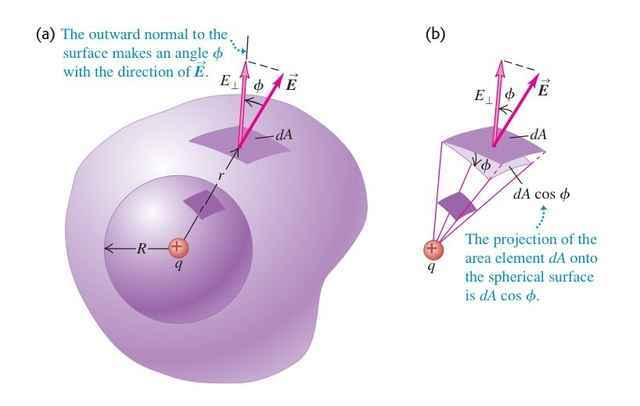
Now consider the same point charge q enclosed by an arbitrary, irregularly shaped closed surface instead of a sphere. A concentric spherical surface centered on the charge serves as a reference for comparing small, corresponding area elements on the two surfaces.
A small area element dA on the irregular surface can be projected radially onto a corresponding area element dA′ on the concentric sphere at the same distance from the charge. The angle φ between the local surface normal and the radial direction to the charge foreshortens the projection, so dA′ = dA cosφ.
The flux through the small irregular area element is ΦdA = E⊥ dA = E (dA cosφ) = E dA′. Integrating this relationship over the entire irregular surface produces the same total flux as through the sphere at the same radius:
ΦE = ∮ E·dA = q / ε₀
This confirms that Gauss’s law holds for a point charge enclosed by any closed surface, regardless of its shape, in a static field.
Case 3: Multiple Charges Enclosed by a Closed Surface
For multiple enclosed charges q₁, q₂, q₃, and so on, the resulting electric field at any point is the vector sum of the fields produced by each individual charge. Applying the single-charge analysis above to each charge and summing the contributions gives the total electric flux through the closed surface:
ΦE = ∮ E·dA = Qenc / ε₀
Qenc = q₁ + q₂ + q₃ + …
The total electric flux through a closed surface equals the total enclosed charge divided by ε₀, regardless of how many individual charges make up that total or how they are arranged inside the surface.
How Was Gauss’s Law Confirmed Experimentally?
The Faraday ice-pail experiment provides experimental confirmation of Gauss’s law. Because Gauss’s law is mathematically equivalent to Coulomb’s law, the ice-pail experiment also demonstrates the inverse-square relationship of the electrostatic force with greater precision than Coulomb’s original torsion-balance measurements.
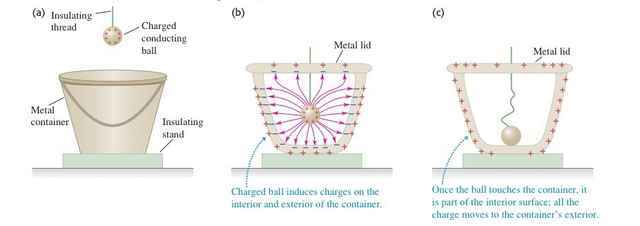
The experiment uses a conducting container mounted on an insulating stand, initially uncharged. A charged metal ball, suspended from an insulating thread, is lowered into the container, which is then closed with a lid. This induces charge on the inner and outer walls of the container.
If the ball is allowed to touch the inner surface, charge transfers so that the ball’s surface becomes part of the cavity surface. Gauss’s law predicts that the net charge on the cavity surface must equal the charge originally on the ball. Removing the ball afterward and measuring it shows that the ball has lost its charge while the container retains the induced charge, a result consistent with Gauss’s law for static fields.
What Are the Limits of This Derivation?
This derivation proves Gauss’s law for charges located inside a closed surface under electrostatic conditions; it does not address the treatment of charges located outside the surface. Gauss’s law itself is more general than this electrostatic derivation and applies to time-varying fields when combined with Maxwell’s other equations.
The same stepwise approach used here, starting from a simple symmetric case and generalizing step by step, is a common method for deriving other relationships among Maxwell’s equations, including Ampère’s law.
Glossary
- Gaussian surface: An imaginary closed surface used to apply Gauss’s law, chosen for convenience based on the symmetry of a charge distribution.
- Electric flux (ΦE): A measure of the electric field passing through a given surface, calculated as the field strength times the perpendicular area.
- Permittivity of free space (ε₀): A physical constant that describes how an electric field propagates in a vacuum.
- Charge density (ρ): The amount of electric charge per unit volume at a point in space.
- Divergence theorem: A mathematical theorem relating the flux of a vector field through a closed surface to the divergence of that field within the enclosed volume.
Frequently Asked Questions
Who formulated Gauss’s law and when?
Carl Friedrich Gauss formulated Gauss’s law in 1835. It became one of the four Maxwell’s equations that form the mathematical foundation of classical electrodynamics, describing the relationship between electric fields and electric charge.
Is Gauss’s law the same as Coulomb’s law?
Gauss’s law is mathematically equivalent to Coulomb’s law for static electric fields. Any inverse-square force law can be rewritten in a form similar to Gauss’s law, and the derivation from a point charge inside a spherical surface shows this equivalence directly.
Why does Gauss’s law work for irregularly shaped surfaces?
For any closed surface enclosing a point charge, a small area element can be projected radially onto a corresponding element on a concentric sphere at the same distance from the charge. The foreshortening factor cosφ exactly compensates for the surface’s irregular shape, so the total flux equals that through the sphere.
What does the Faraday ice-pail experiment demonstrate?
The Faraday ice-pail experiment demonstrates that when a charged ball touches the inside of a conducting container, the ball loses all its charge while the container retains an equal induced charge on its surface. This outcome is consistent with Gauss’s law and offers a precise experimental test of the inverse-square electrostatic force.
Does Gauss’s law apply only to electrostatics?
The derivation presented here applies specifically to charges enclosed within a closed surface under electrostatic conditions. Gauss’s law itself is more general and continues to hold for time-varying electric fields when used alongside Maxwell’s other three equations.
What is a Gaussian surface used for?
A Gaussian surface is an imaginary closed surface chosen to match the symmetry of a charge distribution, such as a sphere around a point charge or a cylinder around a charged wire. Choosing a surface with matching symmetry makes the electric flux integral in Gauss’s law straightforward to evaluate.
Reference
University Physics with Modern Physics, 13th Edition

Currently a high school student, passionate about physics, especially areas of theoretical particle physics. Benefited a lot from study of physics MOOCs and great platforms like Physics Forums.






Does electricity have superimposed intelligence (wisdom)? Choosing pathway of least resistance? Might her decisions be better understood in viewing her as a simple relationship between field and wave distribution, for her period as a particle she is at rest as torsion field perpendicular to spinning black hole? As a wave seeking harmonic balance, adjustability …
Two thumbs up!
I am surprised you’re in high school. Nice. Congratulations.