
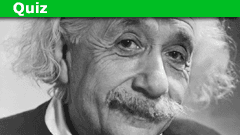
Albert Einstein Quiz: Test Your Knowledge of His Theories
Albert Einstein developed the theory of relativity and the mass-energy equivalence formula E=mc², won the 1921 Nobel Prize in Physics for his explanation of the photoelectric effect, and his work underpins technologies such as GPS navigation. This quiz tests specific facts about his life, theories, and scientific legacy.
Table of Contents
Key Takeaways
- Albert Einstein won the Nobel Prize in Physics in 1921 for explaining the photoelectric effect, not for his theory of relativity.
- The equation E=mc² describes mass-energy equivalence, where energy equals mass multiplied by the speed of light squared.
- The Theory of Relativity has two parts: Special Relativity, which addresses observers moving at constant speed, and General Relativity, which incorporates gravity.
- Einstein signed a 1939 letter to President Franklin Roosevelt that helped launch U.S. efforts toward building an atomic bomb, though he did not work on the Manhattan Project himself.
- GPS navigation systems rely on corrections for time dilation, a phenomenon predicted by Einstein’s theory of relativity.
No prizes for this one, so no Googling allowed. Post your honest score in the discussion thread.
On Mystery
“The most beautiful experience we can have is the mysterious. It is the fundamental emotion that stands at the cradle of true art and true science. Whoever does not know it and can no longer wonder, no longer marvel, is as good as dead, and his eyes are dimmed.”

Ready for your next quiz? Try the Isaac Newton quiz to test your knowledge of another foundational figure in physics.
Who Was Albert Einstein?
Albert Einstein was a German-born theoretical physicist widely recognized as one of the greatest physicists in history. He developed the theory of relativity, one of the two pillars of modern physics alongside quantum mechanics, the branch of physics describing the behavior of matter and energy at atomic and subatomic scales. Einstein’s work is also known for its lasting influence on the philosophy of science.
What Is Einstein’s Most Famous Equation?
Einstein’s most famous equation is E=mc², known as the mass-energy equivalence formula. The equation states that energy (E) equals mass (m) multiplied by the speed of light (c) squared. E=mc² has been pivotal in the development of nuclear energy and in understanding the energy produced by the sun and other stars.
What Is the Theory of Relativity?
The Theory of Relativity is a fundamental framework in physics developed by Albert Einstein, consisting of two parts: Special Relativity and General Relativity. Special Relativity established that the laws of physics are the same for all non-accelerating observers and that the speed of light in a vacuum remains constant regardless of an observer’s speed. General Relativity extended these ideas to include gravity as a property arising from the warping of space and time.
Did Einstein Receive a Nobel Prize?
Albert Einstein received the Nobel Prize in Physics in 1921. The prize was not awarded for his theory of relativity but for his explanation of the photoelectric effect, a discovery that was pivotal in establishing quantum theory.
What Impact Did Einstein Have on the Development of the Atomic Bomb?
Einstein did not directly participate in building the atomic bomb, but his equation E=mc² laid the theoretical foundation for nuclear energy and weapons development. In 1939, Einstein signed a letter to President Franklin Roosevelt that helped initiate U.S. efforts to build an atomic bomb.
How Did Einstein’s Views Change the World of Physics?
Einstein’s theories, including relativity and his contributions to quantum mechanics, significantly changed scientific understanding of time, space, matter, energy, and gravity. His work led to the development of new fields of physics and opened the door to modern technologies such as GPS navigation, which relies on accounting for time dilation, a concept drawn directly from his theory of relativity.
Frequently Asked Questions
Where was Albert Einstein born?
Albert Einstein was born in Germany. He is described as a German-born theoretical physicist, and his early life and education took place in German-speaking Europe before he later emigrated.
Did Einstein win the Nobel Prize for relativity?
No. Einstein won the 1921 Nobel Prize in Physics for his explanation of the photoelectric effect, which helped establish quantum theory, not for his theory of relativity.
What are the two parts of Einstein’s Theory of Relativity?
The Theory of Relativity consists of Special Relativity, which covers the physics of observers moving at constant speeds and the constancy of the speed of light, and General Relativity, which incorporates gravity as a warping of space and time.
Did Einstein help build the atomic bomb?
Einstein did not directly work on building the atomic bomb. His equation E=mc² provided the theoretical basis for nuclear energy, and his 1939 letter to President Franklin Roosevelt helped spur U.S. efforts toward the bomb’s development.
How does GPS relate to Einstein’s work?
GPS navigation systems must account for time dilation, a phenomenon where time passes at different rates depending on speed and gravitational field strength, as predicted by Einstein’s theory of relativity. Without these corrections, GPS positioning would drift and become inaccurate.
What does E=mc² mean?
E=mc² is the mass-energy equivalence formula, stating that energy (E) equals mass (m) multiplied by the speed of light (c) squared. It explains how mass can be converted into energy, a principle central to nuclear power and stellar energy production.

I have a BS in Information Sciences from UW-Milwaukee. I’ve helped manage Physics Forums for over 22 years. I enjoy learning and discussing new scientific developments. STEM communication and policy are big interests as well. Currently a Sr. SEO Specialist at Shopify and writer at importsem.com





Only 6/12.
Well, I guess 1 is as good a starting point as any :-) Fun quiz – I learned from it!