
Supernova Refsdal: Multiply-Imaged Supernova Guide
Table of Contents
Supernova (SN) Refsdal — Key Points
- Astronomers have been trying to understand space for thousands of years.
- Supernova Refsdal was the first known multiply-imaged supernova.
- Multiple images of the supernova are produced by strong gravitational lensing.
- Astronomers predicted the reappearance of the supernova before it was observed.
- The multiple images of the supernova exhibit measurable time delays between them.
- HST observations on 11 December 2015 revealed the fifth image of SN Refsdal.
- SN Refsdal is a valuable test case for gravitational lens models and their assumptions.
- Some lens models follow the observations more closely, but many predict higher magnifications or shorter time delays than observed.
- Comparing predictions and observations constrains model uncertainties and validates some modeling assumptions.
What is Supernova (SN) Refsdal?
Space is always changing. Over thousands of years, astronomers have attempted to understand how the Universe works. Explaining astronomical events gives researchers the opportunity to test physics on scales far beyond everyday experience.
Discovery and location
A group of astronomers had one such opportunity when they predicted the reappearance of a previously seen supernova: Supernova (SN) Refsdal. The supernova was originally discovered in November 2014 and was the first known multiply imaged supernova. It appeared near an early-type galaxy in the galaxy cluster MACS J1149.5+2223.
Gravitational lensing explained
SN Refsdal’s multiple images were produced by strong gravitational lensing. Like an optical lens, a large concentration of mass bends light. The more massive the lens, the more it bends light from objects behind it. With strong lensing we can observe multiple images of a single object when light rays that would otherwise miss us are redirected and arrive from slightly different directions.
Prediction and historical context
Although other supernovae have been magnified by lensing, SN Refsdal was the first supernova observed as multiple distinct images. It is named after Sjur Refsdal, a Norwegian astrophysicist who first discussed how multiply imaged sources could be used in cosmology. Between July and October 2015, the cluster containing SN Refsdal was too close to the Sun to be observed by the Hubble Space Telescope (HST). The observing team predicted the supernova could reappear as early as 30 October 2015, when HST could resume observations of MACS J1149.5+2223.
Why do multiple images appear at different times?
In addition to appearing in different positions on the sky, multiple images produced by gravitational lensing also experience time delays relative to each other. Light for each image follows a different path and traverses different gravitational potentials, so the travel time differs. As a result, light from some images reaches us earlier than light from others. The new image of Refsdal arrived later because its light had to travel a longer path.
HST detection of the fifth image
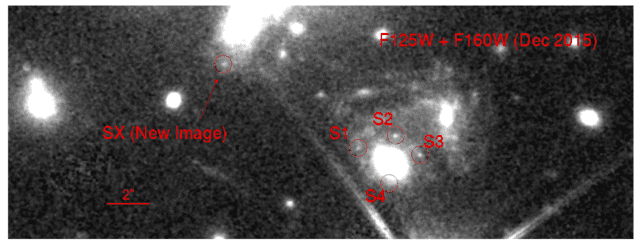
HST observations of MACS J1149.5+2223 taken on 11 December 2015 show an object interpreted as a new image of SN Refsdal. This was the fifth image of SN Refsdal and—importantly—the first time astronomers successfully predicted the appearance of a supernova image. HST images that include all five appearances are shown in Figure 1.
Lens models and predictions
Fifth image and model predictions
Several teams of lens modelers revised their models using the data and light curve from the original four images. These refinements were completed before the first possible observation of the fifth image (30 October 2015), so the predictions were blind. Because the distribution of dark and baryonic matter in the cluster is not perfectly known, each model makes different assumptions and thus predicts different properties for the fifth image.
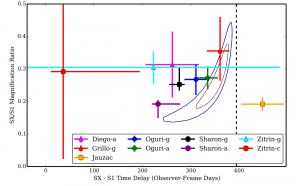
Although there is not yet enough information to use SN Refsdal for precision cosmology at the level Sjur Refsdal originally envisioned, the object provides a unique test of gravitational lens models. A multiply imaged supernova can test both the predicted magnification and the relative time delays between images—constraints that a singly magnified supernova cannot provide. A comparison of model predictions with the new observation is shown in Figure 2.
Model uncertainties and comparison
Scientists note that this test is local—models are being tested in the region near the images, not for the entire cluster—and still provides valuable insight into intrinsic model uncertainties. Tests with lensed supernovae can quantify uncertainties otherwise difficult to estimate. The comparison concluded that unknown systematic uncertainties in some models are not larger than the random uncertainties, which supports the models’ basic assumptions.
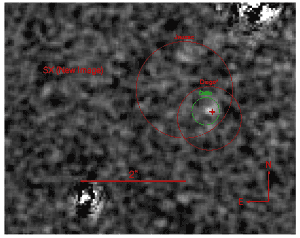
Some models match the observations more closely than others, but many models tend to predict higher magnifications or shorter time delays than were observed. Figure 3 shows the predicted locations of the fifth image from several models together with the actual location.
FAQ
What is a supernova?
A supernova is a powerful, luminous stellar explosion. It is the most violent type of explosion in space and occurs when a star has exhausted its fuel and can no longer support itself. The resulting shock wave of energy and matter can be seen across the Universe.
What causes a supernova?
Supernovae occur when a star has exhausted its nuclear fuel and can no longer support its own gravity. This collapse triggers a powerful explosion. (Different types of supernovae have different detailed causes, but the outcome is a catastrophic release of energy.)
How long does a supernova last?
The visible light from a supernova typically lasts for a few weeks to months, but radiation and other effects from the explosion can linger for years.
Are supernovae dangerous?
Supernovae are not dangerous to us on Earth in normal circumstances. The shock wave and expelled matter typically dissipate long before reaching our planet. Only a very close supernova (tens of light-years away) could pose a direct threat.
References
Kelly, P. L. et al. (Department of Astronomy, University of California, Berkeley).
A Nuclear Fusion Physicist and Astrophysicist.
BSc Physics & Engineering, MSc Nuclear Physics & Engineering, MSc Astrophysics, PhD Plasma Physics


Leave a Reply
Want to join the discussion?Feel free to contribute!