
Real Numbers: Definition, Properties & Completeness
Table of Contents
Definition of real numbers
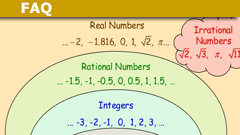
Real numbers are the set of all values that can appear on the continuous number line. They include rational numbers (fractions and terminating or repeating decimals) and irrational numbers (non-repeating, non-terminating decimals). The real numbers are usually denoted by the symbol ℝ. They can be positive, negative, or zero, and they can be represented as finite decimals, repeating decimals, or infinite non-repeating decimals.
Key characteristics
Key characteristics of real numbers include:
- Positive real numbers: numbers greater than zero (for example: 1, 2, 3.5).
- Negative real numbers: numbers less than zero (for example: −1, −2.7, −0.5).
- Zero: the number 0 is a real number and serves as the additive identity.
- Rational numbers: numbers that can be expressed as a fraction of two integers (denominator ≠ 0), e.g. 1/2, −3/4, 5.
- Irrational numbers: numbers that cannot be written as a simple fraction and have non-repeating, non-terminating decimal expansions, e.g. √2, π, e.
- Density: the real numbers are dense on the number line: between any two real numbers there are infinitely many other real numbers. This makes them suitable for representing continuous quantities in mathematics and science.
Importance and applications
Real numbers are a fundamental concept in mathematics and are used widely to describe quantities, measurements, and relationships in many disciplines.
Extended explanation
Scope
This article is a concise introduction; more examples and proofs will be added in the future.
A brief history
The idea of real numbers grew from the geometric notion of length. Ancient mathematicians noticed that rational numbers alone could not measure every length (for example, the diagonal of a unit square); this observation led to methods such as Eudoxus’s “method of exhaustion.” For more modern expositions see the linked article on real numbers.
Formal constructions
Modern mathematics offers several equivalent constructions of the real numbers. Two standard constructions are:
- Cauchy sequences: real numbers can be obtained as equivalence classes of Cauchy sequences of rational numbers (sequences whose terms get arbitrarily close to each other).
- Dedekind cuts: real numbers can be defined as Dedekind cuts in the rationals, i.e., partitions of the rationals into two nonempty sets with certain order properties.
Both constructions require some care (for example, the Cauchy-sequence approach uses equivalence classes), but they produce isomorphic complete ordered fields.
Basic language and primitives
The real number system is presented as a set with distinguished elements and operations. Concretely:
- the set ℝ (elements called real numbers)
- the distinguished constants 0 (additive identity) and 1 (multiplicative identity)
- binary operations: addition + and multiplication ·
- unary operation: negation −
- partial unary operation: reciprocal (inverse) written as x⁻¹ for x ≠ 0
- an order relation: ≤
Field axioms (algebraic properties)
a + banda · bare in ℝ for alla, bin ℝ.- Negation:
−ais in ℝ for allain ℝ. - Inverses: if
d ≠ 0thend⁻¹is in ℝ. - Commutativity:
a + b = b + a,a · b = b · a. - Associativity:
a + (b + c) = (a + b) + c,a · (b · c) = (a · b) · c. - Distributivity:
a · (b + c) = (a · b) + (a · c). - Identities:
a + 0 = a,a · 1 = a. - Inverses:
a + (−a) = 0, and ford ≠ 0we haved · d⁻¹ = 1.
Ordering axioms
- If
a ≤ bandb ≤ athena = b. - If
a ≤ bandb ≤ cthena ≤ c(transitivity). - Comparability (total order): either
a ≤ borb ≤ afor anya, b. - If
a ≤ bthena + c ≤ b + cfor anyc. - If
0 ≤ canda ≤ bthena · c ≤ b · c.
Completeness axiom
The defining analytic property of the real numbers is completeness. One standard form is the least-upper-bound property:
Every non-empty subset of ℝ that has an upper bound has a least upper bound (supremum).
An equivalent sequential form is the monotone convergence theorem: every bounded monotone sequence of real numbers converges to a real limit. For example, if (fₙ) is an increasing sequence with an upper bound, then the limit limₙ→∞ fₙ exists in ℝ.
Other operations and derived identities
- Subtraction:
a − bis defined asa + (−b). - Division: if
d ≠ 0thena / dis defined asa · d⁻¹.
Common confusions
The term “real” in “real numbers” is simply a historical name distinguishing this number system from others (integers, rationals, finite fields, etc.). It does not imply “more real” or “ordinary” in the everyday sense.
Additional notes
There are two common rigorous introductions to the real numbers: Dedekind cuts and equivalence classes of Cauchy sequences. Both approaches require a small amount of advanced (analysis-level) machinery to make the intuitive notion of the continuous number line precise.
Further reading
This article was authored by several Physics Forums members with PhDs in physics or mathematics.




Leave a Reply
Want to join the discussion?Feel free to contribute!