
AI Enriched Problem Solving
Table of Contents
Introduction
This article is written by way of a reference for my longstanding PF colleague and prolific poster of challenging Maths/geometry problems @chwala . The particular post this article will discuss is an example of one such problem which he raised on Physics Forums.
The Problem
We take the liberty of including the original diagram from that thread:
f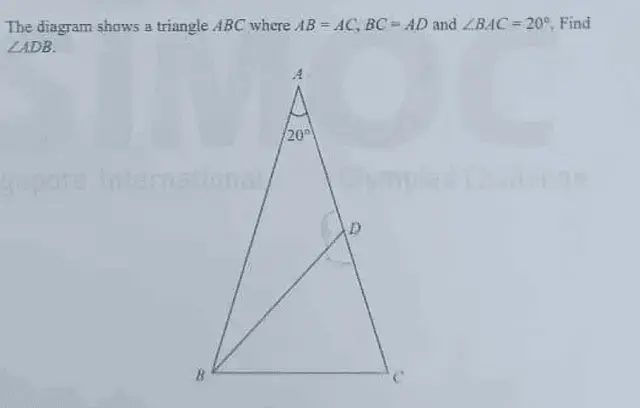
A deceptively simple diagram which holds a ‘treasure trove’ of geometry and trigonometry as we shall discover with a little help from an AI engine!
Solution Using Sine and Cosine rules
We begin with the solution presented by @chwala who assigns a length x to sides BC and DA and a length y to side CD. Hence AB=AC=x+y.
Applying the sine rule to triangle ABC:
##\dfrac{x}{x+y} = \dfrac{\sin 20^{\circ}}{\sin 80^{\circ}}##
##\dfrac{x}{x+y} =0.347##
If we set ##x=3.47## then it follows that ##y=10-3.47=6.53##. Then:
##BD^2=3.47^2+10^2-(2×3.47×10×\cos 20^{\circ})##
##BD= 6.842##
Noting that ##x+y=10## , we again apply the cosine rule to triangle BDA:
##10^2=3.47^2+6.842^2-(2×3.47×6.842 ×\cos m)##
##41.15=-47.4696\cos m##
##\cos m = -0.866##
##m= 150^{\circ}##
The purpose of @chwala‘s post was to ask if there might be other approaches to solving this problem. Some suggestions were posted in the original thread referenced above and in this article we include two distinctly different solutions, the one trigonometric and the other geometric. The latter we must ascribe to the latent genius of AI.
Solution using the Sine and Tan Rules
Most courses in trigonometry will include the sine rule and cosine rule so it is somewhat surprising that the relatively easily derived “Tan Rule” is rarely (if at all) mentioned. In a situation where the “givens” are two sides and an included angle, it enables the direct determination of either of the remaining two angles without requiring the calculation (by cosine rule) of the third side. This is exactly what is required in this particular problem. Referring to the diagram, we begin by setting BC=AD=1 unit and DC=y units. As in the first solution, we begin by applying the sine rule in triangle ABC:
##\dfrac{AD}{AB}=\dfrac{1}{1+y} = \dfrac{\sin 20^{\circ}}{\sin 80^{\circ}}##
As pointed out by PF contributor @SammyS this ratio can be simplified:
## \dfrac{\sin 20^{\circ}}{\sin 80^{\circ}}=2\sin 10^{\circ}\cos 10^{\circ}\sec 10^{\circ}=2\sin 10^{\circ}##
Applying the tan rule in triangle BDA:
##\tan(B\hat{D}A)=\dfrac{AB\sin20^{\circ}}{AD-AB\cos20^{\circ}}##
##\implies\cot(B\hat{D}A)=\dfrac{AD-AB\cos20^{\circ}}{AB\sin20^{\circ}}=\dfrac{\sin20^{\circ}\csc20^{\circ}}{\sin80^{\circ}}-\dfrac{\cos20^{\circ}}{\sin20^{\circ}}=\csc80^{\circ}-\cot20^{\circ}##
##\implies B\hat{D}A=\tan^{-1}\left(\dfrac{1}{\csc80^{\circ}-\cot20^{\circ}}\right)=150^{\circ}##
PF contributor @Gavran suggests the following solution which arrives at the exact same result as above:
As in @chwala‘s original solution we assign a length x to sides BC and DA and a length y to side CD. Hence AB=AC=x+y.Let angle BDA=m. Then applying the sine rule in triangle BDA:
## \dfrac {x}{x+y} =\dfrac {\sin (160^\circ-m)}{\sin m}=\dfrac{\sin 20^\circ \cos m + \cos 20^\circ \sin m}{\sin m}=2\sin 10^\circ ##
##\implies \cot m = \dfrac{2\sin 10^\circ-\cos 20^\circ}{\sin 20^{\circ}}=\sec 10^\circ – \cot 20^\circ##
##\implies m=\tan^{-1}\left(\dfrac{1}{\sec 10^{\circ}-\cot20^{\circ}}\right)=150^{\circ}##
At this point it is worth mentioning that @Gavran‘s solution is equivalent to applying the ‘tan rule’ as above. In both cases a second angle of a triangle (in which the givens are two sides and an included angle) is directly determined without having to first calculate the third side of the triangle using the cosine rule.
Geometrical Solution (AI Generated).
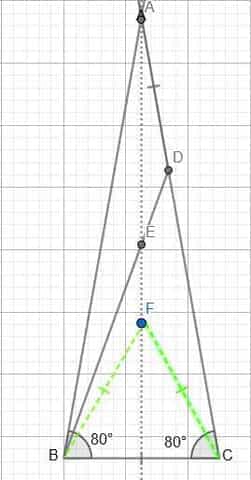
Construct the perpendicular bisector of BC through A. Construct equilateral triangle BFC with F on the perpendicular bisector. Then:
##\triangle BFA \cong \triangle ADB (SAS)##
Since the angles of triangle BFA are known, the corresponding angles of triangle ADB are also known.
Further AI Enrichment
We determined by calculation that:
##\tan B\hat{D}A=\dfrac{1}{\csc80^{\circ}-\cot20^{\circ}}=-0.57335##
and hence that angle BDA is 150 degrees. But can we actually prove the trig identity:
##\csc80^{\circ}-\cot20^{\circ}=\cot 150^{\circ}=-\sqrt{3} ?##
It turns out to be quite a complex identity to prove so for those interested, we supply a link to the very interesting AI generated proof:
cosec(80)-cot(20)=cot(150)=-sqrt(3)
Summary and Conclusion
In this article we have presented a number of different solutions to a very interesting problem posted by PF user @chwala in the Maths “homework help” forum. It is fair to say that this is just one of many challenging problems originated by @chwala and in that sense he has continually contributed to the ever evolving ‘knowledge store’ one can experience on Physics Forums today.
We have also tentatively explored a possible direction whereby AI generated content can be usefully integrated into that “knowledge store” as exemplified by the AI generated solution(s) in this article. For this author anyway the AI-generated geometrical proof was a “Eureka moment” which definitely needs to be shared with the PF community and readers of PF “Insights” articles.
BSc (Elec Eng) University of Cape Town, HDE University of South Africa
Maths and Science Tutor, Florida Park, Johannesburg
Research areas (personal interest): Hydrogen / Hydrogen-like spectra. Historical Maths.
Wikipdedia contributions: Ptolemy’s Theorem, Diophantus II.VIII, Continuous Repayment Mortgage

The geometric solution also makes it easy to figure out what is special about the figure. If the angle at the top is ##\alpha##, the proof depends on ##90°-60°-\alpha/2=\alpha##.