
Why the Gauge (Henstock-Kurzweil) Integral Matters
Table of Contents
The gauge integral (Henstock–Kurzweil)
The current (pure) mathematics curriculum at the university is well-established. Most of the choices made are sensible, but some important topics are still usually not taught. Some of these topics are obscure and not well known even to many professional mathematicians; others are known to specialists but for some reason are not touched upon in standard courses. The goal of this blog series is to visit some of these omissions, explain their basic theory, argue why they should be taught, and explore why they are omitted. Today’s topic is the gauge integral, also known as the Henstock–Kurzweil integral (also called the narrow Denjoy integral, the Luzin integral, or the Perron integral).
Riemann integral — two viewpoints
Every mathematics student is of course acquainted with the Riemann integral. The Riemann integral is defined for functions ##f:[a,b]\rightarrow \mathbb{R}##. The Riemann integral of ##f## can be presented in essentially two equivalent ways.
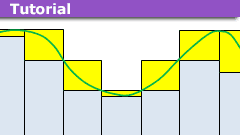
First, the Darboux method bounds the “area” of ##f## from below and above. We take a partition ##X = \{x_0,x_1,\dots,x_n\}## with ##x_0=a##, ##x_n=b## and ##x_i\le x_{i+1}##. Then define
[tex]U_X(f) = \sum_{i=0}^{n-1} (x_{i+1} – x_i)\sup_{x\in [x_i,x_{i+1}]}f(x)[/tex]
and
[tex]L_X(f) = \sum_{i=0}^{n-1} (x_{i+1} – x_i)\inf_{x\in [x_i,x_{i+1}]}f(x)[/tex]

The Darboux integral is defined when ##U_X(f) – L_X(f) \rightarrow 0## as the partition ##X## gets finer. In that case the common limit of ##U_X(f)## and ##L_X(f)## is called the Darboux integral.
The second viewpoint uses Riemann sums. Again take partition points ##X = \{x_0,\dots,x_n\}## as above and choose sample points ##\{a_0,\dots,a_{n-1}\}## with ##x_i\le a_i \le x_{i+1}##. The Riemann integral of ##f## is the limit of
[tex]\sum_{i=0}^{n-1} f(a_i)(x_{i+1} – x_i)[/tex]
as the partition gets finer (mesh tends to zero). The two approaches are equivalent; see Bloch, Real Numbers and Real Analysis for a textbook treatment: https://www.amazon.com/Real-Numbers-Analysis/dp/0387721762
Extending the domain: improper integrals
One simple extension of the Riemann integral is to allow domains such as ##[a,+\infty)##. For example, we define
[tex]\int_a^{+\infty} f(x)\,dx = \lim_{d\rightarrow +\infty} \int_a^d f(x)\,dx[/tex]
when the limit exists. These improper Riemann integrals cover many important cases in applications.
Lebesgue integral and its advantages
Later in their courses, mathematics students learn the Lebesgue integral. The Lebesgue integral is built by partitioning the codomain of the function (values) rather than the domain, and this shift yields major advantages.

The Lebesgue integral is much more powerful in many respects: it integrates many more functions, it supports strong theorems that allow interchange of limits and integrals (dominated convergence, monotone convergence, etc.), and many proofs become cleaner. The setup of the Lebesgue theory is more technical than Riemann’s, but it pays off in generality and convenience.
Limitations of the Lebesgue integral
However, Lebesgue integration is not strictly stronger in every sense. While every Riemann-integrable function on a compact interval is Lebesgue integrable, some improper Riemann integrals are not Lebesgue integrable in the naive extended sense. For example,
[tex]\int_0^{+\infty}\frac{\sin(x)}{x}\,dx[/tex]
is not Lebesgue integrable (over ##[0,\infty)##) in the absolute sense, yet the improper Riemann integral exists and equals ##\pi/2##. Thus the Lebesgue integral can be both more general and, in certain extended senses, weaker than improper Riemann integration.
Definition: the gauge integral
This tension is resolved by the gauge integral. The gauge integral (Henstock–Kurzweil) is a simple modification of the Riemann definition that produces a very powerful integral, one that encompasses the Riemann integral, many improper Riemann integrals, and the Lebesgue integral.
Recall a formal epsilon–delta style definition of the Riemann integral: we say the Riemann integral of ##f:[a,b]\rightarrow\mathbb{R}## is a number ##L## such that for every ##\varepsilon>0## there exists ##\delta>0## so that whenever a partition ##x_0,\dots,x_n## and sample points ##a_1,\dots,a_n## satisfy appropriate ordering and ##x_i-x_{i-1}<\delta## for all ##i##, then
[tex]\left|L – \sum_{i=1}^n f(a_i)(x_i – x_{i-1})\right|<\varepsilon[/tex]
The gauge integral replaces the uniform ##\delta## by a positive function (a gauge). More precisely, the gauge integral of ##f:[a,b]\rightarrow\mathbb{R}## is a number ##L## such that for every ##\varepsilon>0## there exists a function ##\delta:[a,b]\rightarrow(0,+\infty)## with the property that whenever points ##x_0,\dots,x_n## and sample points ##a_1,\dots,a_n## satisfy the usual ordering and
[tex]x_i – x_{i-1}<\delta(a_i)\quad\text{for all }i,[/tex]
then
[tex]\left|L – \sum_{i=1}^n f(a_i)(x_i – x_{i-1})\right|<\varepsilon.[/tex]
Variants of this definition extend the domain ##[a,b]## in natural ways; those generalizations are not pursued here.
Key properties and examples
The gauge integral has several striking properties. First, a function ##f## is Lebesgue integrable if and only if it is gauge integrable and ##\int |f|<+\infty##; thus Lebesgue integrable functions are precisely the absolutely gauge integrable functions. Intuitively, the Lebesgue integral corresponds to absolutely convergent series while the gauge integral corresponds to conditionally convergent series in the series analogy.
Second, many classical theorems for the Riemann and Lebesgue integrals hold in the gauge setting, often in cleaner and more general forms. For example, one classical statement of the fundamental theorem of calculus says: if ##F## is continuous on ##[a,b]## with derivative ##F’=f## and ##f## is Riemann integrable, then
[tex]\int_a^b f(x)\,dx = F(b)-F(a).[/tex]
One drawback of that statement is the hypothesis “if ##f## is Riemann integrable.” The gauge integral removes that restriction: if ##F’ = f## everywhere on ##[a,b]## except possibly at countably many points, then ##f## is gauge integrable and
[tex]\int_a^b f(x)\,dx = F(b)-F(a).[/tex]
Similarly, limit theorems, substitution rules, and integration-by-parts formulas admit strong, general versions in the gauge-integral framework.
Pedagogical advantages and limitations
Why should gauge integration receive more attention in undergraduate education? First, its definition is as easy to state as the Riemann integral and — with some practice — is intuitive. Second, it yields a single integral theory that unifies Riemann, many improper Riemann, and Lebesgue integrals on ##\mathbb{R}##; from the gauge integral one can recover the Lebesgue integral as a special case. Third, many general theorems become cleaner and most general in the gauge setting, making it attractive from a conceptual standpoint.
Why isn’t it widely taught? The gauge integral’s main drawback is that it is naturally formulated for functions ##\mathbb{R}\rightarrow\mathbb{R}##; although extensions exist for ##\mathbb{R}^n##, the Lebesgue theory handles very general measure spaces and higher-dimensional domains more systematically. For applied scientists the Riemann integral is usually sufficient; for analysts the Lebesgue integral is indispensable. These pragmatic considerations help explain why gauge integration is often omitted in standard curricula.
Conclusion
Mathematics values the most beautiful and general statements for theorems. From that perspective the gauge integral is an important omission in undergraduate education: it is easy to state, unifies several common integrals, and yields very general, elegant theorems. What are your thoughts?
References
- Introduction to Real Analysis — Swartz & DePree. Uses the gauge integral; coverage is introductory. https://www.amazon.com/Introduction-Real-Analysis-John-DePree/dp/0471853917
- A Modern Theory of Integration — R. G. Bartle. Exhaustive treatment dedicated to the gauge integral. https://www.amazon.com/Modern-Integration-Graduate-Studies-Mathematics/dp/0821808451
Advanced education and experience with mathematics





Выбор врача-остеопата — серьёзный этап на пути к реабилитации.
Прежде всего стоит определить свои потребности и запросы от консультации у специалиста.
Важно проверить образование и практику выбранного остеопата.
Рекомендации обратившихся помогут сделать осознанный выбор.
https://ok.ru/profile/584977149666/statuses/157236532638690
Также нужно учитывать техники, которыми оперирует специалист.
Стартовая консультация помогает понять, насколько подходит вам общение и подход специалиста.
Не забудьте оценить тарифы и формат приёма (например, онлайн).
Грамотный выбор врача способен ускорить лечение.
[QUOTE="disregardthat, post: 5561161, member: 49781"]Interesting. So do you as for improper Riemann integrals define for example the gauge integral ##int^{infty}_a f(x) dx## as the limit of the gauge integrals ##lim_{t to infty} int^t_a f(x) dx## (whenever the limit exists or is ##pm infty##) where ##f : [a, infty) to mathbb{R}## is gauge integrable on ##[a,t]## for all ##t geq a##? As far as I can see, you only gave a definition of a gauge integrable function on a closed interval.”You do the exact same thing except (i) replace the reals ##mathbb{R}## with the extended reals and (ii) define the "length" of an unbounded interval (that's the ##x_{i}-x_{i-1}## factor in micromass's definition) as equal to zero. This forces the Riemann sum to be a finite number, and all the proofs can be used unchanged. See Robert McLeod (1980) The Generalized Riemann Integral for an overview.”Assuming the above, what's stopping us from simply defining ##int^{infty}_a f(x) dx## as the limit of the Lebesgue integrals ##lim_{t to infty} int^t_a f(x) dx## (whenever the limit exists or is ##pm infty##) for functions ##f : [a,infty) to infty## which are Lebesgue integrable on ##[a,t]## for all ##t geq a##? Using the same idea for all the different improper integrals would give us a notion of improper Lebesgue integrals, and improperly Lebesgue integrable functions.”There is no such thing as "improper Lebesgue integral" because ##[a,infty)## is a measurable space. ##int_{[a,infty)} f , dmu##, where the right hand side is using the Lebesgue measure, is not improper. Note that ##int_0^infty frac{sin(x)}{x}, dx## is undefined as a Lebesgue integral (it becomes a ##infty-infty## situation), but exists as an improper Riemann integral, or as a gauge integral directly.Remember the reason why we care about Lebesgue at all is because of dominated convergence, but with Riemann we need uniform convergence.
Interesting. So do you as for improper Riemann integrals define for example the gauge integral ##int^{infty}_a f(x) dx## as the limit of the gauge integrals ##lim_{t to infty} int^t_a f(x) dx## (whenever the limit exists or is ##pm infty##) where ##f : [a, infty) to mathbb{R}## is gauge integrable on ##[a,t]## for all ##t geq a##? As far as I can see, you only gave a definition of a gauge integrable function on a closed interval.Assuming the above, what's stopping us from simply defining ##int^{infty}_a f(x) dx## as the limit of the Lebesgue integrals ##lim_{t to infty} int^t_a f(x) dx## (whenever the limit exists or is ##pm infty##) for functions ##f : [a,infty) to infty## which are Lebesgue integrable on ##[a,t]## for all ##t geq a##? Using the same idea for all the different improper integrals would give us a notion of improper Lebesgue integrals, and improperly Lebesgue integrable functions.It seems to me that perhaps the theorem you gave about the equivalence between Lebesgue integrable functions and gauge integrable functions such that ##int |f| < infty## implies that the definition above of a Lebesgue integrable function (proper and improper) is equivalent with the definition of a gauge integrable function.Maybe I'm wrong and missing something here. What exactly can gauge integration do which Lebesgue integration and improper Lebesgue integration like I defined above cannot?Also, what do you do about gauge integrals ##int_A f(x) dx## for arbitrary sets ##A##? For which sets and functions are such integrals defined?
Enlightening! I always thought of Lebesgue as Riemann with running over the null-sets :)
Liked your article too.
minor typo in the first paragraph look for integratal
The Insight article has nice pictures that give intuition about the Riemann integral and the Legesgue integral. Is there a useful picture that explains the gauge integral ?The arguments given in favor of the gauge integral focus on the nice implications it provides – if f is gauge integrable then ….. To use such implications in a specific setting, one would need to establish the "f is gauge integrable" clause. I don't get any intuitive understanding of how to do that, except in a trivial case where we can define [itex] delta(x) [/itex] to be a constant function, reverting it to the ordinary [itex] delta [/itex].For example, I gather that [itex] int_0 ^ {infty} frac{sin{x}}{x} [/itex] can be defined as an "extended" gauge integral in the usual way, by taking the limit of a gauge integrals over a finite intervals. So, technically, we need the existence of a different function [itex] delta(x) [/itex] for each of the finite intervals.Does the "gauge" in gauge integral has something to do with the concept of "gauge" in physics? (Unfortunately for me, the concept of a "gauge" in physics isn't very intuitive. There are explanations such ashttps://terrytao.wordpress.com/2008/09/27/what-is-a-gauge/ , but I need someone to explain the explanation!)
[QUOTE="micromass, post: 5527766, member: 205308"]How would "##|f|## is gauge integrable" imply "##f## is measurable"? From my posts follows only that ##|f|## is measurable.”Ok; I see the subtle difference. Thus ''##f## is Lebesgue integrable iff ##f## and ##|f|## are gauge integrable".
How would "##|f|## is gauge integrable" imply "##f## is measurable"? From my posts follows only that ##|f|## is measurable.
[QUOTE="micromass, post: 5527754, member: 205308"]No, that would be incorrect. Can you show why you think your statement is true?”Well if (i) Lebesgue integrable implies measurable and (ii) every gauge integrable function is measurable and (iii) ##f## is Lebesgue integrable iff ##f## is measurable and ##|f|## is gauge integrable" (three assertions taken from your posts) then my statement follows.
[QUOTE="A. Neumaier, post: 5527731, member: 293806"]Then the optimal statement should be ''##|f|## is gauge integrable iff ##f## is Lebesgue integrable'', shouldn't it?”No, that would be incorrect. Can you show why you think your statement is true?
[QUOTE="micromass, post: 5527720, member: 205308"]No, every gauge integrable function is measurable.”Then the optimal statement should be ''##|f|## is gauge integrable iff ##f## is Lebesgue integrable'', shouldn't it?
[QUOTE="A. Neumaier, post: 5527719, member: 293806"]OK, thanks. Are there nonmeasurable functions ##f## for which both ##f## and ##|f|## are gauge integrable? (assuming ZFC)”No, every gauge integrable function is measurable.
[QUOTE="micromass, post: 5527718, member: 205308"]Lebesgue integrable implies measurable, so I don't know why you put in a condition "measurable and Lebesgue integrable".” OK, thanks. Are there nonmeasurable functions ##f## for which both ##f## and ##|f|## are gauge integrable? (assuming ZFC)
[QUOTE="A. Neumaier, post: 5527717, member: 293806"]The two answers don't quite match. It seems to me that you wanted to say that ''##|f|## is gauge integrable iff ##f## is measurable and Lebesgue integrable''. Is this the correct assertion?”Lebesgue integrable implies measurable, so I don't know why you put in a condition "measurable and Lebesgue integrable". So no, it is not the correct assertion. It is "##f## is Lebesgue integrable iff ##f## is measurable and ##|f|## is gauge integrable".
[QUOTE="micromass, post: 5527686, member: 205308"]Read the rest of the post for the exact statement that is true. It also says that the statement as posted is false.Yes.”The two answers don't quite match. It seems to me that you wanted to say that ''##|f|## is gauge integrable iff ##f## is measurable and Lebesgue integrable''. Is this the correct assertion?
[QUOTE="A. Neumaier, post: 5527684, member: 293806"]What do you mean by ''essentially correct"? The question was a precise mathematical statement, so it is either known to be true or not known to be true.”Read the rest of the post for the exact statement that is true. It also says that the statement as posted is false.”And is the inverse also true, is every Lebesgue integrable function also gauge integrable?”Yes.
[QUOTE="micromass, post: 5527671, member: 205308"]That is essentially correct. We just want ##f## to be measurable/gauge integrable to exclude pathological cases having to do with nonmeasurable functions.”What do you mean by ''essentially correct"? The question was a precise mathematical statement, so it is either known to be true or not known to be true. And is the inverse also true, is every Lebesgue integrable function also gauge integrable?
[QUOTE="wrobel, post: 5527653, member: 593228"]Thanks.So if ##|f|## is gauge integrable then ##f## it is Lebesgue integrable?”That is essentially correct. We just want ##f## to be measurable/gauge integrable to exlcude pathological cases having to do with nonmeasurable functions.
Thanks.So if ##|f|## is gauge integrable then ##f## it is Lebesgue integrable?
[QUOTE="wrobel, post: 5527588, member: 593228"]Does the gauge integral allow to define spaces analogous to ##L^p##?”The situation is the same as with convergent and absolutely convergent series. Absolutely convergent series allow us to define ##ell^p##. Convergent series is general do not. In the same way, the absolutely convergent integrals can be used to define ##L^p##. Note that ##|f|## is absolutely convergent iff ##f## is Lebesgue integral.”If the gauge integral ##int|f|=0## then what can we say about ##f##?”We can say that ##f=0## a.e. just as with the Lebesgue integral.
Does the gauge integral allow to define spaces analogous to ##L^p##? If the gauge integral ##int|f|=0## then what can we say about ##f##?
Here is the theorem of differentiation under the integral sign for the gauge integral:Theorem: Let ##f:[a,b]times [c,d]rightarow mathbb{R}## (where ##b## can be infinity) such that for each ##tin [c,d]##, the function ##xrightarrow f(x,t)## is measurable on ##[a,b]##.Suppose that:1) There exists ##tin [c,d]## such ##xrightarrow f(x,t)## is gauge integrable.2) The partial derivative ##frac{partial f}{partial t}## exists on ##[a,b]times [c,d]##.3) There are gauge integrable functions ##alpha## and ##omega## such that[tex]alpha(x)leq frac{partial f}{partial t}(x,t)leq omega(x)[/tex]for all ##xin [c,d]## and ##tin [a,b]##.1) Then ##xrightarrow f(x,t)## is gauge integrable for each ##tin [c,d]##.2) The function ##xrightarrow frac{partial f}{partial t}## is guage integrable for each ##tin [c,d]##3) We have[tex]frac{d}{dt}int_a^b f(x,t)dx = int_a^b frac{partial f}{partial t}dx[/tex]In particular, if ##f(x,t) = e^{-tx}frac{sin(x)}{x}##, then this is clearly measurable in ##x## since it is continuous.Setting ##t=1## gives us ##e^{-x}frac{sin(x)}{x}## which is gauge integrable by the following theorem.Theorem: A measurable function ##g## is gauge integrable iff there are gauge integrable functions ##g_1##, ##g_2## such that ##g_1leq gleq g_2##.We have ##frac{partial f}{partial t} = -e^{-tx}sin(x)## exists on ##[0,+infty]times [varepsilon,1]## and is easily seen to be gauge integrable by using the above Theorem. So the theorem applies, at least for ##tin [varepsilon, 1]##. So for those ##t##, we can indeed et[tex]int_0^{+infty} e^{-tx}frac{sin(x)}{x}dx = frac{pi}{2} – text{arctan}(t)[/tex]Then we would need to switch limit and integral to conclude that ##int_0^{+infty}frac{sin(x)}{x}dx = frac{pi}{2}##. This is provided in the document I linked.
[QUOTE="A. Neumaier, post: 5527436, member: 293806"]The main reason why the standard courses about integration treat the Lebesgue integral rather than the Henstock integral is that the former has much stronger properties required in all applications to measure theory and functional analysis.One cannot do most of modern mathematics without the Lebesgue integral, while one can do most of it without the Henstock integral. Being maximally general is simply something very different from being maximally useful.”Almost all of the theorems of Lebesgue integration also hold for the gauge integral. This includes stuff like dominated convergence and integration under the integral sign.[QUOTE="A. Neumaier, post: 5527437, member: 293806"]The justification must be based on proven properties of the integral. Are these properties satisfied for the Lebesgue integral? For the Henstock integral?”Yes, they are.[QUOTE="strangerep, post: 5527446, member: 70760"]Oh, ok. (I knew about DUI already, of course, but hadn't seen it applied to sin(x)/x.) In any case, I now realize I misinterpreted your article. I was replying to your statement:but forgot that you had said earlier that it's Riemann-integrable.DUI tends to be used quite freely in theoretical physics, so it would be useful to know if there's any easy ways to tell where it doesn't work. Perhaps a subject for another insights article? :oldbiggrin:”That's a good idea!
[QUOTE="A. Neumaier, post: 5527437, member: 293806"]This is a heuristic recipe that requires justification. Why is one allowed to do that in this particular case? Surely there are conditions on the integrand needed to make it work as it is known yhat the trick may fail to give the correct answer.The justification must be based on proven properties of the integral. Are these properties satisfied for the Lebesgue integral? For the Henstock integral?”From Necessary and Sufficient Conditions for Differentiating Under the Integral Sign by Erik TalvilaTheorem Let ##f:[alpha,beta] times [a,b] to mathbb{R}##. Suppose that ##f(cdot, y)## is ##ACG_*## on ##[alpha, beta]## for almost all ##y in (a,b)##. Then ##F:= int_a^b f(cdot,y) , dy## is ##ACG_*## on ##[alpha,beta]## and ##F'(x) = int_a^b f_1(x,y) , dy## for almost all ##x in (alpha,beta)## if and only if##int_{x=s}^{t} int_{y=a}^b f_1 (x,y) dy dx = int_{y=a}^{b} int_{x=s}^t f_1(x,y) dx dy## for all ##[s,t]subset [alpha,beta]##.Recall, a function is said to be absolutely continuous in the restricted sense on ##Esubset [a,b]## (##AC_*##) if for all ##epsilon > 0## there exists ##delta > 0## such that ##Sigma_{i=1}^{N} sup_{x,y in [x_i, y_i]} | F(x) – F(y)| < epsilon## for all finite sets of disjoint open intervals with endpoints in E and ##Sigma_{i=1}^N (y_i-x_i) < delta##.A function is said to be generalised absolutely continuous in the restricted sense on E (##ACG_*##) if it is continuous and E is a countable union of sets on which it is ##AC_*##
[QUOTE="A. Neumaier, post: 5527437, member: 293806"]This is a heuristic recipe that requires justification. Why is one allowed to do that in this particular case? Surely there are conditions on the integrand needed to make it work as it is known yhat the trick may fail to give the correct answer.The justification must be based on proven properties of the integral. Are these properties satisfied for the Lebesgue integral? For the Henstock integral?”From Necessary and Sufficient Conditions for Differentiating Under the Integral Sign by Erik TalvilaTheorem Let ##f:[alpha,beta] times [a,b] to mathbb{R}##. Suppose that ##f(cdot, y)## is ##ACG_*## on ##[alpha, beta]## for almost all ##y in (a,b)##. Then ##F:= int_a^b f(cdot,y) , dy## is ##ACG_*## on ##[alpha,beta]## and ##F'(x) = int_a^b f_1(x,y) , dy## for almost all ##x in (alpha,beta)## if and only if##int_{x=s}^{t} int_{y=a}^b f_1 (x,y) dy dx = int_{y=a}^{b} int_{x=s}^t f_1(x,y) dx dy## for all ##[s,t]subset [alpha,beta]##.Recall, a function is said to be absolutely continuous in the restricted sense on ##Esubset [a,b]## (##AC_*##) if for all ##epsilon > 0## there exists ##delta > 0## such that ##Sigma_{i=1}^{N} sup_{x,y in [x_i, y_i]} | F(x) – F(y)| < epsilon## for all finite sets of disjoint open intervals with endpoints in E and ##Sigma_{i=1}^N (y_i-x_i) < delta##.A function is said to be generalised absolutely continuous in the restricted sense on E (##ACG_*##) if it is continuous and E is a countable union of sets on which it is ##AC_*##
[QUOTE="micromass, post: 5526994, member: 205308"]One approach is to differentiate under the integral sign. […][/quote] Oh, ok. (I knew about DUI already, of course, but hadn't seen it applied to sin(x)/x.) In any case, I now realize I misinterpreted your article. I was replying to your statement:[quote=micromass]Furthermore, integrals like ##int_0^infty sin(x)/x ; dx## that can not be found by Lebesgue, can be found by the gauge integral and yield sensible answers[/quote]but forgot that you had said earlier that it's Riemann-integrable.DUI tends to be used quite freely in theoretical physics, so it would be useful to know if there's any easy ways to tell where it doesn't work. Perhaps a subject for another insights article? :oldbiggrin:
[QUOTE="micromass, post: 5526994, member: 205308"]to differentiate under the integral sign”This is a heuristic recipe that requires justification. Why is one allowed to do that? The justification must be based on proven properties of the integral. Are these properties satisfied for the Lebesgue integral? For the Henstock integral?
The main reason why the standard courses about integration treat the Lebesgue integral rather than the Henstock integral is that the former has much stronger properties required in all applications to measure theory. One cannot do most of modern mathematics without the Lebesgue integral, while one can do most of it without the Henstock integral. being maximally general is simply something very different from being maximally useful.
[QUOTE="strangerep, post: 5526850, member: 70760"][USER=205308]@micromass[/USER]: Coincidentally, I recently read a bit about the "Henstock–Kurzweil" integral, which I understand is the same thing as the Gauge Integral? (Btw, is there any reason you didn't mention that name?)”Yes, it is the same thing. I'll add the various names to the article. Thanks”Regarding the integral $$int_0^infty frac{sin(x)}{x}, dx ~~,$$I've only ever seen that performed by contour integration (i.e., interpreted as a Cauchy PV integral). How is it done by Gauge Integration? (Maybe you could post an online link to the details?)”One approach is to differentiate under the integral sign. Consider ##F(t) = int_0^{+infty} e^{-tx}frac{sin(x)}{x}dx##. Then [tex]F'(t) = -int_0^{+infty} e^{-tx} sin(x)dx = -frac{1}{1+t^2}[/tex]So ##F(t) = frac{pi}{2} – text{arctan}(t)##. Letting ##trightarrow 0## gives us the value of ##pi/2##.Here you can find more details: http://www.math.uconn.edu/~kconrad/blurbs/analysis/diffunderint.pdf This document doesn't deal with the gauge integral, but everything in the document applies to that setting as well.”And speaking of contour integration, one thing I like about Cauchy PV integrals is their relationship to Lebesgue integrals. But I get the impression from your article that one cannot in general achieve such a close relationship with Gauge Integrals, since the domain is ##mathbb C##, not ##mathbb{R}## ?”Right. It is possible though to define the gauge integral on ##mathbb{C}##, but this is technical. In any case, it's not something I've looked into.
[USER=205308]@micromass[/USER]: Coincidentally, I recently read a bit about the "Henstock–Kurzweil" integral, which I understand is the same thing as the Gauge Integral? (Btw, is there any reason you didn't mention that name?)Regarding the integral $$int_0^infty frac{sin(x)}{x}, dx ~~,$$I've only ever seen that performed by contour integration. How is done by Gauge Integration? (Maybe you could post an online link to the details?)And speaking of contour integration, one thing I like about Cauchy PV integrals is their relationship to Lebesgue integrals. But I get the impression from your article that one cannot in general achieve such a close relationship with Gauge Integrals, since the domain is ##mathbb C##, not ##mathbb{R}## ?
Enlightening! I always thought of Lebesgue as Riemann with running over the null-sets. This article cleared this wrong view.