
Quantum Entanglement is a Kinematic Fact, not a Dynamical Effect
Towards the end of the first lecture for the Qiskit Global Summer School 2025, Foundations of Quantum Mechanics, Olivia Lanes (Global Lead, Content and Education IBM) stated:
Before we end, let’s now briefly talk about the birth of quantum information science, a pivotal shift that began in the 1990s. This is the era when researchers stopped asking, why is quantum physics so weird? And started asking, how can we use that weirdness for something useful? … Scientists began to see that quantum weirdness was not a bug, it’s a feature. Instead of resisting entanglement, superposition, and uncertainty, they started engineering around them laying the foundations for the quantum technologies that we’re building today.
She is correct in that quantum information science began the so-called second quantum revolution in the 1990s whereby “quantum weirdness” was exploited to develop today’s newest quantum technologies like quantum computing and quantum cryptography. But she is wrong when she stated “researchers stopped asking, why is quantum physics so weird?” In fact, just the opposite is true, the second quantum revolution introduced an entirely new information-theoretic approach to answering that very question.
It began with Carlo Rovelli’s challenge in 1996:
[Q]uantum mechanics will cease to look puzzling only when we will be able to derive the formalism of the theory from a set of simple physical assertions (‘postulates’, ‘principles’) about the world. Therefore, we should not try to append a reasonable interpretation to the quantum mechanics formalism, but rather to derive the formalism from a set of experimentally motivated postulates.
The reasons for exploring such a strategy are illuminated by an obvious historical precedent: special relativity. … Special relativity is a well understood physical theory, appropriately credited to Einstein’s 1905 celebrated paper. The formal content of special relativity, however, is coded into the Lorentz transformations, written by Lorentz, not by Einstein, and before 1905. So, what was Einstein’s contribution? It was to understand the physical meaning of the Lorentz transformations.
What Einstein did to produce a “physical meaning of the Lorentz transformations” was to bypass causal accounts of the light postulate, i.e., everyone measures the same value for the speed of light c, regardless of their relative motions. At that time, people were trying to explain the light postulate causally using length contraction via the luminiferous aether. Einstein gave up such “constructive” attempts, writing [1]:
By and by I despaired of the possibility of discovering the true laws by means of constructive efforts based on known facts. The longer and the more despairingly I tried, the more I came to the conviction that only the discovery of a universal formal principle could lead us to assured results.
So, instead of finding a causal mechanism for the observer-independence of c, Einstein said it had to follow from the relativity principle. That is, since c is a constant of Nature according to Maxwell’s electromagnetism, the relativity principle says c must be the same in all inertial reference frames. And, since inertial reference frames are related by uniform relative motions (boosts), the relativity principle tells us the light postulate must obtain. This is how special relativity (SR) is introduced in introductory physics textbooks today, e.g., Physics for Scientists and Engineers with Modern Physics 5e by R. Knight (Pearson, San Francisco, 2022) p. 1057:
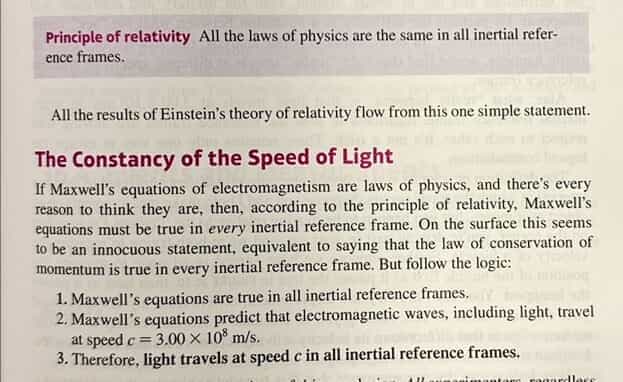
So, SR is a “principle theory” (Einstein’s terminology [2]) because its kinematics (Lorentz transformations) follows from an empirically discovered fact (the light postulate). And, importantly, the light postulate is justified by the relativity principle.
Given this “historical precedent” Rovelli suggested using principles of information theory to render QM a principle theory and in 2001, Lucien Hardy produced the first so-called axiomatic reconstruction of QM via information-theoretic principles. The empirically discovered fact that gives us the finite-dimensional Hilbert space formalism of QM is Information Invariance & Continuity (wording from 2009 by Caslav Brukner and Anton Zeilinger). If you couch that physically, it means everyone measures the same value for Planck’s constant h, regardless of their relative spatial orientations or locations. Let me call that the “Planck postulate” in analogy with the light postulate. Since h is a constant of Nature per Planck’s radiation law (as Olivia explained in the lecture), just like c is a constant of Nature per Maxwell’s equations, and since inertial reference frames are related by spatial rotations and translations as well as boosts, the relativity principle says the Planck postulate must be true just like it says the light postulate must be true.
This means quantum information theorists have rendered QM a principle theory, just like SR, exactly per Rovelli’s 1996 challenge. As a result, quantum superposition and entanglement are not dynamical effects due to some nonlocal or superdeterministic or retro causal mechanism. They are kinematic facts that follow necessarily from the observer-independence of h as required by the relativity principle and Planck’s radiation law. This is totally analogous to the fact that length contraction and time dilation are not dynamical effects due to some causal mechanism like the luminiferous aether. They are kinematic facts that follow necessarily from the observer-independence of c as required by the relativity principle and Maxwell’s equations. Pedagogically, Knight’s introduction to SR could be mirrored for QM:
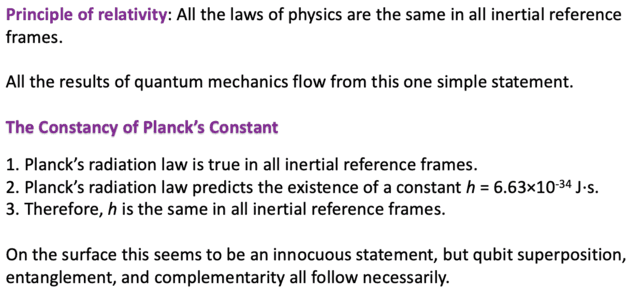
Therefore, far from being disinterested in why QM is weird, it is quantum information theorists who finally answered that very question.
- A. Einstein, “Autobiographical notes” in Albert Einstein: Philosopher-Scientist, P.A. Schilpp, editor, pp 3-94 (Open Court, La Salle, IL, USA, 1949).
- A. Einstein, “What is the Theory of Relativity?” London Times, pp 53-54 (1919).

PhD in general relativity (1987), researching foundations of physics since 1994. Coauthor of “Beyond the Dynamical Universe” (Oxford UP, 2018) and “Einstein’s Entanglement” (Oxford UP, 2024).







Leave a Reply
Want to join the discussion?Feel free to contribute!