
Quantum Mechanics and the Famous Double-slit Experiment
Table of Contents
What Does the Double-Slit Experiment Prove About Quantum Reality?
The double-slit experiment demonstrates that light and matter exhibit both wave and particle behavior depending on what is measured. When no measurement of “which slit” is made, particles produce an interference pattern typical of waves. When that measurement is made, the pattern disappears and particles behave as discrete objects. This wave-particle duality is tied directly to Heisenberg’s uncertainty principle, and Wheeler’s delayed-choice experiment shows the measurement choice can be made after a photon has already passed through the slits.
Key Takeaways
- Thomas Young first described the two-slit apparatus in 1802, using two vertical slits and a viewing screen.
- Physicist Richard Feynman stated in 1966 that the double-slit experiment “contains the only mystery” of quantum mechanics.
- Louis de Broglie proposed in 1923 that all matter, not just light, carries wave-like properties, a concept now called matter waves.
- Double-slit interference has been demonstrated experimentally with buckminsterfullerene (C60) molecules, not just photons or electrons.
- Vincent Jacques and colleagues published an experimental realization of Wheeler’s delayed-choice experiment in Science in 2007 (volume 315, issue 5814, pages 966–968).
- James V. Stone is an Honorary Associate Professor at the University of Sheffield in the United Kingdom.
How Does the Double-Slit Experiment Work?
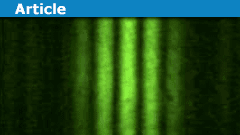
The double-slit apparatus, first described by Thomas Young in 1802, consists of two vertical slits and a viewing screen. Light passing through each slit interferes with light from the other slit, producing an interference pattern of bright and dark bands on the screen. Bright regions correspond to areas where photons — individual particles of light — land with high probability; dark regions correspond to low-probability areas.
Physicist Richard Feynman said in 1966 that the double-slit experiment “contains the only mystery” in quantum mechanics, adding that explaining it requires covering “the basic peculiarities of all quantum mechanics.”
Remarkably, the same interference pattern appears even when light is dimmed so that only one photon at a time reaches the screen. At such low photon rates, the pattern can take weeks to emerge fully, dot by dot. That a wave-like pattern still forms suggests a single photon behaves like a wave passing through both slits at once, even though each photon is detected as a single point on the screen. Only a wave can pass through both slits simultaneously, yet only a particle can register at one point, and this apparent contradiction sits at the center of the puzzle.
What Happens When You Measure Which Slit a Photon Passes Through?
If a detector measures which slit each photon passes through, the interference pattern disappears and is replaced by a broad diffraction envelope, the simple sum of two single-slit patterns. This can be confirmed by recording photons from each slit separately, such as by opening one slit at a time and capturing the result on a photographic plate: the combined image matches the diffraction envelope exactly.
Any experiment that determines which slit a photon passed through forces the light to behave like a stream of particles instead of a wave. This shift from wave-like to particle-like behavior is directly explained by Heisenberg’s uncertainty principle.
What Are Matter Waves?
Before 1927, electrons were assumed to behave like tiny billiard balls. Louis de Broglie proposed in 1923 that electrons, and more broadly all matter, could exhibit wave-like properties, a concept now known as matter waves. When a beam of electrons replaces the light source in a double-slit setup, an interference pattern appears again, just as it does with photons.
Double-slit experiments have since demonstrated matter-wave interference using whole atoms and even large molecules such as buckminsterfullerene (C60), extending the phenomenon well beyond electrons and photons.
Did the Photon Go Through One Slit or Both?
Imagine replacing the screen with an array of tubes, each aimed at a single slit and ending in a photodetector, with a pair of detectors at each screen position aimed at different slits. Any detection at a tube points back to exactly one slit. Using this setup, the resulting distribution of detected photons would form a diffraction envelope, matching the pattern obtained when slits are opened one at a time.
This confirms that detectors measuring slit identity force particle-like behavior, while leaving both slits open without such detectors restores the interference pattern. This trade-off is the essence of wave-particle duality.
How Does Heisenberg’s Uncertainty Principle Explain These Results?
Heisenberg’s uncertainty principle links the precision of a position measurement to the resulting uncertainty in momentum, and this trade-off governs double-slit outcomes. When slit identity is not measured, the uncertainty in a particle’s screen position is roughly equal to the fringe spacing seen in the interference pattern.
Any reduction in uncertainty about slit identity, meaning position at the barrier, increases uncertainty in the momentum of photons as they exit the slits. Because momentum includes direction, greater momentum uncertainty blurs where photons land on the screen. Position identifies which slit a photon used, while momentum, or direction, determines where it lands on the screen.
In practice, varying detector accuracy changes how much slit-identity information is gained. As more position information is obtained, interference fringes wash out gradually and the pattern becomes a broad diffraction envelope. Heisenberg originally explained this by noting that observing an electron with light perturbs it. A more fundamental explanation treats position and momentum as waves subject to Fourier analysis, producing an inequality that makes the trade-off precise: reducing position uncertainty increases momentum uncertainty, and neither can be known exactly at the same time.
What Is Wheeler’s Delayed-Choice Experiment?
Wheeler’s delayed-choice experiment asks what happens if the experimental setup changes while a photon is still in transit between the slits and the screen, after it has already passed through the slit or slits but before it reaches the screen or tube detectors.
Vincent Jacques and colleagues performed an experiment along these lines using interferometers, publishing their results in Science in 2007 (volume 315, issue 5814, pages 966–968). When the screen was left in place, an interference pattern was observed. When the screen was removed to reveal detectors instead, a diffraction-like distribution appeared. The choice of which measurement to perform was made at random after the photon had already passed the slit or slits.
If the distance between the slits and the screen is S, the photon transit time is T = S / c seconds, where c is the speed of light. If a measurement decision is made at time t and the photon arrives a short time dt later, selecting only photons where dt is less than T ensures the choice was made while the photon was still between the slit and the screen.
In principle, the slit-to-screen distance could be made extremely large, so that photons take billions of years to arrive, meaning a decision made today about which measurement to perform would appear to affect how those photons behaved billions of years ago. These results remain consistent with Heisenberg’s principle regardless of when the measurement choice is made, since measuring slit identity always increases momentum uncertainty and destroys interference.
Can Quantum Mechanics Really Rewrite the Past?
A decision made now about whether to leave the screen in place effectively determines how photons are recorded as having behaved in the past. Removing the screen to reveal detectors ensures photons are recorded as having exited a single slit. Leaving the screen in place produces an interference pattern, consistent with the photon having sampled both slits. Either decision can be made after the photons have already passed through the slit or slits.
The temporal reach of this effect depends on the photons’ transit time. Natural phenomena such as gravitational lensing can mimic distant “slits,” making it possible in principle for this kind of temporal effect to reach back extremely far, potentially as far as the age of the universe in extreme scenarios.
Not everyone agrees that Wheeler’s delayed-choice experiment literally edits the past. Like most quantum-mechanical formalism, the equations admit multiple physical interpretations, and physicists differ on the philosophical implications of these results.
Frequently Asked Questions
What is wave-particle duality?
Wave-particle duality is the principle that quantum entities such as photons and electrons can exhibit either wave-like behavior, such as interference, or particle-like behavior, such as landing at a single point, depending on how they are measured. The double-slit experiment is the classic demonstration of this duality.
Why does measuring which slit a photon passes through destroy the interference pattern?
Measuring slit identity requires gaining position information about the photon at the barrier. Heisenberg’s uncertainty principle dictates that this reduction in position uncertainty increases uncertainty in the photon’s momentum, which blurs its landing position on the screen enough to wash out the interference fringes, leaving a diffraction envelope instead.
Who first proposed that matter has wave-like properties?
Louis de Broglie proposed in 1923 that electrons, and more broadly all matter, could exhibit wave-like properties, now called matter waves. This was confirmed experimentally when electron beams produced interference patterns similar to those seen with light.
What is Wheeler’s delayed-choice experiment?
Wheeler’s delayed-choice experiment tests what happens when the choice of measurement, whether to detect slit identity or screen position, is made after a photon has already passed through the slit or slits. Vincent Jacques and colleagues realized this experiment using interferometers, publishing results in Science in 2007.
Does quantum mechanics actually rewrite the past?
Physicists disagree on whether Wheeler’s delayed-choice results literally mean the past is being rewritten. The mathematical formalism of quantum mechanics admits multiple interpretations, and this remains a matter of ongoing philosophical debate rather than settled consensus.
What is the source of this article’s material?
This content is an edited extract from The Quantum Menagerie by James V. Stone, published in December 2020. Stone is an Honorary Associate Professor at the University of Sheffield in the United Kingdom.
Reference
V. Jacques, et al. “Experimental realization of Wheeler’s delayed-choice gedanken experiment.” Science, 315(5814):966–968, 2007.









Leave a Reply
Want to join the discussion?Feel free to contribute!