
Infinity in Mathematics: Limits and Cardinality FAQ
Table of Contents
Introduction
Understanding the behavior of infinity is one of the major accomplishments of mathematics. However, the infinite is often misunderstood and can lead to apparent paradoxes when misused or misinterpreted.
This FAQ explains the role of infinity in mathematics and attempts to resolve several apparent paradoxes.
1. Infinity is not a real number!
Very often, people try to work with infinity as they work with ordinary real numbers. They soon end up with paradoxical situations, like
It’s certainly true that [itex]2\infty=\infty[/itex]. Divide both sides by infinity and we get that 2=1.
This is an absurd result. The resolution to this apparent paradox is simply that infinity is not a member of the set of real numbers. We can often adjoin infinite quantities to [itex]\mathbb{R}[/itex], but these infinite things do not behave like ordinary real numbers and not every calculation with infinite things is allowed. For example [itex]\frac{\infty}{\infty}[/itex] will often not be allowed.
When asked to solve a problem in the set of real numbers, working with infinity is usually not allowed (because, again, infinity is not a real number). If you do want to work with it, you need to state that explicitly and be careful about the rules you use.
2. Why bother with infinity if infinity doesn’t exist in reality?
We do not know whether actual physical infinity exists. In any case, it is irrelevant to mathematics: mathematicians work with infinity because it is often more convenient than not working with it.
For example, suppose you measure the heights of a group of people and obtain values such as 1.70 m, 1.76 m, 1.84 m, and so on. To model the experiment it is convenient to regard the space of possible lengths as [itex]\mathbb{R}[/itex]. You will never encounter a length exactly equal to [itex]\sqrt{\pi}[/itex] metres in practice, but choosing [itex]\mathbb{R}[/itex] makes the mathematics simpler and more powerful.
With [itex]\mathbb{R}[/itex] available, we can apply the methods of calculus: fit curves to data, compute slopes and areas, and so on. Without an infinite model these tools are either impossible or much harder to use.
3. So, what is infinity?
There is no single definition of “infinity” in mathematics. There are several different notions and each serves a particular purpose.
Sometimes infinity is just a symbol. For example:
- In limits: notations such as [itex]\lim_{x\rightarrow +\infty}{f(x)}[/itex] or [itex]\lim_{x\rightarrow a}{f(x)}=+\infty[/itex].
- The order of an element in a group (sometimes written as “infinite”).
Although the examples above are often symbolic, it is useful in many contexts to give these symbols a precise meaning by adjoining infinite quantities to the original set. In that way the [itex]\infty[/itex>-notation in limits becomes an actual limit and we can sometimes perform arithmetic with infinite quantities within a chosen framework.
- The extended real line is [itex]\mathbb{R}\cup \{+\infty,-\infty\}[/itex].
- The projective real line is [itex]\mathbb{R}\cup \{\infty\}[/itex].
- The Riemann sphere is [itex]\mathbb{C}\cup \{\infty\}[/itex].
- In nonstandard analysis, there are infinite numbers and infinitesimal numbers.
Finally, “infinite” can serve both roles: it can denote a notion of being arbitrarily large and, in appropriate frameworks, it can denote objects that can be manipulated.
The cardinal numbers measure the size of infinite sets.
Below we pick a few of these notions and explain them further.
4. How is infinity used in limits?
In limits, infinity is often just a shorthand. For example, the notation [itex]\lim_{x\rightarrow +\infty}{f(x)}=a[/itex] means “if we take x sufficiently large, then f(x) will be arbitrarily close to a; taking x larger still makes f(x) closer to a.” For instance, with [itex]f(x)=\frac{1}{x}[/itex], choosing x = 1000 gives f(x) = 0.001 (close to 0); choosing x = 100000 gives f(x) = 0.00001 (even closer). We say that f(x) converges to 0.
This notion can be formalized: we say [itex]\lim_{x\rightarrow +\infty}{f(x)}=a[/itex] if, by taking x sufficiently large, we can make the distance between f(x) and a as small as desired.
As you can see, the symbol [itex]\infty[/itex] here indicates that values can be arbitrarily large but still finite.
What is the extended real line?
The extended real line was introduced to make certain limit statements more convenient. In the real numbers the expression “x = +\infty” does not make sense because infinity is not a real number. By adjoining two new points, [itex]+\infty[/itex] and [itex]-\infty[/itex], to [itex]\mathbb{R}[/itex] we obtain the extended real line, and expressions such as [itex]f(x)=+\infty[/itex] become meaningful in that enlarged set.
Within the extended real line some arithmetic expressions are defined, for example:
[itex]+\infty+\infty=+\infty,\quad \frac{1}{+\infty}=0,\quad 2<+\infty[/itex]
However, not all expressions are defined there: for instance [itex]+\infty-\infty[/itex] is undefined. See Wikipedia: Extended real number line for more details.
The projective line uses a different idea: it adjoins a single element [itex]\infty[/itex] to [itex]\mathbb{R}[/itex] that represents both directions at once, so the real line becomes topologically a circle. In that model one may write
[tex]\frac{1}{0}=\infty[/tex]
but [itex]\infty-\infty[/itex] remains undefined, and one cannot in general compare ordinary real numbers with the projective [itex]\infty[/itex] (so statements such as [itex]2<\infty[/itex] do not make sense there). See Wikipedia: Real projective line for more information.
5. What are cardinal numbers?
Cardinal numbers distinguish different sizes of infinity: some infinite sets are, in a precise sense, larger than others.
To see the idea, first consider finite collections. Suppose a toddler named Greg is given two sets of marbles and asked whether the sets contain an equal number of marbles. If Greg cannot count, he can still pair marbles one-to-one: pick one marble from the first set and one from the second set and match them until no more pairings are possible. If one set has unpaired marbles remaining, that set is larger.
The same notion extends to arbitrary sets. We say that sets A and B have the same cardinality if there exists a one-to-one correspondence between A and B.
There is a counterintuitive consequence for infinite sets. Consider
[tex]A=\{0,1,2,3,4,5,…\}\quad\text{and}\quad B=\{0,2,4,6,…\}[/tex]
Although B is a subset of A, A and B have the same cardinality via the bijection
[tex]A\rightarrow B: n\mapsto 2n[/tex]
Every element of A is paired with a unique element of B, and conversely, so A and B are the same size. This is a standard phenomenon in infinite sets.
Using similar reasoning one shows that the set of natural numbers, the set of integers and the set of rational numbers are countably infinite and therefore have the same cardinality. By contrast, the set of real numbers is uncountable and strictly larger. Cantor was the first to demonstrate these differences.
Contributors to this FAQ:
- bcrowell
- DaveC426913
- Hurkyl
- micromass
- PAllen
- Redbelly98
Advanced education and experience with mathematics





infinity is 0
You can experience infinity in real life. Try to imagine NOT existing at all. The closer you get to an authentic visualization, the farther you get also. Try it. Another example is counting. They say "Count as high as you can and then I'll just add one." and "If you find the edge of the universe and then stand on it and shoot an arrow…" The most famous argument against infinity is actually the most sound proof that infinity does exist in the real world. Infinity is an Anti-number of sorts. The fact that you can "add one" or "shoot another arrow" means that there is actually and anti-force which accommodates possibility. And you want infinitesimal? Add a drop of water to a swimming pool at rest. Does it rise?
Even elementary introductory physics requires at least simple calculus which necessarily involves the concept of infinity.
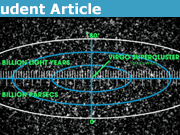
The observable universe is a sphere, centered on us, where the radius is the horizon distance, which is the distance light could have traveled since the Big Bang. The observable universe is finite, but is only a subset of the entire universe. Is the entire universe finite or infinite? If the universe has positive curvature, like a sphere, it could be finite. If it has zero curvature, like a plane, or negative curvature, like a hyperboloid, it is infinite. According to all our measurements, the universe is flat, and thus infinite. There is still the possibility that the universe could have positive curvature, and be finite, but where the radius of curvature is so large, that the deviation of flatness, from our point of view, that it would appear flat to us.It used to be thought that the universe might have enough mass to recollapse into a Big Crunch. This has been disproven. In fact, the expansion of the universe is accelerating. That means, we know that it will exist for an infinite length of time in the future.The Big Bang has been confirmed by the CMB, so we think of the Big Bang theory as having won the Big Bang versus Steady State debate. However, we still don't know whether the Big Bang was the fundamental beginning of time, which is the traditional view, was instead only a local Big Bang, which created this specific part of the universe, which we think of as the universe. According to chaotic inflation, at any time, a given patch of space might suddenly undergo inflation. According to this view, time would extend infinitely backwards.So does infinity exist in the real universe? According to our recent theories, the universe is very probably infinite in space, definitely infinite in future time, and possibly infinite in past time. There are other occurrences of infinity in physics, such as having to sum over an infinite number of Feynman diagrams.Someone here acted like if you can't count to infinity, then infinity doesn't exist. That is a misunderstanding of infinity. When you ask, "Can you count to such and such number?", what you are asking is, does number X appear in the set of integers, Z = 1, 2, 3, …? Well, the number 1/2 also does not appear in the set of integers. Does that mean 1/2 does not exist? Why single out the integers as your set of comparison? Why not choose some other set, such as the prime numbers? Why not say the number 9 does not exist because it does not appear among the prime numbers? You can't count to infinity. You also can't count all the numbers that appear between 0 and 1. Does that imply that these numbers don't exist? You can't write down all of the digits of pi. Does that imply pi doesn't exist?
Mathematics is not physics so whether or not something in mathematics is "in our universe" is irrelevant to its existence and importance in mathematic. There are methods of making "infinity" as well as "infinitesmals" rigorous. One of them is in what is called "non-standard analysis":
http://mathworld.wolfram.com/NonstandardAnalysis.html
I get frustrated when anyone talks about infinity as if it is something that actually exists rather than something that a variable tends towards. Same with the infinitesimal. Indeed when most mathematicians write the symbol for infinity into an equation they are using it to describe the different rates at which a variable tends towards infinity/-infinity. In the real world nothing will ever reach infinity. You could argue with me that "Hey! I'll just start counting," (maybe you'll even start from a really large number), "I'll surely get to it one day," you say. Then I say to whatever number you have arrived at "Okay, now add 1 to that number." Well wait a minute. "If I counted forever, though?" you suggest. Then I say, "how do you intend to do that? Will you just go on living forever?" Then, you say: "Well I'll build a computer that is tough enough to process this problem forever, and continues to create its own storage space to allow the counting." Then I will just say: "Well if we assume there is enough matter in the universe to store all that information, then my only concerns are this: What does the computer do when it has lived until the end of this universe? How will it process if this universe has reached its natural end?" Then you suggest: "Maybe the universe goes on forever!". I will smile and just say: "Okay, tell me what it's age in seconds is when this universe reaches "forever", and I will ask you to add 1 second to that number. Then, come back to me in a second and tell me if the previous forever was truly "forever".OK, this thought experiment might show that there is no infinity in our universe (at least, we won't be able to count it). But why does that mean that infinity cannot be a useful model and approximation for reality?
The following also gives a good discussion about infinity.http://www.quora.com/What-is-the-difference-between-2-infty-and-infty-2
I get frustrated when anyone talks about infinity as if it is something that actually exists rather than something that a variable tends towards.I think you are voicing the opinion found in [https://en.wikipedia.org/wiki/Where_Mathematics_Comes_From]. Many of us echo your sentiments about the importance of understanding how the theory of computation relates to the mathematical concept of infinity, and your frustration, as best as I can tell, comes with those who advocate the Platonic philosophy of mathematics (which misses the big picture pretending that mathematical ideas (like numbers and algorithms) are floating around outside of information systems like mathematical angels and demons in the ether). Most of the responders are right about infinity being understood quite rigorously within mathematics, and I think the problem is not so much the concept of infinity, but the poor way in which those who practice elementary and undergraduate mathematics are taught it. It's easy to see when the symbol is treated both as a quantity and not a quantity in notation. Normally, we use the lemniscate just as we would a real number notationally (e.g., ## -∞ < r < ∞ : r in ℝ ## , and looking at it, you can see why someone would get the impression it is a "number". That's exactly the point of why we extend the reals. (See [https://en.wikipedia.org/wiki/Extended_real_number_line].) What I think you're frustrated with is mathematicians who don't understand the nature of computation in working with infinity, and those same people usually treat irrational numbers the same way. "All" numbers come from computation, because all numbers are data in an information system made of physical media.
But because this is all true doesn't make infinity and the infinitesimal any less important or valid. In fact, it's well understood both in the philosophies of mathematics and logic AND the theory of computation.
You said, "I would suggest this is true in any reality, no matter how finely a variable is allowed to be describes, it has to stop somewhere." In practice, yes, but besides having a computational value, it also has a conceptual value. It is the symbolic notation for the concept of infinite regress which is EXTREMELY important when considering models of computation. If we say ## f(x) := g(x) + 1 ## and ## g(x) := f(x) + 1 ##, then for any ## x in ℝ ## computing either ## g(x) ## or ## f(x) ## will result in ## ∞ ## as an answer, and the importance of this is not whether we can continue calculating forever (the science seems stacked against that as you point out), but AVOIDING creating mathematical systems that create the situation to begin with! (Anyone who has written an infinte loop or a recursive computer function with no base case can attest to the dangers of that.) In fact, Zen philosophy which has amused mathematicians and computer hackers alike, is a worldview that intentionally likes to point the importance of understanding the importance of the infinite not just within mathematics, but personal ontologies! (See [https://en.wikipedia.org/wiki/Infinite_regress].)
In the real world nothing will ever reach infinity.Nothing has to 'reach' infinity for infinity to be a logical and rigorous concept. If I divide space into infinitely small or infinitely many sections, I am taking no physical action. I'm not taking a space-time knife and slicing it into small slices. I'm merely performing a very useful, and very well supported mathematical process.
So, despite my rude way of arguing my point, you can see why I don't want mathematicians to waste their time with logically inconsistent concepts such as the infinite or infinitesimal.No, I can't. Calculus is built on those concepts and is itself a fundamental mathematical subject that has countless applications. If there was something wrong with infinities or infinitesimals then calculus wouldn't work and wouldn't be used.
I get frustrated when anyone talks about infinity as if it is something that actually exists rather than something that a variable tends towards.What do you think actually exists?
So, despite my rude way of arguing my point, you can see why I don't want mathematicians to waste their time with logically inconsistent concepts such as the infinite or infinitesimal.The ideas of the infinite are rigorous.
Another argument against the infinite (or in this case infinitesimal) is a slight variation on Zeno's paradox. "If a person walks from one side of a room to another, they must first move halfway there, and then they must move halfway between that point and the other side of the room. They must keep making this division in space and if they do (if they could) they would never reach the wall on the other side of the room.Why can't Achilles traverse infinitely many intervals and overtake the tortoise?
This suggests, that whether it is a result of space being discrete at some level, or a result of the motion of the object and how its kinetic energy is defined being discrete, that at some point our reality gives up on the infinite, and just allows the object to move to the next position. I would suggest this is true in any reality, no matter how finely a variable is allowed to be describes, it has to stop somewhere.Current physical theory demands the idea of the infinite. E.G. the Shroedinger equation for a free particle assumes an infinite domain and the size of that infinity is way beyond any idea of a limit of a counting process. General relativity assumes a continuous space/time so that is also an uncountable infinite domain, Electricity and Magnetism is modeled on a trivial U(1) bundle, again uncountable. String theory – which models everything – takes place on a manifold – uncountably infinite again.
– The theory of the infinite is profound, stunning, important, and beautiful. Instead of disparaging it as "inconsistent" why not learn something about it?
I get frustrated when anyone talks about infinity as if it is something that actually exists rather than something that a variable tends towards. Same with the infinitesimal. Indeed when most mathematicians write the symbol for infinity into an equation they are using it to describe the different rates at which a variable tends towards infinity/-infinity. In the real world nothing will ever reach infinity. You could argue with me that "Hey! I'll just start counting," (maybe you'll even start from a really large number), "I'll surely get to it one day," you say. Then I say to whatever number you have arrived at "Okay, now add 1 to that number." Well wait a minute. "If I counted forever, though?" you suggest. Then I say, "how do you intend to do that? Will you just go on living forever?" Then, you say: "Well I'll build a computer that is tough enough to process this problem forever, and continues to create its own storage space to allow the counting." Then I will just say: "Well if we assume there is enough matter in the universe to store all that information, then my only concerns are this: What does the computer do when it has lived until the end of this universe? How will it process if this universe has reached its natural end?" Then you suggest: "Maybe the universe goes on forever!". I will smile and just say: "Okay, tell me what it's age in seconds is when this universe reaches "forever", and I will ask you to add 1 second to that number. Then, come back to me in a second and tell me if the previous forever was truly "forever".
So, despite my rude way of arguing my point, you can see why I don't want mathematicians to waste their time with logically inconsistent concepts such as the infinite or infinitesimal. In 3D gaming engines they often have Euclidian coordinate systems using floating point numbers that have corrections for the cases where a repeating decimal is the true answer to where an object should be moved (if moving at a certain velocity as defined by their spatial coordinate system and the computer clock) and techniques for making sure these corrections don't cause additive errors. I would suggest this to be akin to our universes quantum mechanical effects.
Another argument against the infinite (or in this case infinitesimal) is a slight variation on Zeno's paradox. "If a person walks from one side of a room to another, they must first move halfway there, and then they must move halfway between that point and the other side of the room. They must keep making this division in space and if they do (if they could) they would never reach the wall on the other side of the room. This suggests, that whether it is a result of space being discrete at some level, or a result of the motion of the object and how its kinetic energy is defined being discrete, that at some point our reality gives up on the infinite, and just allows the object to move to the next position. I would suggest this is true in any reality, no matter how finely a variable is allowed to be describes, it has to stop somewhere.
(Y) Wonderful !! I have a question if infinity doesn't fall in the set of real number than ever do it stand ?? Umm complex no?No. It's not a number at all, either real or complex. Infinity is more of a concept than a number.
Semi-relevant and interesting problem I stumbled across the other day: If you have an infinite number of infinitely small objects, would it take up near-zero volume or infinite volume? You will have to define "infinitely small" objects. I suspect you mean "infinitesimal" but the answer can be either of those (or a non-zero finite number) depending on exactly how those infinitesimal objects are defined.
Semi-relevant and interesting problem I stumbled across the other day: If you have an infinite number of infinitely small objects, would it take up near-zero volume or infinite volume?It depends. It could be anything in between, depending on the situation.
Simple examples:
All real numbers between 0 and 1 – length (measure) =1
All rational numbers – length (measure) = 0
All real numbers – length (measure) is infinite
(Y) Wonderful !! I have a question if infinity doesn't fall in the set of real number than ever do it stand ?? Umm complex no?
Semi-relevant and interesting problem I stumbled across the other day: If you have an infinite number of infinitely small objects, would it take up near-zero volume or infinite volume?
Nice work guys!