

The Concept of Zero: History, Rules, and Why 0/0 Fails
Zero is neither positive nor negative, is defined as the additive identity so that x + 0 = x for every number x, and produces 0 when multiplied by any number. Division by zero is left undefined because no unique quotient exists, factorials fix 0! = 1 by both algebraic and combinatorial reasoning, and 0^0 is inconsistently defined depending on context.
Table of Contents
Key Takeaways
- Zero began as a placeholder digit distinguishing numbers like 11 from 1010, and only later became accepted as a number in its own right.
- The combined concept of zero as placeholder and number originated in India in the 9th century, then spread to Europe through al-Khwarizmi and Fibonacci.
- By the 16th century, Hindu numerals including zero were in standard use across Europe.
- 0! equals 1, confirmed both by the recursive factorial definition and by the Gamma function identity Γ(1) = 1.
- 0^0 has no universally agreed value: setting it to 1 keeps the binomial theorem consistent, but the two-variable function x^y has an essential singularity at (0,0).
A Short History of Zero
Historically, zero served two distinct roles: a placeholder and a number in its own right. As a placeholder, zero simply marks position, as in the number 1010, where it shows that the first 1 represents a thousand and the second 1 represents ten. Without a placeholder zero, there would be no way to distinguish 11 from 1010.
Zero as a number, meaning it carries the same mathematical standing as 1, 2, 3, and so on, is a more controversial historical development. The Babylonians could not reliably distinguish numbers such as 8 and 80, since they lacked a placeholder. Placeholder zero and zero as a number were combined into the concept used today in India during the 9th century, though early mathematicians remained uncertain how to handle it in calculations.
Some early rules for zero included treating a number divided by 0 as a fraction with 0 in the denominator, and treating zero divided by zero as equal to zero. Neither rule is used in mathematics today.
Indian mathematical knowledge of zero passed to the Arab world, where al-Khwarizmi popularized the Hindu numeral system. Fibonacci later carried this knowledge into Europe. By the 16th century, Hindu numerals, including zero, were in standard use throughout Europe.
Is Zero Positive or Negative?
By definition, zero is neither positive nor negative. Positive numbers are defined as numbers x such that x > 0, and negative numbers are defined as numbers x such that x < 0. Since 0 is not greater than or less than itself, it falls into neither category and is said to have no sign. Zero is, however, both nonnegative and nonpositive.
How Do Basic Operations Work With Zero?
Zero is known as the additive identity, meaning that for every number x (natural, real, complex, or otherwise), x + 0 = x = 0 + x.
[tex]0x=(0+0)x=0x+0x~\Rightarrow~0x=0[/tex]
From the additive identity property and the distributive law, it follows that 0 multiplied by anything equals 0, a result that holds in every ring.
Division is defined so that a/b = c only if c is the unique number satisfying a = bc. From this definition, 0/x = 0 for every nonzero x, since 0x = 0 and no other number c satisfies cx = 0 when x is nonzero. Proving that uniqueness formally requires the Peano axioms and a precise definition of multiplication, which falls outside the scope of this discussion.
Why Is Division by Zero Undefined?
Division by zero is undefined because no number can satisfy the required equation in a consistent way. If x is nonzero, there is no number c such that 0c = x, because 0 multiplied by any number is always 0, never a nonzero value.
The case of 0/0 fails for a different reason: every number c satisfies 0c = 0, so 0/0 would have to equal every number simultaneously. Because a quotient must be unique, mathematicians leave 0/0 undefined rather than assign it multiple conflicting values.
Some claim that x/0 equals infinity, but infinity is not a number in the standard real number system, so this statement only makes sense within an extended number system. The extended real numbers add positive and negative infinity as formal endpoints, yet even there, division by zero remains undefined.
The graph of the function 1/x illustrates why. As x approaches 0 from the right, 1/x grows toward positive infinity; as x approaches 0 from the left, 1/x grows toward negative infinity. Because these one-sided limits disagree, no single value can be assigned to 1/0 in the extended real numbers.
One exception exists: the projective real line adds a single unsigned point at infinity, allowing x/0 to be defined as that point for nonzero x. Even in this system, 0/0 remains undefined, since no unique value of c satisfies 0c = 0.
What Is Zero Raised to the Zero Power?
For a nonzero natural number n, exponentiation is defined as repeated multiplication, a multiplied by itself n times. Extending this to a^0 requires the exponent law a^(n+m) = a^n · a^m to hold when one exponent is zero, which forces a^0 to act as the multiplicative identity. As a result, a^0 = 1 for any nonzero a.
The expression 0^0 is genuinely problematic. Defining 0^0 = 1 keeps it consistent with the algebraic derivation above, but it also creates a discontinuous function: f(x) = 0^x equals 0 for every x not equal to zero, then jumps to 1 exactly at x = 0. The two-variable function f(x,y) = x^y has an essential singularity at the point (0,0), meaning its value there depends on the direction of approach. For this reason, many sources leave 0^0 undefined altogether.
Despite this ambiguity, many mathematicians adopt the convention 0^0 = 1 because it preserves standard combinatorial formulas. The binomial theorem, (x+y)^n = the sum over k from 0 to n of C(n,k) x^k y^(n-k), holds in full generality only if 0^0 is set equal to 1, since terms involving x = 0 and n = 0 would otherwise be undefined.
Why Does 0! Equal 1?
Factorials behave more consistently than exponents at zero. The recursive definition states that 1! = 1 and (n+1)! = (n+1) · n!. Setting n = 0 in this recursion gives 1! = 1 · 0!, which forces 0! = 1.
Factorials also have a combinatorial meaning: n! counts the number of ways to order n distinct objects. There are 3! = 6 permutations of the set {a,b,c}: (a,b,c), (a,c,b), (b,a,c), (b,c,a), (c,a,b), and (c,b,a). Similarly, there are 2! = 2 permutations of {a,b}, 1! = 1 permutation of {a}, and exactly 0! = 1 way to order the empty set, corresponding to the single empty sequence. Formally, n! also counts the bijections from {1,…,n} to itself, and there is exactly one such bijection for the empty set: the empty function.
Factorials appear in the binomial coefficient formula C(n,k) = n! / (k!(n-k)!), which counts the number of ways to choose k elements from a set of n elements without regard to order. For example, C(4,2) = 6, matching the six distinct 2-element subsets of {a,b,c,d}.
Setting k = n in this formula should give exactly one way to choose all n elements, so C(n,n) = 1. Setting k = 0 should likewise give exactly one way to choose nothing, the empty selection, so C(n,0) = n!/(0! · n!) = 1. Both results only work correctly if 0! is defined as 1, which keeps the binomial theorem and related combinatorial identities consistent.
The Gamma function offers an analytic extension of the factorial to non-integer values, defined as Γ(z) = the integral from 0 to infinity of t^(z-1) e^(-t) dt, satisfying Γ(n) = (n-1)!. Evaluating this at z = 1 gives 0! = Γ(1) = 1, confirming the same result through calculus rather than combinatorics.
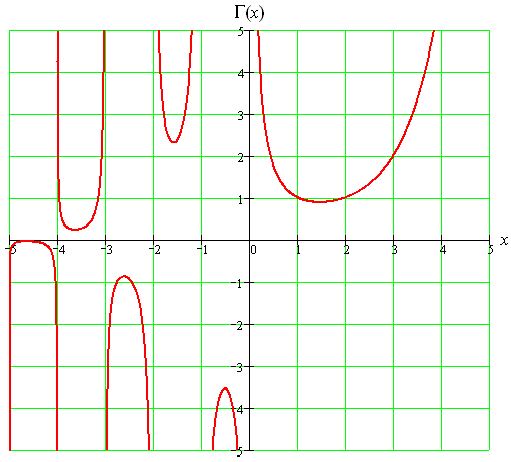
Taken together, the recursive definition, the combinatorial interpretation, and the Gamma function all support the convention 0! = 1. No comparably consistent definition exists for 0^0.
Frequently Asked Questions
Is zero a positive or negative number?
Zero is neither positive nor negative. Positive numbers are defined as those greater than zero, and negative numbers as those less than zero, so zero satisfies neither condition. It is classified as both nonnegative and nonpositive.
Why is dividing by zero undefined?
For a nonzero number x, no value of c can satisfy 0c = x, since 0 times any number is always 0. For 0/0, every number c satisfies 0c = 0, so the quotient would have to equal every number at once, violating the requirement that a quotient be unique.
What does 0! equal, and why?
0! equals 1. This follows from the recursive factorial definition, where 1! = 1 · 0! forces 0! = 1, from the combinatorial fact that there is exactly one way to order an empty set, and from the Gamma function identity Γ(1) = 0! = 1.
What does 0^0 equal?
There is no universally accepted value. Setting 0^0 = 1 keeps algebraic rules and the binomial theorem consistent, but the function x^y has an essential singularity at (0,0), so many sources leave 0^0 undefined rather than commit to a single value.
Where did the modern concept of zero originate?
The combined use of zero as both a placeholder and a number originated in India in the 9th century. It spread to the Arab world through al-Khwarizmi, then into Europe through Fibonacci, becoming standard throughout Europe by the 16th century.
Can zero ever appear in a denominator in an extended number system?
In the projective real line, a single unsigned point at infinity allows x/0 to be defined for nonzero x. However, even in this extended system, 0/0 remains undefined, since no unique number satisfies the required equation.

Advanced education and experience with mathematics







Good article!
“Just a historical correction. Khwarizmi was actually Iranian.”
Actually, micromass never said he was other, and as a Muslim, it would have been through the Arabs and with Arabs that the information came.
Just a historical correction. Khwarizmi was actually Iranian.
Micromass, you omit to mention that the Mayas also created or came up with the number Zero. :D Good analysis.
Nice article !
Thanks, Micromass.
Nice article, Micro! Thanks for sharing!