
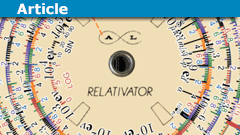
Relativator (Circular Slide-Rule) – Simulated with Desmos
Table of Contents
The Relativator (revisited)
This is an update of my 2006 post (reconstructed in 2014) Relativator: The circular slide-rule for physicists.
This is a circular slide-rule for doing relativistic calculations for elementary particle physics that I learned about from
– an article by Elizabeth Wade ( “Artifact: Relativator”, Symmetry (FNAL/SLAC), 01/01/06,
https://www.symmetrymagazine.org/article/december-2005january-2006/artifact-relativator https://www.symmetrymagazine.org/sites/default/files/legacy/pdfs/200512/artifact_relativator.pdf ),
which is based on a blog post and photos posted by
– Peter Steinberg
(“The Relativator”, Quantum Diaries, March 12, 2005, https://qd.typepad.com/5/2005/03/the_relativator.html )
(“artifact:relativator”, Entropy Bound, Jan. 4, 2006, https://entropybound.blogspot.com/2006/01/artifact-relativator.html )
The Relativator was sold by (as printed) Atomic Laboratories, Inc. 3086 Claremont Ave, Berkeley 5, California , which seems to be a division of Cenco Instruments (Central Scientific Company).

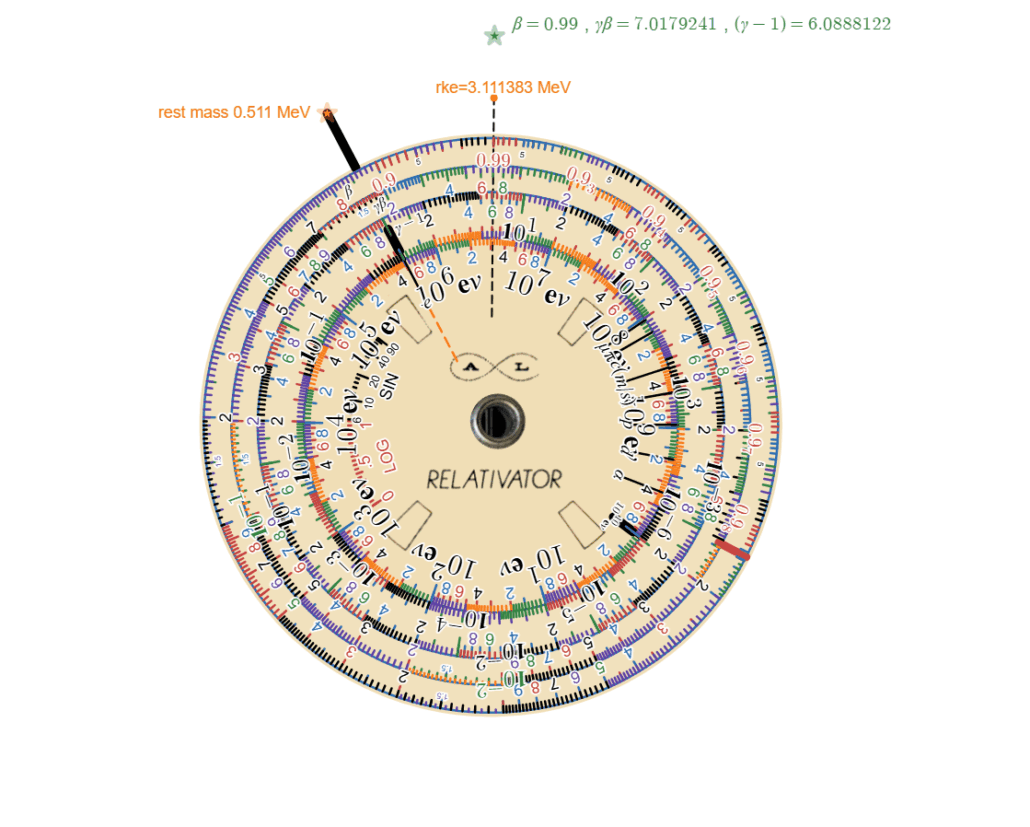
The Relativator in Desmos
So, I present…robphy – relativator virtualized using Desmos 2025
https://www.desmos.com/calculator/lii1mjbpoo
How it was constructed
- Inspired by my GeoGebra simulation of a Vernier Caliper ( https://www.geogebra.org/m/DemUu87n ),
I thought that I could use similar methods to make a simulator for the Relativator. Over the years, I learned how to construct (by calculation) the tick marks on the Relativator,
based on photographs from the article and photos referenced above.
Admittedly, the calculations, the structure, and the color-choices of the Desmos simulation are not optimized.
My primary goal has been functionality, based on the photographs that were made available.
The meaning of the scales
- The three outermost concentric scales are
– [itex]\beta=v/c[/itex], the dimensionless-velocity-fraction (practically [itex]0<\beta<1[/itex]; actually [itex]10^{-6}\leq\beta \leq 0.999999995[/itex])
– [itex]\gamma\beta[/itex] (for relativistic momentum) , where [itex]\gamma=\frac{1}{\sqrt{1-\beta^2}}[/itex] is the time-dilation factor ([itex]10^{-6}\leq\gamma\beta \leq 10^4[/itex])
– [itex](\gamma-1)[/itex] (for relativistic kinetic energy), with range [itex] 10^{-6}\leq (\gamma-1) \leq 10^4 [/itex] and a notch at [itex] (\gamma-1) =10^0=1 [/itex]
These scales are fixed relative to each other.
For example, along radial line through [itex]\beta=0.99[/itex],
you can read-off [itex]\gamma\beta=\frac{\beta}{\sqrt{1-\beta^2}}\approx 7.018[/itex] and [itex](\gamma-1)=\frac{\beta}{\sqrt{1-\beta^2}}-1\approx 6.089[/itex] (as seen above).
In the Desmos simulation, this is the [itex]Z_{tuneTo099}[/itex] preset. - The inner scale (which sits on a concentric disk) are particle rest-masses in electron Volts[itex]/c^2[/itex] , ranging from [itex]1\rm\ eV/c^2[/itex] to [itex]10^{10}\rm\ eV/c^2[/itex].
How I think it works
- We will always keep the inner disk and the mass-scale fixed, and rotate the set of outer scales.
- Given [itex] m=1\rm\ eV/c^2[/itex] , by dragging the orange star, we line up (as shown) the outer black notch on the [itex](\gamma-1)[/itex] scale with [itex] m=1\rm\ eV/c^2=10^{-6}\rm MeV/c^2[/itex], which is at the inner black notch on the mass-scale.

- Then, further given [itex] \beta=0.99 [/itex], drag the green star to move the hairline to [itex] \beta=0.99 [/itex].
Now, you can determine the associated relativistic-kinetic energy as [itex] m (\gamma -1)c^2 \approx 6\rm\ eV \approx 6\times 10^{-6}\rm\ MeV[/itex] by reading the innermost scale. (One could zoom-in to get a better reading. In principle, one could also calculate a refined scale for more accuracy.) - If instead, you were further given [itex] \gamma\beta=7.01 [/itex], you would have moved the hairline to [itex] \gamma\beta=7.01 [/itex] (here, practically the same hairline location), then read off the relativistic kinetic energy.
- If instead, you were further given [itex] \gamma=7.089 [/itex], you would have moved the hairline to [itex] (\gamma-1)=7.089-1=6.089 [/itex] (here, practically the same hairline location), then read off the relativistic kinetic energy.
- If instead, you were further given [itex] K_{rel}=10\rm\ eV[/itex], you would have moved the hairline to line up with innermost scale at [itex] 10\rm\ eV [/itex] , then read off the associated velocity: [itex]\beta \approx 0.995[/itex].

- For an electron, use [itex] m=0.511\rm\ MeV/c^2=0.511\times 10^6\rm\ eV/c^2[/itex], as shown in the first image of the Desmos simulation.
- Now, here’s a puzzle.
Suppose you have a particle with relativistic kinetic energy [itex]10\rm\ MeV[/itex] with velocity [itex] \beta =0.6[/itex].
What is the rest-mass of the particle?
With the green star, tune the hairline to [itex] 10\rm\ MeV [/itex] on the innermost scale.
With the orange star, move the outer-scales until [itex] \beta =0.6[/itex] appears at the hairline.
Note where the outer black notch from the [itex] (\gamma-1)[/itex]-scale points to on the innermost mass-scale. That determines the rest-mass.


Professor of Physics (BS,MS,PhD), Math (BS). Interested in relativity, physics, mathematics, computation, physics pedagogy.




Leave a Reply
Want to join the discussion?Feel free to contribute!