
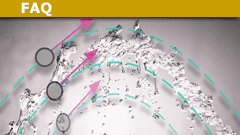
Parabola Explained: Properties, Equations & Practical Uses
Table of Contents
What is a Parabola?
A parabola is a U-shaped curve that appears frequently in mathematics, physics and engineering. It is a conic section defined by a simple geometric property: every point on the curve is equidistant from a fixed point (the focus) and a fixed line (the directrix). Parabolas are symmetric and can be described by algebraic equations.
Key characteristics
- Symmetry: A parabola is symmetric about its axis of symmetry. For a standard vertical parabola this axis is a vertical line through the vertex; the two arms are mirror images.
- Focus and directrix: The focus is a fixed point inside the parabola and the directrix is a fixed line outside it. For any point on the parabola, the distance to the focus equals the distance to the directrix—this is the defining property.
- Standard quadratic form: A vertical parabola is commonly written as
y = ax² + bx + c. The sign ofadetermines whether the parabola opens upward (a > 0) or downward (a < 0). - Vertex: The vertex is the point where the parabola changes direction (the highest or lowest point for vertical parabolas). The tangent at the vertex is parallel to the directrix.
- Focus–vertex–directrix distance: The distance from the vertex to the focus equals the distance from the vertex to the directrix; this distance controls the “width” or focal length of the parabola.
Glossary
Vertex: The point where the axis of symmetry meets the parabola. It is the maximum or minimum point for vertical parabolas, and the tangent at the vertex is parallel to the directrix.
Latus rectum: The chord of the parabola that passes through the focus and is parallel to the directrix. Its length is a measure of the parabola’s focal width.
Axis: The line through the focus and the vertex; it is perpendicular to the directrix and is the axis of reflective symmetry for the parabola.
Standard equations
For a parabola with its vertex at the origin and directrix parallel to the y-axis, a common canonical equation is:
y² = 4ax
For this parabola:
Directrix:x = −aFocus:(a, 0)
Translated to a vertex at (f, g), the equation becomes:
(y − g)² = 4a(x − f)
Parametric form
A point P on the parabola y² = 4ax may be written parametrically as:
P(t) = (a t², 2 a t)
Equivalently, using slope m at the point,
P = (a / m², 2a / m)
where m is the slope of the tangent at that point.
Tangent and normal
For the point (a t², 2 a t) the tangent and normal equations are:
t y = x + a t² (tangent)
y + t x = 2 a t + a t² (normal)
Extended explanation
Additional equivalent definitions:
- A parabola is a conic section with eccentricity
e = 1. - As Wikipedia notes, a parabola is the conic formed when a plane intersects a right circular cone parallel to a generator of the cone.
- A parabola can be viewed as the limiting case of an ellipse with one focus at infinity.
The parabola (pronounced /pəˈræbələ/, from the Greek παραβολή) is a conic section generated by the intersection of a right circular conical surface and a plane parallel to a generating straight line of that surface.
Applications and examples
Parabolas and projectile motion
In a uniform gravitational field (neglecting air resistance) the trajectory of a projectile is a parabola (except for purely vertical motion). For example, a ball thrown at an angle follows a parabolic arc; see this discussion of projectile motion.
Because Earth’s gravity is approximately spherical rather than perfectly uniform, true long-range trajectories are better described by conic sections (ellipses, parabolas, hyperbolas) with respect to the central mass. Over short distances the difference from a parabola is negligible.
A projectile launched exactly at escape velocity in an inverse-square (Newtonian) gravitational field follows a parabolic path. Slower launches give ellipses; faster launches give hyperbolas.
Common misconceptions
The shape of a hanging chain with uniform mass per unit length is not a parabola; it is a catenary. However, the main cables of suspension bridges—when supporting a uniformly distributed horizontal load—trace a parabolic curve.
Paraboloids and common encounters
A paraboloid is the surface generated by rotating a parabola about its axis. Common real-world paraboloid uses include:
- Surfaces of fluids in rotating containers approximate paraboloids.
- Reflecting telescope mirrors and satellite dishes use paraboloid shapes because rays from objects at (effectively) infinite distance focus at a single point—the focus.
Further reading
Related forum threads and discussions:
This article was authored by several Physics Forums members with PhDs in physics or mathematics.



Leave a Reply
Want to join the discussion?Feel free to contribute!